A daily injection that builds new bone
Abaloparatide
A daily self-injection that builds new bone to treat osteoporosis in postmenopausal women at high risk of fractures.
What is Abaloparatide?
Abaloparatide is a specialist medicine used to treat osteoporosis in postmenopausal women at high risk of breaking bones. Like teriparatide, it is a bone-building treatment rather than one that simply slows bone loss, and it works on the same pathway. It is given as a daily injection under the skin with a pen device. It is used for a limited total period (typically up to around 18 months to two years over a lifetime), partly because of a bone-cancer (osteosarcoma) concern seen in animal studies. After the course, another osteoporosis medicine is usually started to keep the benefit.
Education and reference only. This is a plain-language guide to Abaloparatide — it deliberately contains no doses. Doses depend on the person, the brand and the reason for treatment, and belong with your prescriber. Always check the BNF, the product labelling (SmPC) and follow medical advice.
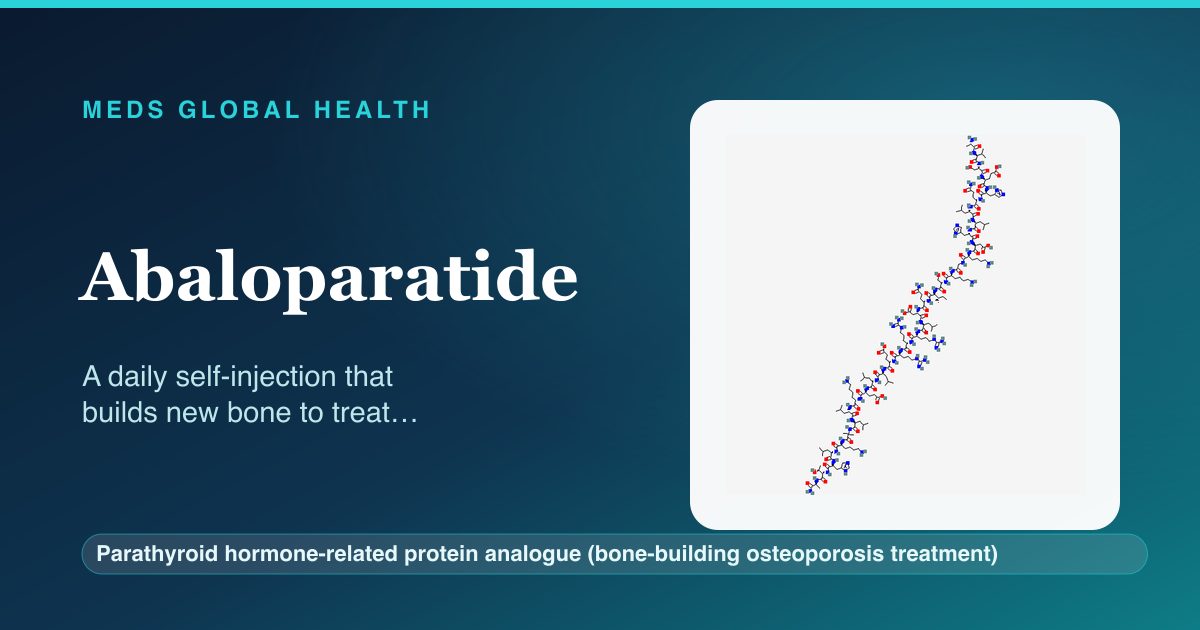
What it is
Abaloparatide is a bone-building medicine used to treat osteoporosis in postmenopausal women who are at high risk of fractures. Osteoporosis makes bones thin and fragile so they break easily. Most osteoporosis treatments slow the breakdown of bone, but abaloparatide, like teriparatide, stimulates the formation of new bone. It is closely related to parathyroid hormone-related protein, a natural signal that affects bone. It is given as a daily injection under the skin using a pen, for a limited period, under specialist supervision.
How it works
Bone is constantly broken down and rebuilt. Abaloparatide acts on the same receptor as parathyroid hormone, and when given as a small daily pulse it tips the balance towards building new bone, raising bone density and strength and lowering the risk of fractures. This bone-building action is why it is reserved for people at high risk and given once daily for a limited time. After the course, the gains are usually preserved by following on with another osteoporosis medicine that protects the new bone.
Company & origin
A specialist injection used in the UK to treat osteoporosis in postmenopausal women at high risk of fractures, by building new bone.
What it treats
Conditions Abaloparatide is used for
Practical use
How to take Abaloparatide
General, dose-free guidance — always follow your prescriber's and the leaflet's specific instructions.
- Give it once a day as an injection under the skin, using the pen device as you have been shown.
- For the first doses, be ready to sit or lie down, as some people feel briefly dizzy or notice a faster heartbeat.
- Keep to the limited course length your specialist sets, as it is not a lifelong treatment.
- Store and handle the pen as instructed, and follow the advice for disposing of needles.
- Expect to start another osteoporosis medicine after the course, to keep the bone you have gained.
Weighing it up
Advantages & disadvantages of Abaloparatide
Advantages
- Actively builds new bone rather than just slowing bone loss.
- Reduces the risk of fractures in postmenopausal women at high risk.
- Offers a bone-building option alongside teriparatide for severe osteoporosis.
Disadvantages
- Given as a daily self-injection rather than a tablet.
- Used only for a limited total time over a lifetime.
- Can cause brief dizziness or a faster heartbeat after a dose, and follow-on treatment is usually needed afterwards.
Practical use
Good to know
Abaloparatide is used for a limited total time over a lifetime, not indefinitely, similar to teriparatide. The duration limit reflects a concern about a rare bone cancer called osteosarcoma raised in animal studies; this has not been shown to be a problem in people at the doses used, but the limit and certain cautions remain as a precaution. It is a daily self-injection with a pen, and some people feel briefly dizzy or have a faster heartbeat after a dose, so the first dose is often given where you can sit or lie down. As with teriparatide, another osteoporosis medicine is usually started after the course, because stopping without follow-on treatment lets the newly built bone be lost again.
Who should not take it / use with caution
- People with certain bone conditions, such as Paget's disease, unexplained raised bone blood tests, or previous radiotherapy to the bones, should not use it because of a higher bone-cancer concern.
- People with high blood calcium, certain bone cancers or cancer that has spread to bone should not use it.
- It is not used in pregnancy or breastfeeding, in growing young people, or in severe kidney problems.
Monitoring
- Reviewing the response over the course, often with a bone-density scan.
- Checking blood calcium where needed, especially if symptoms suggest it is raised.
- Planning follow-on osteoporosis treatment as the course comes to an end.
Side effects
- Brief dizziness, light-headedness or a faster heartbeat, especially after early doses.
- Nausea, headache or injection-site reactions.
- A temporary rise in blood calcium, which is usually mild but is checked if needed.
Key interactions
- It can raise blood calcium, so it is used with care alongside digoxin, where calcium changes matter.
- Tell your team about calcium and vitamin D supplements, which are often continued but reviewed.
- Give a full list of your medicines so anything affecting calcium can be considered.
Available as: A solution for injection under the skin, given by a prefilled pen.
Answers
Abaloparatide: frequently asked questions
What is abaloparatide used for?
It is used to treat osteoporosis in postmenopausal women at high risk of fractures, building new bone rather than just slowing bone loss.
How is it different from teriparatide?
Both are bone-building injections working on the same pathway; abaloparatide is closely related to parathyroid hormone-related protein and is licensed for postmenopausal women at high risk.
Why is it used only for a limited time?
It is used for a limited total period over a lifetime, partly because of a bone-cancer concern raised in animal studies, kept as a precaution.
Will I feel dizzy after a dose?
Some people feel briefly dizzy or notice a faster heartbeat after a dose, so it is wise to sit or lie down for the early injections.
What happens after the course?
Another osteoporosis medicine is usually started afterwards, because stopping without follow-on treatment lets the newly built bone be lost again.
Authoritative sources
- BNF
- NICE CKS
Building a medicines information resource?
We create evidence-led, dose-free drug and formulary references for teams.