An oral retinoid for severe psoriasis
Acitretin
An oral vitamin A-based medicine for severe psoriasis, used under specialist supervision with strict pregnancy precautions.
What is Acitretin?
Acitretin is a vitamin A-based tablet (an oral retinoid) used under specialist care for severe psoriasis and some other skin conditions. It is strongly harmful to an unborn baby, so pregnancy must be avoided during treatment and for three years afterwards, and women follow a pregnancy-prevention programme. It commonly causes very dry skin, lips and eyes, and needs blood tests for the liver and blood fats.
Education and reference only. This is a plain-language guide to Acitretin — it deliberately contains no doses. Doses depend on the person, the brand and the reason for treatment, and belong with your prescriber. Always check the BNF, the product labelling (SmPC) and follow medical advice.
What it is
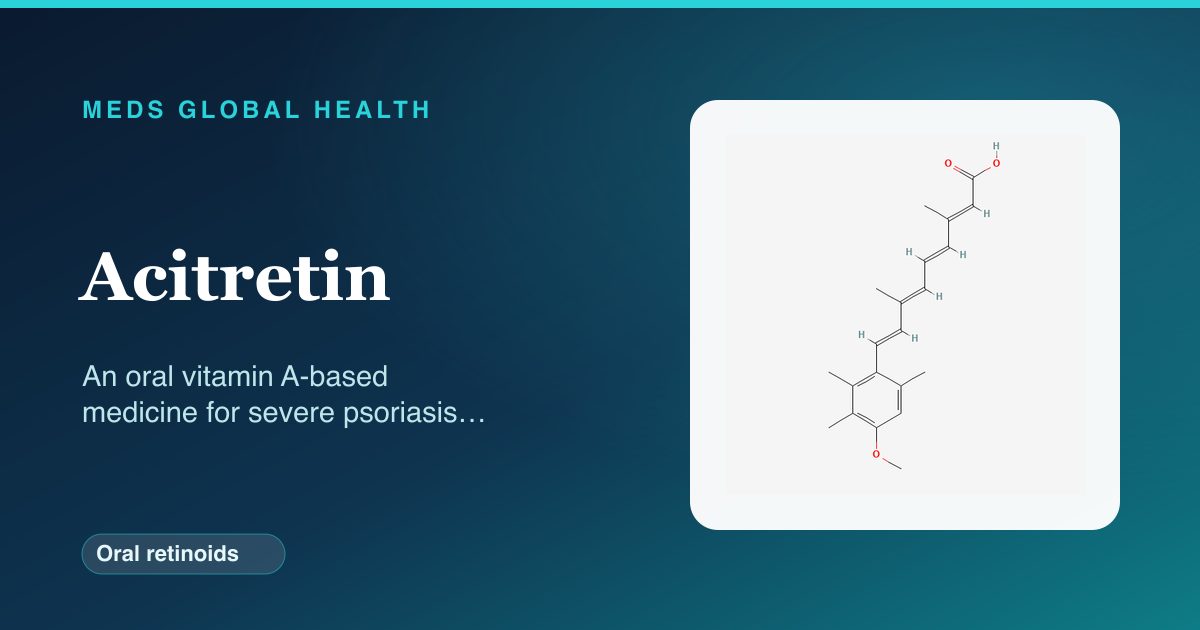
Acitretin is a man-made form of vitamin A taken as a capsule for severe skin conditions, most often severe or resistant psoriasis. It is a specialist medicine, started and supervised by a dermatology team rather than a GP alone. It works gradually over weeks to months and is used when creams, light treatment and other options have not been enough. Because of its risks, it is prescribed with careful counselling and monitoring.
How it works
Acitretin acts on the way skin cells grow and mature, helping to normalise the rapid, disordered skin-cell production seen in severe psoriasis. This reduces the thickness, scaling and redness of the plaques over time. It also affects skin and mucous membranes generally, which is why dryness of the skin, lips and eyes is such a common effect.
Company & origin
Originated / developed by: An oral retinoid treatment.
An oral retinoid used in the UK under specialist supervision for severe psoriasis and some other skin conditions.
Practical use
How to take Acitretin
General, dose-free guidance — always follow your prescriber's and the leaflet's specific instructions.
- Take the capsules by mouth exactly as your specialist directs, usually with food or milk, which helps absorption.
- Women who could become pregnant must use reliable contraception and follow the pregnancy-prevention programme throughout treatment and for three years afterwards.
- Use moisturisers, lip balm and eye drops regularly to manage the dryness of skin, lips and eyes, and use sun protection as your skin may be more sun-sensitive.
- Do not donate blood during treatment or for three years afterwards, and women should avoid alcohol during and for a period after treatment.
- If you forget a dose, take it when you remember unless it is nearly time for the next one, then skip it — never take two doses together.
Weighing it up
Advantages & disadvantages of Acitretin
Advantages
- Can be very effective for severe or resistant psoriasis when other treatments have failed.
- Taken as a capsule, so it treats widespread disease without applying creams everywhere.
- Not an immune-suppressing medicine, so it can suit people for whom that is a concern.
Disadvantages
- Strongly harmful in pregnancy, requiring strict contraception during treatment and for three years after.
- Commonly causes troublesome dryness of the skin, lips, eyes and nose.
- Requires regular blood tests and specialist supervision, and works only slowly.
Practical use
Good to know
Acitretin is strongly harmful to a developing baby, so pregnancy must be avoided during treatment and for three years after stopping, and women who could become pregnant follow a strict pregnancy-prevention programme with reliable contraception and regular pregnancy tests. You must not donate blood during treatment or for three years afterwards, in case the blood is given to a pregnant woman. Women are advised to avoid alcohol during treatment and for a period afterwards, because alcohol can change how the medicine behaves in the body. Very dry skin, lips, eyes and nose are extremely common, so regular moisturisers and lip balm help a lot. Regular blood tests are needed to check the liver and blood-fat levels, and you should report any new or worrying symptoms to your team.
Who should not take it / use with caution
- Women who are pregnant, breastfeeding, or could become pregnant and cannot follow the pregnancy-prevention programme must not take it.
- People with significant liver disease or very high blood-fat levels should not usually take it.
- Anyone who has had a serious reaction to retinoid medicines should avoid it.
Monitoring
- Pregnancy tests are done before, during and after treatment for women in the prevention programme.
- Blood tests check liver function and blood-fat (cholesterol and triglyceride) levels regularly.
- Your specialist reviews how your skin responds and watches for side effects throughout treatment.
Side effects
- Very dry, peeling skin and dry, cracked lips, along with dry eyes and nose, are extremely common.
- Thinning hair, nail changes and sometimes aching joints or muscles.
- Raised blood-fat levels and changes in liver tests, and rarely more serious liver problems.
Key interactions
- It must not be combined with other vitamin A supplements or certain other retinoids, which add to its toxicity.
- The acne antibiotic of the tetracycline group is avoided alongside it because of a risk of raised pressure in the head.
- Tell your team about all medicines, including some for cholesterol and the contraceptive progestogen-only minipill, which may be less reliable.
Available as: Capsules taken by mouth.
Answers
Acitretin: frequently asked questions
Why must I avoid pregnancy for so long?
Acitretin is strongly harmful to an unborn baby and can stay relevant in the body for a long time, so pregnancy must be avoided during treatment and for three years after stopping.
Why can't I donate blood?
You must not donate blood during treatment or for three years afterwards, in case it is given to a pregnant woman and harms her baby.
Why do I need blood tests?
Regular blood tests check your liver and your blood-fat levels, because acitretin can raise these, allowing your team to adjust treatment safely.
Why is my skin and my lips so dry?
Dryness of the skin, lips, eyes and nose is a very common effect; regular moisturisers, lip balm and eye drops help a great deal.
Can I drink alcohol on it?
Women are advised to avoid alcohol during treatment and for a period afterwards, because alcohol can change how the medicine behaves in the body.
The wider class
About Oral retinoids
Acitretin belongs to the oral retinoids class. For how the class as a whole works, its shared safety principles and monitoring, see the full guide.
Browse by body system
Authoritative sources
- BNF
- NICE CKS
Building a medicines information resource?
We create evidence-led, dose-free drug and formulary references for teams.