An injection given in hospital to stop certain fast heart rhythms
Adenosine
A very short-acting injection given in hospital to stop certain fast heart rhythms (SVT) and during heart stress tests.
What is Adenosine?
Adenosine is a very short-acting medicine given into a vein in hospital to stop certain fast heart rhythms known as supraventricular tachycardia (SVT), and also during some cardiac stress tests. It works within seconds by briefly interrupting the electrical signals in the heart. The most striking thing about it is that it usually causes a brief but alarming pause in the heartbeat, along with flushing, chest tightness and a feeling of breathlessness, all lasting only seconds. It is always given with heart (ECG) monitoring and resuscitation equipment to hand, and is avoided in people with asthma because it can trigger wheezing.
Education and reference only. This is a plain-language guide to Adenosine — it deliberately contains no doses. Doses depend on the person, the brand and the reason for treatment, and belong with your prescriber. Always check the BNF, the product labelling (SmPC) and follow medical advice.
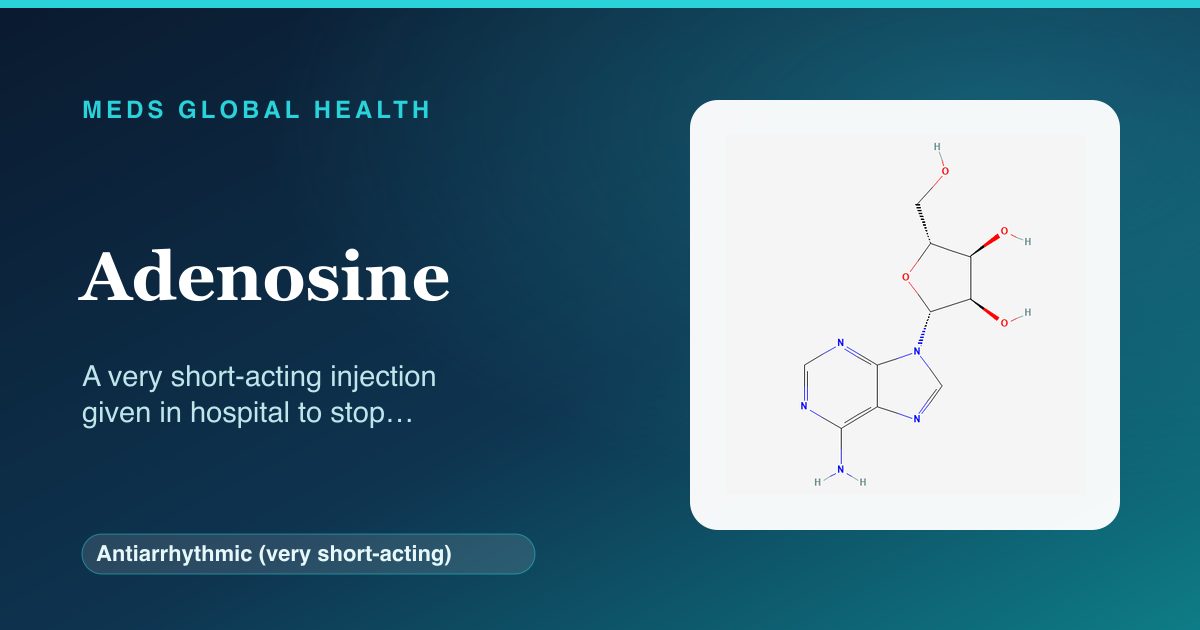
What it is
Adenosine is a medicine that occurs naturally in the body and is used in hospital to deal with certain fast heart rhythms. Its main use is to stop an episode of supraventricular tachycardia (SVT), a rhythm where the heart suddenly beats very fast because of a short-circuit in its upper chambers. It is also used during cardiac stress tests to mimic the effect of exercise on blood flow to the heart. It is given as a rapid injection into a vein, and because it acts and wears off within seconds, it is only ever used in a monitored setting by trained staff.
How it works
Adenosine briefly slows or blocks the electrical signal passing through a relay point in the heart called the AV node. In SVT, this short interruption breaks the abnormal electrical loop that is driving the fast rhythm, allowing the heart to reset to its normal beat. Because the body breaks adenosine down almost instantly, its effect lasts only a few seconds, which is why it is given as a fast push followed by a flush of fluid. In stress testing, it works differently, widening the heart's blood vessels to reveal areas with poor blood supply.
Company & origin
A hospital medicine used in the UK to stop certain fast heart rhythms and as part of cardiac stress testing, given into a vein under heart monitoring.
Practical use
How to take Adenosine
General, dose-free guidance — always follow your prescriber's and the leaflet's specific instructions.
- It is given only in hospital as a fast injection into a vein by trained staff, never taken by yourself.
- It is given with continuous heart (ECG) monitoring, so the team can watch the rhythm change.
- Expect a brief but alarming pause, flushing, chest tightness or breathlessness lasting just seconds.
- Tell staff if you have asthma or wheezy lung problems before it is given, as it can trigger wheezing.
- Mention recent caffeine and all your medicines, as these can change how it works.
Weighing it up
Advantages & disadvantages of Adenosine
Advantages
- Works within seconds to stop many episodes of supraventricular tachycardia (SVT).
- Wears off almost instantly, so any unpleasant effects are very short-lived.
- Can also help reveal the diagnosis of a fast rhythm by its effect on the heart's electrical signal.
Disadvantages
- Causes a brief but frightening pause in the heartbeat, with flushing, chest tightness and breathlessness.
- Can trigger wheezing, so it is generally avoided in people with asthma.
- Must be given in hospital with heart monitoring and emergency equipment to hand.
Practical use
Good to know
The most important thing to expect with adenosine is that it deliberately causes a very brief pause in the heartbeat, often felt as a fluttering, thumping or stopping sensation, along with flushing, chest tightness and breathlessness. These effects are alarming but normally pass within a few seconds because the medicine wears off almost instantly. It is always given with continuous heart (ECG) monitoring so staff can see the rhythm change and confirm the SVT has stopped. A key safety point is that it can trigger wheezing and is generally avoided in people with asthma or similar lung conditions. Caffeine can blunt its effect, while some other medicines can make it stronger, so staff take a full history before using it.
Who should not take it / use with caution
- People with asthma or certain other wheezy lung conditions, as it can trigger severe wheezing.
- People with certain heart conduction problems, such as some types of heart block, unless they have a pacemaker.
- People who have had a serious allergic reaction to adenosine should not be given it.
Monitoring
- Continuous heart (ECG) monitoring during and after the injection.
- Watching blood pressure and breathing for any wheezing or low blood pressure.
- Having resuscitation equipment available in case of a serious rhythm disturbance.
Side effects
- A brief but alarming pause in the heartbeat, often felt as fluttering or thumping.
- Flushing, chest tightness, breathlessness or a feeling of impending doom, all lasting only seconds.
- Headache, dizziness or nausea shortly after the injection.
- Rarely, wheezing or more serious heart-rhythm disturbances, which is why it is given under monitoring.
Key interactions
- Caffeine and similar substances can reduce its effect, so recent intake is taken into account.
- Dipyridamole can strongly increase its effect, so the team adjusts how it is used.
- Some heart medicines can prolong its slowing effect on the heart, so a full medicines list matters.
Available as: A solution given as a rapid injection into a vein in hospital.
Answers
Adenosine: frequently asked questions
What is adenosine used for?
It is given in hospital to stop certain fast heart rhythms known as supraventricular tachycardia (SVT) and during some cardiac stress tests.
Why does it make my heart feel like it stops?
Adenosine deliberately causes a very brief pause in the heart's electrical signal to reset the rhythm; the alarming pause, flushing and chest tightness last only a few seconds.
Why can't I have it if I have asthma?
It can trigger wheezing, so it is generally avoided in people with asthma or similar wheezy lung conditions.
Why is it given so quickly with a flush?
The body breaks it down almost instantly, so it must be pushed in fast and flushed through to reach the heart before it wears off.
Will the unpleasant feelings last long?
No. Because the medicine wears off within seconds, the flushing, chest tightness and breathless feeling usually pass very quickly.
Authoritative sources
- BNF
- NICE CKS
Building a medicines information resource?
We create evidence-led, dose-free drug and formulary references for teams.