The body's natural salt-retaining steroid hormone
Aldosterone
The body's natural salt-retaining hormone, made by the adrenal glands; it is rarely used as a medicine and is mainly a reference point in tests of hormone balance.
What is Aldosterone?
Aldosterone is a natural steroid hormone made by the adrenal glands that helps control the balance of salt (sodium) and potassium and, with it, blood pressure and fluid levels. It is not a routine treatment: instead, it is mostly discussed as part of how the body works and is measured in blood tests to investigate problems such as high blood pressure or hormone imbalances. When a salt-retaining hormone medicine is actually needed, a related synthetic form rather than aldosterone itself is normally used. Several common blood-pressure medicines work by acting on the aldosterone system.
Education and reference only. This is a plain-language guide to Aldosterone — it deliberately contains no doses. Doses depend on the person, the brand and the reason for treatment, and belong with your prescriber. Always check the BNF, the product labelling (SmPC) and follow medical advice.
What it is
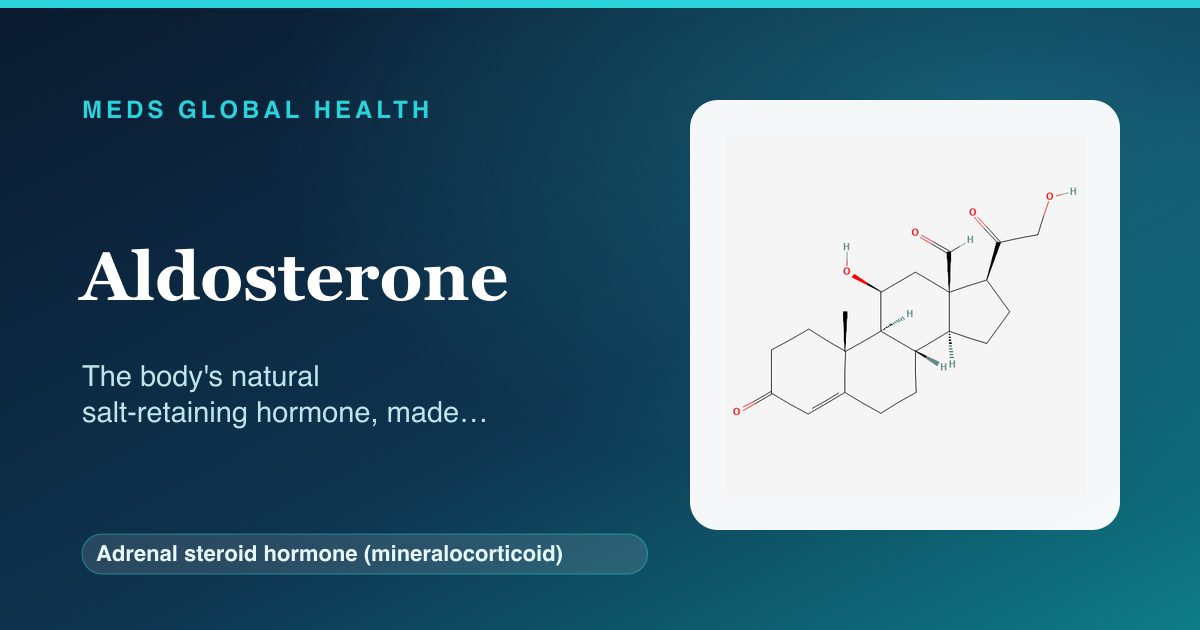
Aldosterone is a hormone the body makes naturally in the adrenal glands, the small glands that sit on top of the kidneys. It is the main mineralocorticoid, meaning its job is to control how much salt and water the body holds on to and how much potassium it loses. Rather than being a medicine people take, aldosterone is mostly important as a reference: doctors measure its level in blood tests to look into conditions such as certain types of high blood pressure or adrenal-gland problems. When a salt-retaining hormone effect is needed as treatment, a related synthetic hormone is normally used instead of aldosterone itself.
How it works
Aldosterone acts mainly on the kidneys, telling them to hold on to sodium (salt) and water and to pass more potassium out in the urine. Holding on to salt and water raises the volume of fluid in the body, which helps support blood pressure. The body controls aldosterone through a system that responds to blood pressure and salt levels, releasing more when blood pressure or salt is low. Understanding this system matters because several widely used blood-pressure and heart medicines work by blocking or reducing aldosterone's effect, which lowers blood pressure and reduces fluid build-up.
Company & origin
Originated / developed by: Naturally produced by the adrenal glands.
A natural steroid hormone made by the adrenal glands that controls the body's salt and water balance; it is mainly a physiological and diagnostic reference rather than a treatment.
Practical use
How to take Aldosterone
General, dose-free guidance — always follow your prescriber's and the leaflet's specific instructions.
- Understand that aldosterone is mainly a natural hormone and a test result, not a tablet you would usually be prescribed.
- If your aldosterone level is being measured, follow any instructions about medicines, posture or salt intake beforehand, as these can affect the result.
- Discuss the results with your doctor, who will interpret them alongside your blood pressure, potassium and other tests.
- If you take medicines that act on the aldosterone system for blood pressure or heart problems, take them exactly as prescribed.
- Tell your doctor about all your medicines, as several can change aldosterone levels or test results.
Weighing it up
Advantages & disadvantages of Aldosterone
Advantages
- A key natural hormone that helps the body control salt, water and blood pressure.
- Measuring it helps doctors investigate high blood pressure and adrenal-gland problems.
- Understanding it explains how many common blood-pressure and heart medicines work.
Disadvantages
- It is not a routine medicine, so it is rarely something a person takes as treatment.
- Too much or too little of the natural hormone can cause problems with blood pressure and potassium.
- Test results can be affected by medicines, posture and salt intake, so they need careful interpretation.
Practical use
Good to know
The most useful point about aldosterone is that it is the body's own hormone, not a tablet people are usually given; you are far more likely to come across it as something measured in a blood test than as a treatment. Doctors check aldosterone levels to investigate conditions such as high blood pressure that is hard to control, or to look for an overactive or underactive adrenal gland. Too much aldosterone tends to cause high blood pressure and low potassium, while too little can cause low blood pressure, salt loss and high potassium. When a medicine with a salt-retaining hormone effect is genuinely needed, a related synthetic hormone is normally used rather than aldosterone itself. Many people unknowingly take medicines that act on the aldosterone system to treat high blood pressure or heart failure.
Who should not take it / use with caution
- As a hormone, aldosterone is not a treatment most people would be given, so this is mainly about its natural role.
- Where a salt-retaining hormone effect is needed as treatment, a related synthetic hormone is normally chosen instead, under specialist advice.
- Any investigation or treatment involving the aldosterone system should be guided by a doctor.
Monitoring
- Measuring aldosterone in blood tests to investigate high blood pressure or adrenal problems.
- Checking it alongside related hormones, potassium and blood pressure for a full picture.
- Reviewing medicines and conditions that can raise or lower its level.
Side effects
- As a natural hormone it is not taken as a tablet, so this concerns the effects of having too much or too little.
- Too much aldosterone tends to cause high blood pressure and low potassium.
- Too little can cause low blood pressure, salt loss and high potassium.
- These imbalances are investigated and managed by a doctor rather than being side effects of a medicine.
Key interactions
- Many blood-pressure and heart medicines act on the aldosterone system, raising or lowering its effect.
- Some medicines, salt intake and even body position can change measured aldosterone levels.
- Tell your doctor about all your medicines before aldosterone is measured, as several affect the result.
Available as: A natural hormone made by the body; mainly measured in blood tests rather than given as a medicine.
Answers
Aldosterone: frequently asked questions
What is aldosterone?
It is a natural steroid hormone made by the adrenal glands that helps control the body's balance of salt, water and potassium, and with it blood pressure.
Is aldosterone a medicine I would take?
No, it is not a routine treatment. It is mainly the body's own hormone and is measured in blood tests; when a similar effect is needed, a related synthetic hormone is normally used instead.
Why would my aldosterone be measured?
Doctors measure it to investigate problems such as hard-to-control high blood pressure or an overactive or underactive adrenal gland.
What happens if there is too much aldosterone?
Too much tends to cause high blood pressure and low potassium, which a doctor will investigate and manage.
Do any medicines work on aldosterone?
Yes, several common blood-pressure and heart medicines work by acting on the aldosterone system to lower blood pressure and reduce fluid build-up.
Authoritative sources
- BNF
- NICE CKS
Building a medicines information resource?
We create evidence-led, dose-free drug and formulary references for teams.