A peripheral opioid blocker to speed bowel recovery after surgery
Alvimopan
A peripherally-acting opioid blocker used short-term in hospital to speed bowel recovery after bowel surgery.
What is Alvimopan?
Alvimopan is a medicine used for a short course in hospital to help the bowel start working again after bowel surgery, a problem known as ileus where the gut goes quiet and stops moving for a time. It works by blocking the effect of opioid pain-relief on the gut, without taking away the pain relief itself. The most important safety point is that, because of a possible signal of a higher risk of heart attack, it is limited to short in-hospital courses given through a controlled programme. It is not for ongoing use at home.
Education and reference only. This is a plain-language guide to Alvimopan — it deliberately contains no doses. Doses depend on the person, the brand and the reason for treatment, and belong with your prescriber. Always check the BNF, the product labelling (SmPC) and follow medical advice.
What it is
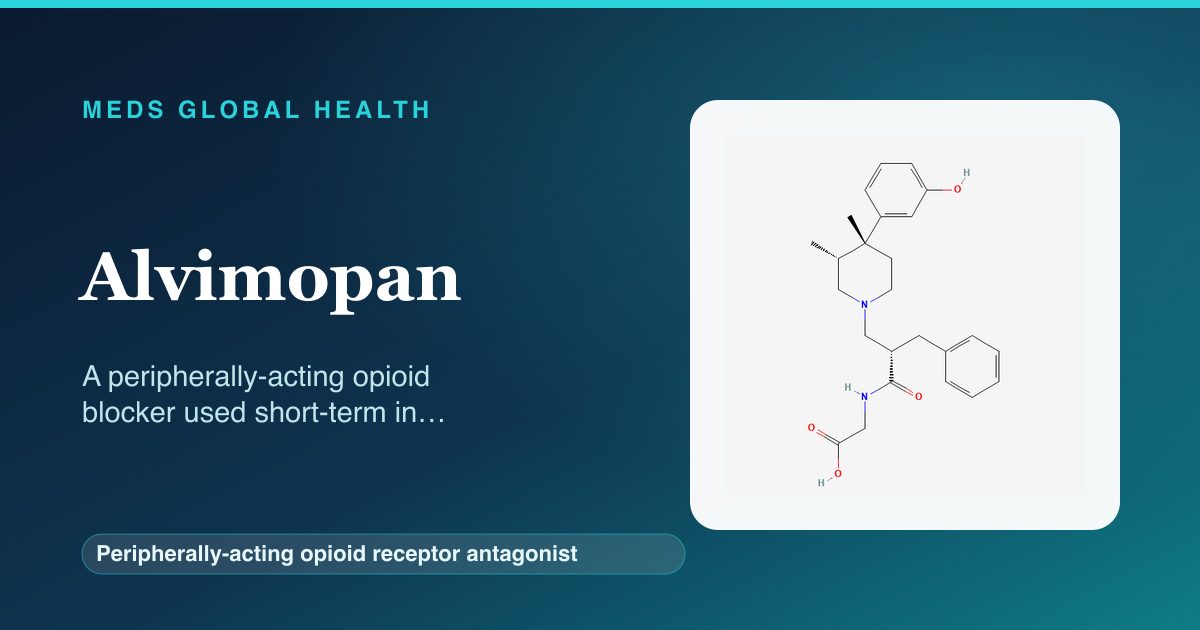
Alvimopan is a peripherally-acting opioid receptor blocker, meaning it blocks opioid effects in the gut while leaving the pain-relieving effect of opioids in the brain largely untouched. It is used in hospital, for a short course, to help the bowel recover and start moving again after bowel surgery, a problem called postoperative ileus in which the gut becomes sluggish and stops working for a while. Because of a safety concern, it is given only as a short in-hospital course through a controlled programme, and is not a medicine for ongoing use at home.
How it works
Opioid pain-relievers, often needed after surgery, slow the gut down because they act on opioid receptors in the bowel as well as in the brain. This adds to the natural slowing of the gut that happens after an operation. Alvimopan blocks the opioid receptors in the gut without crossing into the brain in a meaningful way, so it counters the gut-slowing effect while leaving pain relief in place. This helps the bowel start moving and recover more quickly after surgery. Because it works only in the gut and only for a short course around the operation, it is given in hospital for a limited time.
Company & origin
A hospital-only medicine used for a short course to help the bowel start working again after bowel surgery, given through a controlled programme.
Practical use
How to take Alvimopan
General, dose-free guidance — always follow your prescriber's and the leaflet's specific instructions.
- Receive it in hospital as a short course around your bowel surgery, exactly as the team directs.
- Understand it is a short in-hospital treatment only and is not continued at home.
- Tell the team if you have been taking opioid pain-relievers regularly for some time before surgery.
- Tell the team about any heart problems or history of heart attack.
- Let staff know how your bowel recovery and pain are going, as this guides treatment.
Weighing it up
Advantages & disadvantages of Alvimopan
Advantages
- Helps the bowel start moving again sooner after bowel surgery.
- Counters the gut-slowing effect of opioids without taking away their pain relief.
- Works in the gut without meaningfully entering the brain.
Disadvantages
- Limited to short in-hospital courses through a controlled programme because of a possible heart-attack signal.
- Not suitable for people already taking opioids regularly for a longer time before surgery.
- A hospital-only medicine, not for ongoing use at home.
Practical use
Good to know
The most important thing to understand is the reason alvimopan is limited to short in-hospital courses through a controlled programme: studies raised a possible signal of a higher risk of heart attack with longer use, so it is used only for a short time around bowel surgery and not continued at home. It is meant to help the bowel recover after an operation, working by countering the gut-slowing effect of opioid pain relief without removing the pain relief itself. It is not suitable for people who have been taking opioids regularly for a longer period before surgery, as they may be more sensitive to its effects. The hospital team gives it, watches the bowel's recovery, and stops it after the short planned course. It is not a general laxative or a long-term medicine.
Who should not take it / use with caution
- People who have taken opioid pain-relievers regularly for a longer period before surgery should not use it.
- People who have had a serious allergic reaction to alvimopan should not use it.
- It is used with caution in people with heart problems and is restricted to short in-hospital courses.
Monitoring
- Watching how the bowel recovers and starts moving again after surgery.
- Monitoring heart health, given the possible heart-attack signal.
- Keeping the course short and in hospital, as set by the controlled programme.
Side effects
- Stomach upset such as indigestion or constipation in some people.
- Low potassium levels or changes in blood tests around surgery.
- Of greatest concern, a possible signal of a higher risk of heart attack with longer use, which is why it is limited to short courses.
Key interactions
- It is given alongside opioid pain relief, whose gut-slowing effect it is designed to counter.
- Recent or ongoing regular opioid use makes people more sensitive to it, so it is avoided in that case.
- Tell the hospital team about all your medicines, including heart medicines.
Available as: Capsules given in hospital.
Answers
Alvimopan: frequently asked questions
What is alvimopan used for?
It is used for a short course in hospital to help the bowel start working again after bowel surgery, a problem called ileus where the gut goes quiet.
How does it work?
It blocks the effect of opioid pain relief on the gut, countering the gut-slowing it causes, without taking away the pain relief itself.
Why is it only used in hospital for a short time?
Studies raised a possible signal of a higher risk of heart attack with longer use, so it is limited to short in-hospital courses through a controlled programme.
Can I take it at home?
No. It is a hospital-only treatment given for a short course around your operation, and it is not continued at home.
Why does long-term opioid use matter?
People who have been taking opioids regularly for a longer time before surgery can be more sensitive to it, so it is not used for them.
Authoritative sources
- BNF
- NICE CKS
Building a medicines information resource?
We create evidence-led, dose-free drug and formulary references for teams.