A vasopressor infusion for dangerously low blood pressure in intensive care
Angiotensin II
A vasopressor given by drip in intensive care to raise dangerously low blood pressure in shock.
What is Angiotensin II?
Angiotensin II is a specialist medicine used in intensive care to raise dangerously low blood pressure in a type of shock (called distributive or septic shock) where the blood vessels have become too relaxed and widened. It works by tightening blood vessels so blood pressure rises and vital organs receive enough blood. It is given as a controlled drip into a vein under very close monitoring, usually when other blood-pressure-raising medicines are not enough. An important risk is blood clots (thrombosis), so it is given carefully and patients are watched closely, often with measures to reduce clotting risk.
Education and reference only. This is a plain-language guide to Angiotensin II — it deliberately contains no doses. Doses depend on the person, the brand and the reason for treatment, and belong with your prescriber. Always check the BNF, the product labelling (SmPC) and follow medical advice.
What it is
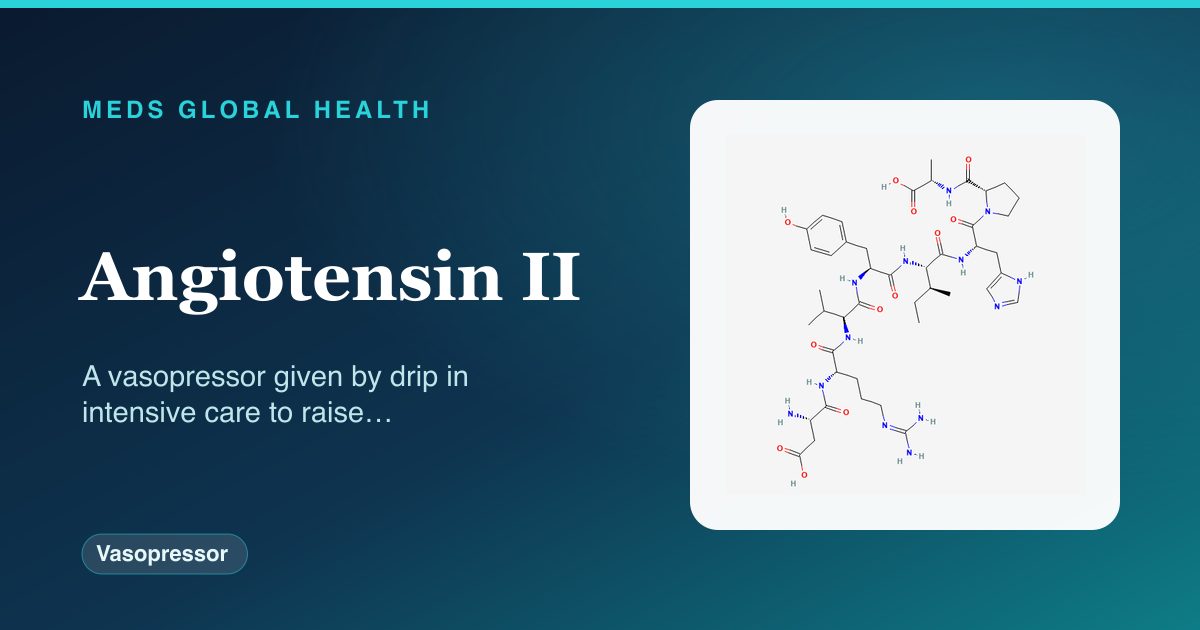
Angiotensin II is a vasopressor, a medicine that raises blood pressure by tightening blood vessels. It is used in intensive care for adults with dangerously low blood pressure caused by distributive or septic shock, a serious situation where the blood vessels widen too much and blood pressure falls to a level that threatens the organs. It is given as a carefully controlled infusion (drip) into a vein, usually alongside or after other vasopressors when those are not raising the blood pressure enough. It is a hospital-only, specialist medicine used under intensive monitoring.
How it works
In shock, the blood vessels can relax and widen so much that blood pressure drops to dangerous levels, which can starve organs of blood. Angiotensin II acts on the blood vessels to make them tighten, which raises blood pressure back towards a safer level so the organs are better supplied. It is given as a continuous drip whose rate is adjusted from minute to minute according to the blood pressure, so the effect can be carefully controlled. It is used in addition to standard treatments for shock, including other vasopressors, as part of intensive-care management.
Company & origin
A specialist medicine used in UK intensive care to raise dangerously low blood pressure in shock, given by infusion under close monitoring.
Practical use
How to take Angiotensin II
General, dose-free guidance — always follow your prescriber's and the leaflet's specific instructions.
- It is given only in hospital, as a controlled drip into a vein by the intensive-care team.
- The drip rate is adjusted continuously according to your blood pressure, so it is given under close monitoring.
- It is used alongside other treatments for shock as the specialist team decides.
- The team watches closely for blood clots and for the right level of blood-pressure effect.
- Measures to reduce the risk of blood clots are often used while it is being given.
Weighing it up
Advantages & disadvantages of Angiotensin II
Advantages
- Raises dangerously low blood pressure in shock when other vasopressors are not enough.
- Acts quickly and can be adjusted minute to minute through a controlled drip.
- Helps maintain blood flow to vital organs in critically ill patients.
Disadvantages
- Carries a risk of blood clots (thrombosis) in the veins or arteries.
- Can only be given in intensive care under very close monitoring.
- Is an add-on for severe shock rather than a first or stand-alone treatment.
Practical use
Good to know
The most important safety point with angiotensin II is the risk of blood clots (thrombosis), which can form in the veins or arteries; because of this, patients are watched closely and measures to reduce clotting risk are often used. It is a powerful medicine reserved for the intensive-care setting, given by a tightly controlled drip and adjusted continuously according to the blood pressure, so it is only ever used under specialist supervision with close monitoring of blood pressure and organ function. It is added to standard shock treatment, usually when other vasopressors are not enough, rather than being a first or stand-alone treatment. Because the patient is critically ill, the intensive-care team weighs the benefits and risks carefully and watches for both too little and too much blood-pressure effect.
Who should not take it / use with caution
- It is used with great caution in people at high risk of blood clots, because it can increase clotting risk.
- It is given only in an intensive-care setting under specialist supervision, not at home.
- Its use in pregnancy and breastfeeding is decided by the specialist team weighing the risks in a critical illness.
Monitoring
- Continuous monitoring of blood pressure with adjustment of the drip rate.
- Watching closely for signs of blood clots in the veins or arteries.
- Reviewing organ function and overall response to treatment in intensive care.
Side effects
- Blood clots (thrombosis) in the veins or arteries, which the team watches for closely.
- Blood pressure rising too high if the drip rate is not finely controlled.
- Other effects related to critical illness, monitored continuously in intensive care.
Key interactions
- Other vasopressors and blood-pressure medicines are taken into account when adjusting the drip.
- Medicines that affect blood clotting may be considered alongside it because of the clot risk.
- The intensive-care team reviews all medicines given during critical illness together.
Available as: A solution given as a controlled infusion (drip) into a vein in hospital.
Answers
Angiotensin II: frequently asked questions
What is angiotensin II used for?
It is used in intensive care to raise dangerously low blood pressure in distributive or septic shock, by tightening blood vessels so organs receive enough blood.
How is it given?
It is given only in hospital as a tightly controlled drip into a vein, with the rate adjusted continuously according to the blood pressure.
What is its main risk?
An important risk is blood clots (thrombosis) in the veins or arteries, so patients are watched closely and measures to reduce clotting risk are often used.
Is it a first treatment for shock?
No. It is usually added when other vasopressors are not raising the blood pressure enough, as part of intensive-care management of shock.
Can it be used at home?
No. It is a hospital-only medicine given in intensive care under very close monitoring by a specialist team.
Authoritative sources
- BNF
- NICE CKS
Building a medicines information resource?
We create evidence-led, dose-free drug and formulary references for teams.