Also called phenazone; an old painkiller now mainly used in ear drops
Antipyrine
An old painkiller and fever medicine now used mainly in ear drops to ease earache.
What is Antipyrine?
Antipyrine, also called phenazone, is one of the oldest painkillers and fever medicines. Today it is used mainly in ear drops to ease the pain of earache, often combined with a local anaesthetic such as benzocaine, and applied directly into the ear. Used this way it acts locally and is generally well tolerated, with allergy being the main, though uncommon, concern. Taking it by mouth as a painkiller is now largely obsolete, having been replaced by safer modern medicines such as paracetamol and ibuprofen.
Education and reference only. This is a plain-language guide to Antipyrine — it deliberately contains no doses. Doses depend on the person, the brand and the reason for treatment, and belong with your prescriber. Always check the BNF, the product labelling (SmPC) and follow medical advice.
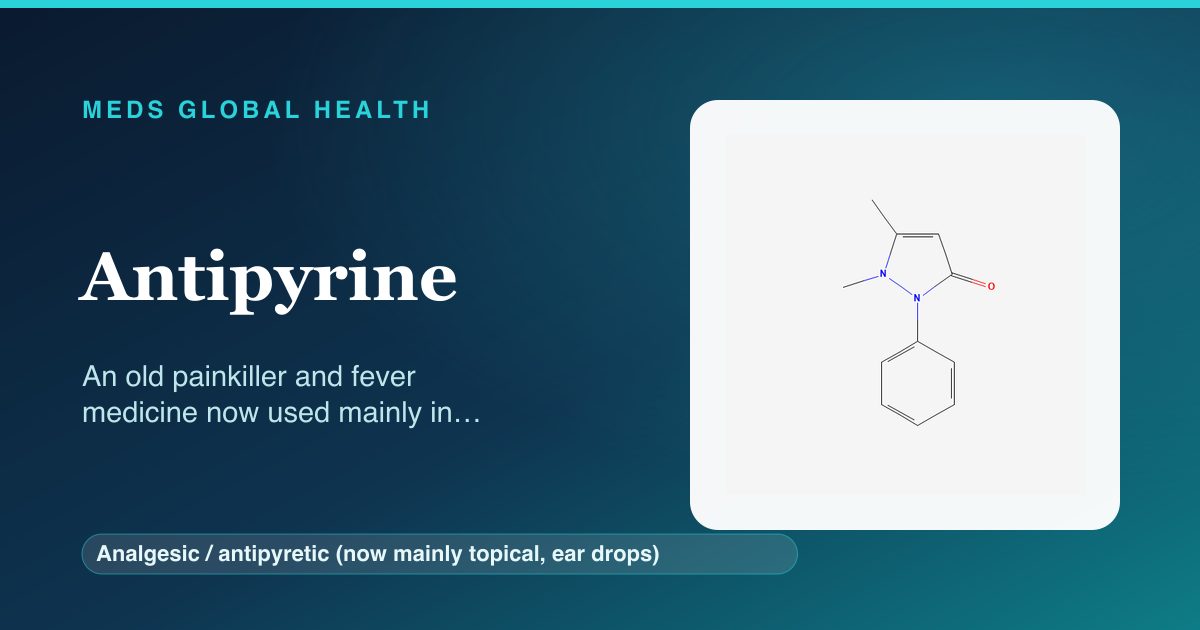
What it is
Antipyrine, also known as phenazone, is a long-established medicine that relieves pain and lowers fever. It was once taken by mouth like aspirin or paracetamol, but this use has almost completely disappeared because newer medicines are safer. Its main modern role in the UK is as an ingredient in ear drops used to soothe the pain of earache, where it is often combined with a numbing local anaesthetic. In that form it works on the spot in the ear canal rather than throughout the body.
How it works
Antipyrine eases pain and lowers fever by dampening the production of chemicals in the body called prostaglandins, which are involved in pain and inflammation, in a similar way to other older painkillers. When used in ear drops for earache, it acts locally in the ear canal to help relieve discomfort, especially when paired with a local anaesthetic that numbs the area. Because it is applied directly rather than swallowed, very little reaches the rest of the body, so its effects and risks in this form are mainly local.
Company & origin
A very old painkiller and fever medicine that is now used in the UK mainly in ear drops for earache, often combined with a local anaesthetic; its use by mouth is largely obsolete.
Practical use
How to take Antipyrine
General, dose-free guidance — always follow your prescriber's and the leaflet's specific instructions.
- When used as ear drops, apply them into the affected ear exactly as directed, then keep the head tilted briefly so they stay in.
- Do not use the ear drops if you think your eardrum is burst or there is discharge, unless a clinician has told you to.
- Stop and seek advice if the ear becomes more painful, itchy, red or swollen, as this may be an allergic reaction.
- Get persistent or severe earache checked rather than treating it yourself for a long time.
- Tell your pharmacist or doctor about any allergies and other medicines before using it.
Weighing it up
Advantages & disadvantages of Antipyrine
Advantages
- Used in ear drops, it can ease the pain of earache, especially combined with a local anaesthetic.
- Applied to the ear, it works locally with little reaching the rest of the body.
- A long-established medicine with a well-understood action.
Disadvantages
- Its use as a painkiller taken by mouth is largely obsolete and replaced by safer medicines.
- Can occasionally cause an allergic reaction, with irritation in or around the ear.
- Ear drops should not be used with a perforated eardrum or discharge unless advised.
Practical use
Good to know
The key thing to understand about antipyrine today is that its main use is local, in ear drops for earache, rather than as a painkiller taken by mouth. Used in the ear, it works on the spot and is generally well tolerated; the main concern is an allergic reaction, which is uncommon but can cause irritation, redness or itching in or around the ear. Ear drops containing it should not be used if the eardrum is perforated or there is discharge, unless a clinician has advised it, so it is worth getting earache checked rather than self-treating a possibly burst eardrum. Its older use as a tablet for pain and fever is essentially obsolete, having been replaced by safer medicines such as paracetamol and ibuprofen. As always, tell your pharmacist or doctor about other medicines and any allergies before use.
Who should not take it / use with caution
- People who have had an allergic reaction to antipyrine (phenazone) or related medicines should not use it.
- Ear drops containing it should not be used if the eardrum is perforated or there is discharge, unless a clinician advises it.
- It is used with caution, and on advice, in young children and in pregnancy.
Monitoring
- Checking whether the earache improves and the eardrum is intact before and during use.
- Watching for signs of an allergic reaction in or around the ear.
- Reviewing persistent earache to look for an underlying cause needing other treatment.
Side effects
- Local irritation, redness or itching in or around the ear with the drops.
- Allergic reactions, which are uncommon but should prompt stopping the medicine.
- With the now largely obsolete oral use, more general effects could occur, which is part of why it is no longer used that way.
Key interactions
- Used as ear drops, it has few significant interactions because little is absorbed into the body.
- Tell your pharmacist about other ear treatments you are using so they are not mixed unhelpfully.
- If ever considered for use by mouth, it could interact with other medicines, but this use is essentially obsolete.
Available as: Mainly ear drops, often combined with a local anaesthetic; oral forms are now largely obsolete.
Answers
Antipyrine: frequently asked questions
What is antipyrine used for?
Today it is used mainly in ear drops to ease the pain of earache, often combined with a local anaesthetic; its older use as a painkiller taken by mouth is largely obsolete.
Is antipyrine the same as phenazone?
Yes, antipyrine and phenazone are two names for the same medicine.
Can I use the ear drops if my eardrum might be burst?
No. Ear drops containing it should not be used with a perforated eardrum or discharge unless a clinician has advised it, so get the ear checked first.
Are there many side effects?
Used in the ear it is generally well tolerated, with the main concern being an uncommon allergic reaction causing irritation in or around the ear.
Why is it not used as a tablet anymore?
Its use by mouth for pain and fever has been replaced by safer modern medicines such as paracetamol and ibuprofen, so that use is now largely obsolete.
Authoritative sources
- BNF
- NICE CKS
Building a medicines information resource?
We create evidence-led, dose-free drug and formulary references for teams.