A direct oral anticoagulant (DOAC)
Apixaban
A direct oral anticoagulant taken twice daily that blocks factor Xa, used for clot treatment and stroke prevention in atrial fibrillation.
What is Apixaban?
Apixaban is a direct oral anticoagulant (DOAC) — a modern 'blood thinner' — that helps prevent harmful clots. It is widely used to reduce the risk of stroke in atrial fibrillation and to treat and prevent deep vein thrombosis and pulmonary embolism.
Education and reference only. This is a plain-language guide to Apixaban — it deliberately contains no doses. Doses depend on the person, the brand and the reason for treatment, and belong with your prescriber. Always check the BNF, the product labelling (SmPC) and follow medical advice.
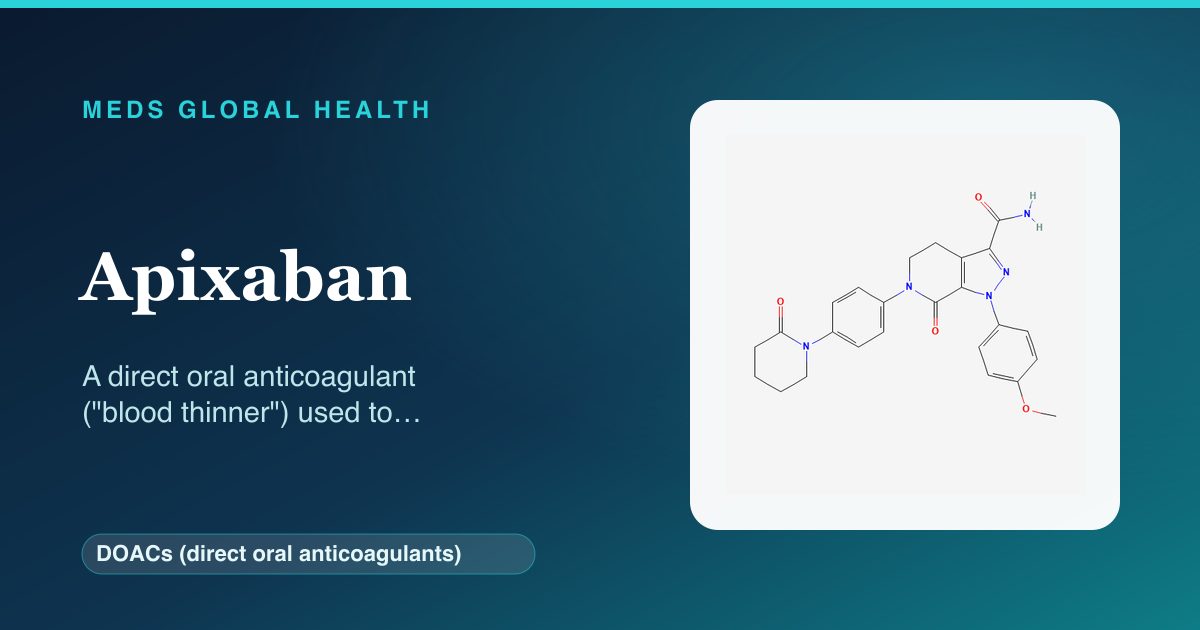
What it is
Apixaban is a direct oral anticoagulant (DOAC) — a modern "blood thinner". It is widely used to reduce the risk of stroke in atrial fibrillation, and to treat and prevent deep-vein thrombosis (DVT) and pulmonary embolism (PE). Unlike warfarin it does not need routine blood-level monitoring or dietary restrictions, and it is taken as a tablet (usually twice daily).
How it works
Apixaban directly blocks a clotting protein called factor Xa, a key step in the chain reaction that forms a blood clot. Damping down this step makes the blood less likely to clot abnormally — for example in the quivering upper chambers of a heart in atrial fibrillation, where pooled blood can form a clot that travels to the brain and causes a stroke.
Company & origin
Originated / developed by: Bristol Myers Squibb and Pfizer.
Apixaban is a direct oral factor Xa inhibitor discovered by Bristol Myers Squibb and co-developed with Pfizer. It was first approved in the European Union in 2011 and by the FDA in 2012, and is marketed as Eliquis.
What it treats
Conditions Apixaban is used for
Practical use
How to take Apixaban
General, dose-free guidance — always follow your prescriber's and the leaflet's specific instructions.
- Usually taken twice a day, at regular times.
- Can be taken with or without food; if swallowing is difficult it can be crushed — ask your pharmacist first.
- Take it as consistently as you can, as the protection depends on regular dosing.
- If you miss a dose, take it as soon as you remember on the same day, then return to your usual schedule — never double up.
- Tell any doctor, dentist or pharmacist that you take an anticoagulant before procedures.
- Report unusual bruising, blood in urine or stools, or prolonged bleeding promptly.
Weighing it up
Advantages & disadvantages of Apixaban
Advantages
- No routine blood-test monitoring, unlike warfarin.
- Few food interactions and fewer drug interactions than warfarin.
- Predictable effect with rapid onset and offset.
- Lower risk of bleeding in the brain than warfarin in atrial fibrillation.
Disadvantages
- Carries a bleeding risk, including serious bleeding.
- The dose must be adjusted and may be unsuitable if kidney function is poor.
- A specific reversal agent exists but is not available everywhere.
- Twice-daily dosing means missed doses lower protection more quickly.
Practical use
Good to know
The main trade-off of any anticoagulant is bleeding: it works by making clotting harder, so unusual or prolonged bleeding should be reported, and serious bleeding is an emergency. Doses should not be missed or doubled up. Tell every dentist, surgeon and pharmacist you take it before any procedure, and carry an anticoagulant alert card.
Who should not take it / use with caution
- People with active significant bleeding, or conditions at high risk of major bleeding.
- Severe liver disease with clotting problems; used with dose review in significant kidney impairment.
- People with mechanical heart valves or moderate-to-severe mitral stenosis (warfarin is used instead); pregnancy and breastfeeding.
Monitoring
- Kidney and liver function periodically (no routine clotting-level test needed)
- Signs of bleeding
- Review before any surgery or dental procedure
Side effects
- Bruising and minor bleeding (e.g. nosebleeds, bleeding gums) are the most common.
- Heavier or prolonged bleeding — report promptly.
- Serious bleeding (in the gut or brain) is uncommon but an emergency — see below.
Key interactions
- Other medicines that affect bleeding — aspirin, other anticoagulants, NSAID painkillers — increase bleeding risk.
- Some antifungal, HIV and epilepsy medicines, and the herbal remedy St John's Wort, can raise or lower apixaban levels.
- Always check new medicines, including those bought over the counter, with a pharmacist.
Available as: Tablets (more than one strength).
Answers
Apixaban: frequently asked questions
What is the difference between apixaban and warfarin?
Both reduce clotting, but apixaban (a DOAC) does not need regular blood-level (INR) monitoring or the dietary care warfarin requires, and has fewer food and drug interactions. Warfarin is still preferred in specific situations such as mechanical heart valves. The choice is individual.
What should I do if I miss a dose?
Do not take a double dose to catch up. Apixaban is usually taken twice a day; if you miss one, take it as soon as you remember on the same day, then continue as normal — but follow the specific advice in your leaflet or from your pharmacist, as timing matters.
When is bleeding on apixaban an emergency?
Seek emergency help (999/A&E) for bleeding that will not stop, vomiting or coughing up blood, black or bloody stools, a severe headache, or after a significant fall or head injury — anticoagulants raise the risk of serious internal bleeding.
Do I need blood tests on apixaban?
Not the routine clotting (INR) tests that warfarin needs. You will still have periodic checks of kidney and liver function, because these affect how the medicine is handled and dosed.
Is Eliquis the same as apixaban?
Yes — apixaban is the generic (active-ingredient) name and Eliquis is the brand name; both contain the same active ingredient.
The wider class
About DOACs (direct oral anticoagulants)
Apixaban belongs to the doacs (direct oral anticoagulants) class. For how the class as a whole works, its shared safety principles and monitoring, see the full guide.
Browse by body system
Authoritative sources
- BNF: Apixaban.
- electronic Medicines Compendium (SmPC): Apixaban (Eliquis).
- NICE CKS: Apixaban.
Keep reading
Related articles
Building a medicines information resource?
We create evidence-led, dose-free drug and formulary references for teams.