A drip anticoagulant used in heparin-induced thrombocytopenia
Argatroban
A hospital drip anticoagulant used mainly when heparin cannot be given because of heparin-induced thrombocytopenia.
What is Argatroban?
Argatroban is an anticoagulant (a medicine that prevents and treats blood clots) given by drip into a vein in hospital. It is a direct thrombin inhibitor, meaning it directly blocks thrombin, a key protein in clotting. Its main use is in people with heparin-induced thrombocytopenia (HIT), a reaction where heparin causes a dangerous drop in platelets and clotting, so a different anticoagulant is needed. The main risk is bleeding, so it is given with careful clotting blood tests to guide the dose. It also raises the INR blood test, which matters when switching to warfarin. It is used only in hospital under specialist care.
Education and reference only. This is a plain-language guide to Argatroban — it deliberately contains no doses. Doses depend on the person, the brand and the reason for treatment, and belong with your prescriber. Always check the BNF, the product labelling (SmPC) and follow medical advice.
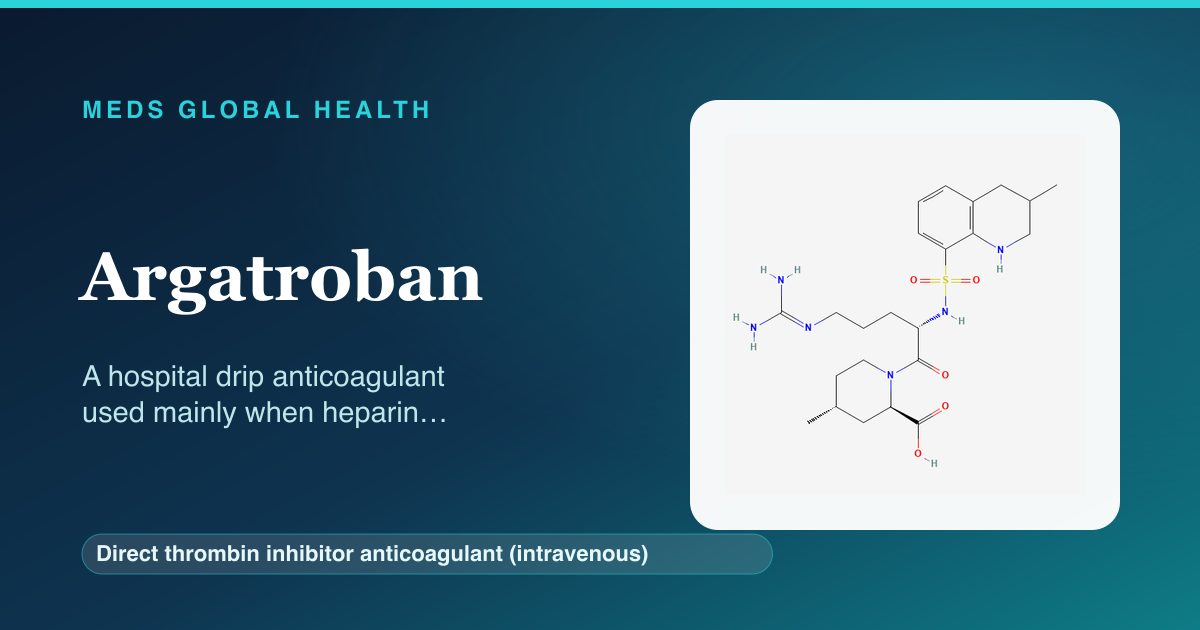
What it is
Argatroban is an anticoagulant given as a continuous drip into a vein in hospital. It belongs to a group called direct thrombin inhibitors. It is used mainly in people who cannot have heparin because they have, or are at risk of, heparin-induced thrombocytopenia (HIT) — a serious reaction in which heparin triggers a fall in platelets and an increased tendency to clot. In that situation, a non-heparin anticoagulant such as argatroban is used to prevent and treat clots. Because it is a powerful blood-thinner that needs close monitoring, it is given only in hospital under specialist supervision.
How it works
Blood clots form through a chain of steps that ends with thrombin, a protein that turns a soluble blood factor into the mesh that forms a clot. Argatroban works by directly blocking thrombin, interrupting this final step so that harmful clots are less likely to form and grow. Because it acts quickly and is given by drip, its effect can be adjusted by changing the drip rate, guided by clotting blood tests. The same clot-blocking action that makes it useful also means it can cause bleeding, which is why it is monitored carefully. It also pushes up the INR test, which has to be allowed for when moving a patient on to warfarin.
Company & origin
A hospital anticoagulant given by drip into a vein, used mainly when heparin cannot be used because of heparin-induced thrombocytopenia.
Practical use
How to take Argatroban
General, dose-free guidance — always follow your prescriber's and the leaflet's specific instructions.
- It is given by a continuous drip into a vein in hospital by the medical team, not taken at home.
- Expect regular clotting blood tests, as these are used to set and adjust the drip rate.
- Tell the team straight away about any bleeding, bruising, blood in the urine or stool, or a sudden severe headache.
- Let the team know about any liver problems, as the amount given is reduced if the liver is not working well.
- Follow the team's plan carefully when switching to warfarin, as argatroban affects the INR test.
Weighing it up
Advantages & disadvantages of Argatroban
Advantages
- An effective anticoagulant for people who cannot have heparin because of heparin-induced thrombocytopenia.
- Acts quickly and can be adjusted by changing the drip rate, guided by blood tests.
- Useful in hospital where close clotting monitoring is available.
Disadvantages
- Its main risk is bleeding, which can be serious.
- Must be given by drip in hospital with regular clotting blood tests.
- Raises the INR test, which complicates switching to warfarin and needs careful handling.
Practical use
Good to know
The most important thing to understand about argatroban is that it is a hospital-only blood-thinner whose main risk is bleeding. Because of this, it is given by drip with regular clotting blood tests so the dose can be fine-tuned, and the team watches closely for any signs of bleeding such as bruising, blood in the urine or stool, or unusual headaches. Its main role is in heparin-induced thrombocytopenia, where heparin itself has become dangerous and a different anticoagulant is needed. A practical point that matters to the medical team is that argatroban raises the INR blood test; this has to be taken into account when switching a patient over to warfarin, so that the warfarin dose is judged correctly. It is cleared by the liver, so the dose is adjusted in people with liver problems. It is always used under specialist supervision.
Who should not take it / use with caution
- People who have had a serious allergic reaction to argatroban should not be given it.
- It is not used in people with active major bleeding.
- It is used with great caution, and dose adjustment, in people with liver problems, as it is cleared by the liver.
- It is given only in hospital under specialist supervision with clotting monitoring.
Monitoring
- Regular clotting blood tests to guide the drip rate.
- Watching closely for any signs of bleeding.
- Checking liver function and adjusting the amount given in people with liver problems.
Side effects
- Bleeding or bruising, which can range from minor to serious.
- A drop in blood pressure or nausea in some people.
- Rarely, more serious bleeding, which needs urgent medical attention.
Key interactions
- Other blood-thinning or anti-clotting medicines, including warfarin and antiplatelets, add to the risk of bleeding.
- It raises the INR test, which must be allowed for when switching to warfarin.
- The team reviews all medicines that affect bleeding before and during treatment.
Available as: A solution given by drip into a vein in hospital.
Answers
Argatroban: frequently asked questions
What is argatroban used for?
It is a hospital anticoagulant used mainly in heparin-induced thrombocytopenia, when heparin has become dangerous and a different blood-thinner is needed to prevent and treat clots.
How is it given?
It is given as a continuous drip into a vein in hospital, with regular clotting blood tests used to adjust the dose.
What is its main risk?
The main risk is bleeding, which is why it is closely monitored and the team watches for any signs of unusual bruising or bleeding.
Why does it affect the INR test?
Argatroban raises the INR blood test, so this has to be taken into account when switching a patient over to warfarin.
Why is the dose reduced in liver problems?
Argatroban is cleared by the liver, so people with liver problems are given less to avoid too strong an effect.
Authoritative sources
- BNF
- NICE CKS
Building a medicines information resource?
We create evidence-led, dose-free drug and formulary references for teams.