The main injectable treatment for severe malaria
Artesunate
An injectable medicine that is the main treatment for severe malaria, given in hospital.
What is Artesunate?
Artesunate is a specialist medicine and the main treatment for severe malaria, a life-threatening infection caused by a parasite spread by mosquito bites. It is given by injection in hospital because severe malaria needs fast, reliable treatment. It works quickly to lower the number of parasites in the blood. A very important point is that, in the weeks after treatment, some people develop delayed anaemia (a drop in red blood cells), so follow-up blood tests are needed even after recovery. It is highly effective and is started and supervised by specialist hospital teams.
Education and reference only. This is a plain-language guide to Artesunate — it deliberately contains no doses. Doses depend on the person, the brand and the reason for treatment, and belong with your prescriber. Always check the BNF, the product labelling (SmPC) and follow medical advice.
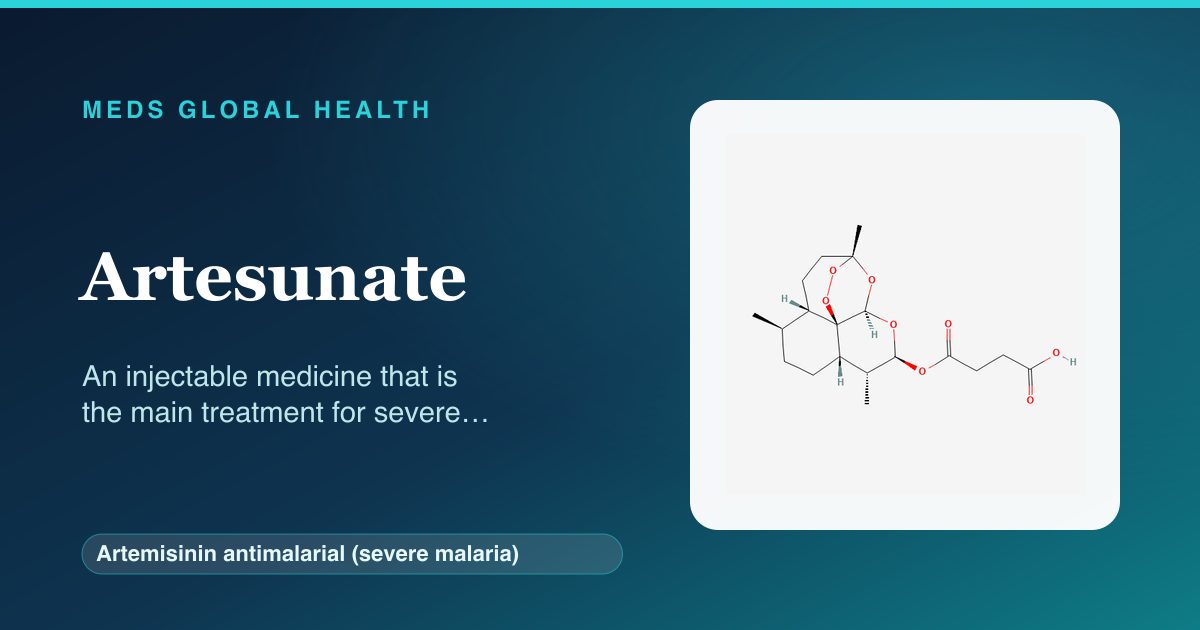
What it is
Artesunate is an antimalarial medicine from the artemisinin family. It is the main treatment for severe malaria, a serious and potentially life-threatening illness caused by malaria parasites spread through mosquito bites. Because severe malaria can worsen rapidly, artesunate is given by injection in hospital so it acts quickly and reliably. After the injectable course, treatment is usually completed with a full course of antimalarial tablets. It is a specialist medicine, started and supervised by hospital infection or tropical-disease teams.
How it works
Malaria parasites live and multiply inside red blood cells, and in severe malaria there are large numbers of them. Artesunate acts rapidly against these parasites, quickly reducing how many are in the blood and helping bring a dangerous infection under control faster than older treatments. Because it works fast and reliably when given by injection, it is the preferred treatment for severe disease. Once the person is improving, treatment is usually completed with a full course of antimalarial tablets to make sure the infection is fully cleared.
Company & origin
A specialist hospital medicine used in the UK as the main treatment for severe malaria, given by injection.
Practical use
How to take Artesunate
General, dose-free guidance — always follow your prescriber's and the leaflet's specific instructions.
- It is given by injection in hospital by the medical team; it is not something used at home.
- Complete the follow-on course of antimalarial tablets exactly as directed, even once you feel well.
- Attend all follow-up blood tests in the weeks after treatment to check for delayed anaemia.
- Report tiredness, breathlessness, pale skin or dark urine after treatment, as these can signal anaemia.
- Tell the team about other medicines and any health conditions so treatment is tailored safely.
Weighing it up
Advantages & disadvantages of Artesunate
Advantages
- The main and highly effective treatment for severe, life-threatening malaria.
- Works quickly to reduce the number of parasites in the blood.
- Given by injection in hospital, where the person can be watched closely.
Disadvantages
- Can be followed by delayed anaemia in the weeks afterwards, needing follow-up blood tests.
- Is a hospital-only injectable treatment, not for use at home.
- Needs to be followed by a full course of tablets to fully clear the infection.
Practical use
Good to know
The most important thing to understand about artesunate is that some people develop delayed haemolytic anaemia in the weeks after treatment, meaning red blood cells break down and blood counts fall even after they seem to have recovered. Because of this, the hospital team arranges follow-up blood tests for a period after treatment, and it is important to attend these and to report tiredness, breathlessness, pale skin or dark urine. Severe malaria itself is a medical emergency, so artesunate is given urgently in hospital and the person is watched closely. After the injectable course, a full course of tablets is usually needed to finish the job, and it is important to complete it even when feeling much better.
Who should not take it / use with caution
- People who have had a serious allergic reaction to artesunate or related artemisinin medicines should not be given it.
- It is used in pregnancy when severe malaria makes it necessary, as the danger of untreated severe malaria is high; this is judged by the specialist team.
- It is given under specialist hospital supervision, with care in people with other serious illnesses.
Monitoring
- Close monitoring in hospital while severe malaria is treated.
- Follow-up blood tests for weeks afterwards to check for delayed anaemia.
- Checking the infection clears fully after the follow-on tablet course.
Side effects
- Delayed breakdown of red blood cells (anaemia) in the weeks after treatment, which follow-up tests are designed to catch.
- Nausea, dizziness or a temporary feeling of being unwell.
- Rarely, allergic-type reactions or changes in liver or blood tests, watched for by the team.
Key interactions
- Tell the hospital team about all your medicines, as some can affect treatment or be affected by it.
- It is used alongside supportive hospital care for severe malaria, not on its own.
- The follow-on tablet course may have its own interactions, which the team will check.
Available as: A powder made up into a solution for injection, given in hospital.
Answers
Artesunate: frequently asked questions
What is artesunate used for?
It is the main treatment for severe malaria, a life-threatening infection spread by mosquito bites, and is given by injection in hospital.
Why do I need blood tests after I recover?
Some people develop delayed anaemia in the weeks after treatment, when red blood cells break down, so follow-up blood tests check for this even once you feel better.
Why do I also need tablets?
After the injectable course, a full course of antimalarial tablets is usually given to make sure the infection is completely cleared, so it is important to finish them.
Is artesunate given at home?
No. Severe malaria is a medical emergency, so artesunate is given by injection in hospital where you can be watched closely.
What symptoms should I report after treatment?
Report tiredness, breathlessness, pale skin or dark urine, as these can be signs of the delayed anaemia that can follow treatment.
Authoritative sources
- BNF
- NICE CKS
Building a medicines information resource?
We create evidence-led, dose-free drug and formulary references for teams.