A treatment for nonsense-mutation Duchenne muscular dystrophy
Ataluren
A specialist medicine for a particular genetic type of Duchenne muscular dystrophy in people who can still walk.
What is Ataluren?
Ataluren is a specialist medicine used for a specific genetic form of Duchenne muscular dystrophy caused by a so-called nonsense mutation, in children and young people who are still able to walk. It works by helping the body read past the faulty part of the gene so it can make some working dystrophin, the muscle protein that is missing. It is taken by mouth as granules mixed into liquid or soft food, several times a day. It is generally well tolerated, with stomach upset being among the more common effects.
Education and reference only. This is a plain-language guide to Ataluren — it deliberately contains no doses. Doses depend on the person, the brand and the reason for treatment, and belong with your prescriber. Always check the BNF, the product labelling (SmPC) and follow medical advice.
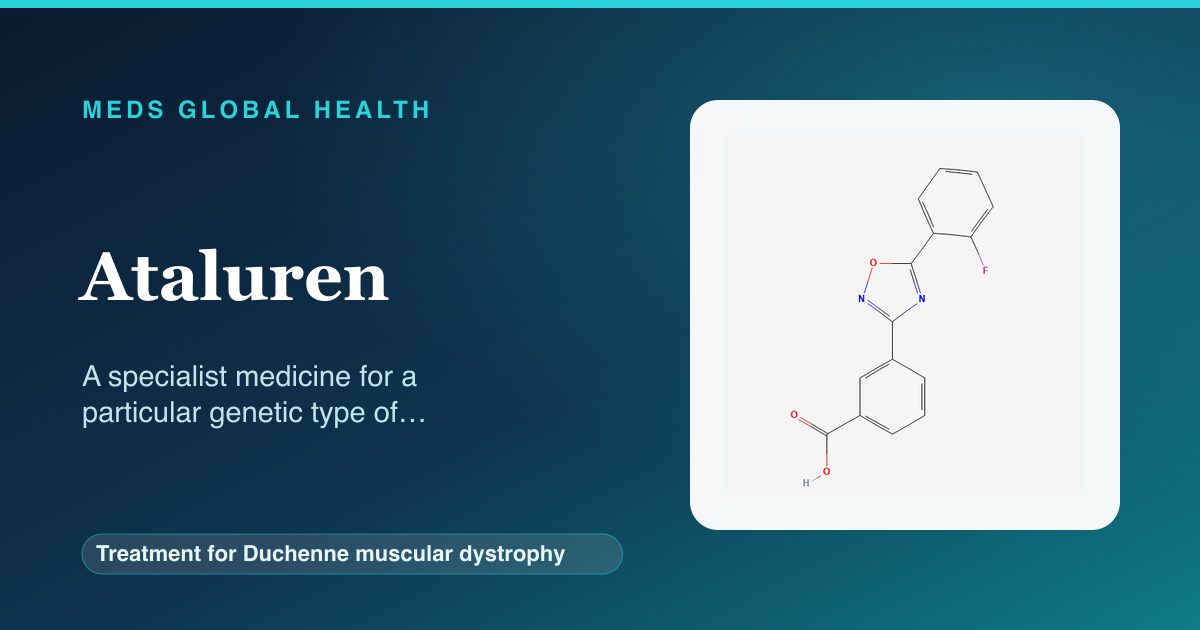
What it is
Ataluren is a medicine used for Duchenne muscular dystrophy, an inherited condition that causes progressive muscle weakness because the body cannot make a muscle protein called dystrophin. Ataluren is only for people whose condition is caused by a particular kind of genetic fault known as a nonsense mutation, confirmed by a genetic test, and who are still able to walk. It is taken by mouth as granules that are mixed into a drink or soft food. It is prescribed and supervised by a specialist neuromuscular team as part of wider care.
How it works
In Duchenne muscular dystrophy caused by a nonsense mutation, a faulty 'stop' signal appears too early in the gene, so the body stops making the dystrophin protein before it is complete. Ataluren helps the cell's machinery read past this premature stop signal, so it can produce some working dystrophin. Even a modest amount of this protein may help muscles work a little better and slow the loss of muscle function. It is taken several times a day, every day, because it needs to be present continuously to keep helping the body make the protein.
Company & origin
A specialist medicine used in the UK for a particular genetic form of Duchenne muscular dystrophy in people who can still walk.
Practical use
How to take Ataluren
General, dose-free guidance — always follow your prescriber's and the leaflet's specific instructions.
- Take it by mouth as granules mixed into a drink or soft food, exactly as prescribed.
- Spread the doses across the day as directed, including the night-time dose, and try to keep to the routine.
- Mix the granules just before taking them and take the whole amount.
- Continue your other care, such as steroids and physiotherapy, alongside it as advised.
- Keep up with your specialist appointments so progress and blood tests can be reviewed.
Weighing it up
Advantages & disadvantages of Ataluren
Advantages
- Targets the underlying genetic cause in a specific type of Duchenne muscular dystrophy.
- May help slow the loss of muscle function in suitable children and young people who can still walk.
- Generally well tolerated, with mostly mild side effects.
Disadvantages
- Only works for the specific nonsense-mutation form, so it is not suitable for everyone.
- Needs to be taken several times a day, including at night, as granules mixed into food or drink.
- Is used as part of wider care rather than as a stand-alone cure.
Practical use
Good to know
Ataluren only works for the specific nonsense-mutation type of Duchenne muscular dystrophy, so a genetic test is needed first to confirm it is the right treatment. It is taken as granules mixed into liquid or soft food and is spread across the day, including a dose at night, so building it into the daily routine matters. It is generally well tolerated, and the most common effects are mild, such as stomach upset, headache or tiredness. It is used as part of a broader care plan that often includes steroids, physiotherapy and other support, rather than on its own. The specialist team monitors how the condition is progressing and reviews whether the medicine should continue, including watching kidney-related blood tests in some cases.
Who should not take it / use with caution
- People who have had a serious allergic reaction to ataluren should not take it.
- It is not suitable for forms of Duchenne muscular dystrophy not caused by a nonsense mutation.
- Care is taken in people with kidney problems, with monitoring as advised.
- It should only be used under specialist neuromuscular care.
Monitoring
- Reviewing how muscle function and the ability to walk change over time.
- Checking kidney-related blood tests where advised.
- Reviewing whether the medicine should continue as the condition progresses.
Side effects
- Stomach upset, such as nausea, vomiting or tummy pain.
- Headache or tiredness.
- Changes in some blood tests, including those linked to the kidneys, which are monitored.
- Generally well tolerated overall, with most effects being mild.
Key interactions
- Care is needed with certain other medicines, such as some antibiotics given into a vein, so tell your team everything that is being taken.
- Care is needed with medicines that can affect the kidneys.
- It is used alongside other Duchenne treatments under specialist guidance.
Available as: Granules taken by mouth after mixing into liquid or soft food.
Answers
Ataluren: frequently asked questions
What is ataluren used for?
It is used for a specific genetic form of Duchenne muscular dystrophy caused by a nonsense mutation, in children and young people who are still able to walk.
How do I know if it is right for me?
A genetic test is needed first to confirm the condition is caused by a nonsense mutation, as ataluren only works for that particular type.
How is it taken?
It is taken as granules mixed into a drink or soft food, spread across the day including a night-time dose, exactly as your specialist directs.
Is it well tolerated?
It is generally well tolerated, with mostly mild side effects such as stomach upset, headache or tiredness.
Does it replace other treatments?
No. It is used as part of wider care that often includes steroids, physiotherapy and other support, rather than on its own.
Authoritative sources
- BNF
- NICE CKS
Building a medicines information resource?
We create evidence-led, dose-free drug and formulary references for teams.