An antimuscarinic used for slow heart rates, poisoning and drying secretions
Atropine
An antimuscarinic medicine used for very slow heart rates, as an antidote to organophosphate or nerve-agent poisoning, and to dry secretions.
What is Atropine?
Atropine is an antimuscarinic medicine with several uses: it speeds up a dangerously slow heart rate, acts as an antidote in organophosphate (pesticide) or nerve-agent poisoning, and dries up excess secretions, for example during surgery or at the end of life. It is also used as eye drops to widen the pupil. Because it blocks the calming nerve signals of the body, its typical effects are a faster heartbeat, dry mouth, blurred vision and difficulty passing urine. It is used with caution in people with glaucoma, an enlarged prostate or certain heart problems.
Education and reference only. This is a plain-language guide to Atropine — it deliberately contains no doses. Doses depend on the person, the brand and the reason for treatment, and belong with your prescriber. Always check the BNF, the product labelling (SmPC) and follow medical advice.
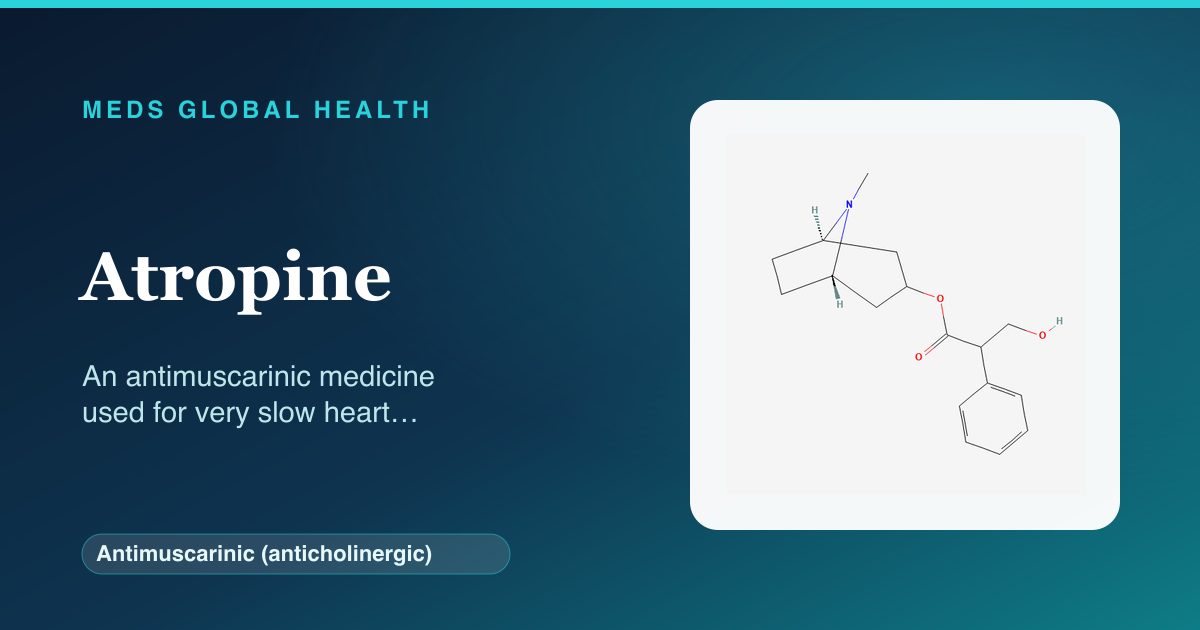
What it is
Atropine is a long-established antimuscarinic (also called anticholinergic) medicine that blocks some of the body's automatic nerve signals. It is used in several different situations: to speed up the heart when it is beating dangerously slowly, as an antidote in poisoning by organophosphate pesticides or nerve agents, and to dry up troublesome secretions, such as during anaesthesia or at the end of life. As eye drops it widens the pupil for eye examinations or to rest the eye. Depending on the use, it is given as an injection, by mouth or as eye drops, usually by or under the direction of healthcare staff.
How it works
Atropine blocks the action of acetylcholine, a chemical messenger that drives many of the body's 'rest and digest' activities. By blocking it, atropine speeds up the heart, reduces saliva and other secretions, relaxes the gut and bladder, and widens the pupil. In organophosphate or nerve-agent poisoning, the body is flooded with acetylcholine, causing dangerous wetness, slow heart rate and breathing problems; atropine counteracts this by blocking those effects. The same blocking action explains its typical side effects, such as dry mouth, blurred vision, a fast heartbeat and difficulty passing urine.
Company & origin
A long-established medicine used in the UK for very slow heart rates, as an antidote to certain poisonings, to dry secretions, and as eye drops.
Practical use
How to take Atropine
General, dose-free guidance — always follow your prescriber's and the leaflet's specific instructions.
- It is usually given by healthcare staff as an injection, or used as prescribed eye drops or by mouth.
- Expect effects such as a dry mouth, blurred vision and a faster heartbeat, which come from how it works.
- After eye drops, avoid driving until vision is clear, as it can blur sight and cause light sensitivity.
- Tell staff if you have glaucoma, an enlarged prostate or trouble passing urine, or heart problems.
- In poisoning, it is given and repeated by trained staff who monitor you closely.
Weighing it up
Advantages & disadvantages of Atropine
Advantages
- Quickly speeds up a dangerously slow heart rate when needed.
- Acts as a life-saving antidote in organophosphate or nerve-agent poisoning.
- Effectively dries up troublesome secretions and, as eye drops, widens the pupil for eye care.
Disadvantages
- Commonly causes dry mouth, blurred vision, a fast heartbeat and difficulty passing urine.
- Can raise pressure in the eye and worsen certain types of glaucoma.
- Older people can be more sensitive, including becoming confused.
Practical use
Good to know
It helps to know that atropine's main effects and side effects are two sides of the same coin: blocking the body's calming nerve signals is exactly what makes it useful but also causes a dry mouth, blurred vision, a fast heartbeat and difficulty passing urine. In poisoning, large and repeated amounts may be needed and are given by trained staff watching closely. As eye drops, the blurring and light sensitivity can last a while, so driving may be unsafe afterwards. It is used with particular caution in people with the eye condition glaucoma (where it can raise pressure in the eye), an enlarged prostate or other causes of difficulty passing urine, and certain heart conditions. Older people can be more sensitive to its effects, including confusion.
Who should not take it / use with caution
- People with certain types of glaucoma, where it can raise pressure in the eye (in non-emergency use).
- People with an enlarged prostate or other causes of difficulty passing urine, used with caution.
- People with certain fast or irregular heart rhythms, used with caution.
- People who have had a serious allergic reaction to atropine should not be given it.
Monitoring
- Watching heart rate and rhythm when it is used for a slow heart.
- In poisoning, monitoring secretions, breathing and heart rate to guide repeated doses.
- Watching for difficulty passing urine, blurred vision or confusion, especially in older people.
Side effects
- Dry mouth, blurred vision and sensitivity to light.
- A faster heartbeat or palpitations.
- Difficulty passing urine and constipation.
- In larger amounts or in older people, confusion, agitation, flushing or overheating.
Key interactions
- Other antimuscarinic medicines add to its drying and other effects.
- Some heart medicines can interact with its effect on heart rate.
- Tell your prescriber about all your medicines, as several can add to or change its effects.
Available as: A solution for injection, eye drops, and tablets, depending on the use.
Answers
Atropine: frequently asked questions
What is atropine used for?
It is used to speed up a very slow heart rate, as an antidote in organophosphate or nerve-agent poisoning, to dry up secretions, and as eye drops to widen the pupil.
Why does it cause a dry mouth and blurred vision?
It blocks the body's calming nerve signals, which dries secretions and affects the eye's focusing, so a dry mouth and blurred vision are common effects.
Can I drive after atropine eye drops?
Not until your vision clears, as the drops can blur sight and cause sensitivity to light for some time.
Why is it used carefully in glaucoma?
In certain types of glaucoma it can raise the pressure inside the eye, so it is used with caution and your eye condition should be mentioned.
How does it help in poisoning?
In organophosphate or nerve-agent poisoning the body is flooded with a nerve chemical; atropine blocks its harmful effects, and trained staff give and repeat it while watching closely.
Authoritative sources
- BNF
- NICE CKS
Building a medicines information resource?
We create evidence-led, dose-free drug and formulary references for teams.