An oral gold medicine for rheumatoid arthritis
Auranofin
An older gold-containing tablet used as a disease-modifying treatment for rheumatoid arthritis.
What is Auranofin?
Auranofin is an older disease-modifying medicine for rheumatoid arthritis that contains gold and is taken as a tablet. It works slowly to dampen the joint inflammation of rheumatoid arthritis, helping reduce pain, swelling and long-term joint damage. Diarrhoea and other tummy upset are common. Because it can affect the blood count, kidneys and liver, and cause skin and mouth reactions, regular blood and urine tests are needed. It works gradually over weeks to months, so it is taken regularly rather than for quick relief, and is used much less often now that newer treatments are available.
Education and reference only. This is a plain-language guide to Auranofin — it deliberately contains no doses. Doses depend on the person, the brand and the reason for treatment, and belong with your prescriber. Always check the BNF, the product labelling (SmPC) and follow medical advice.
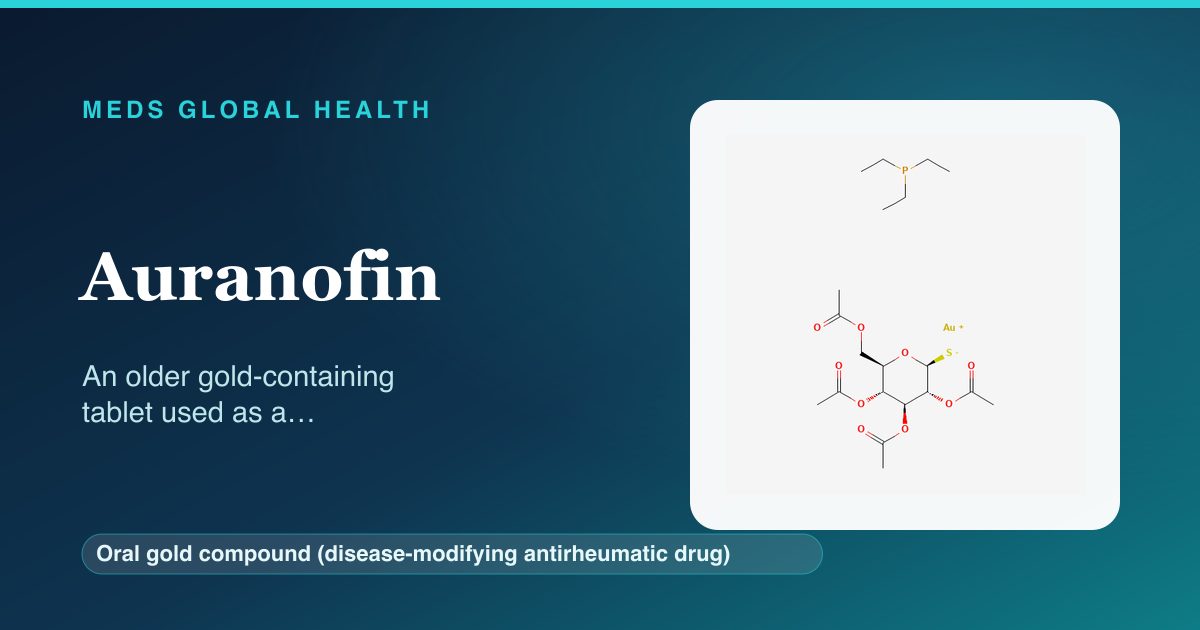
What it is
Auranofin is a disease-modifying antirheumatic medicine, a group of treatments that work on the underlying disease process in conditions like rheumatoid arthritis rather than just easing symptoms. It is unusual in that it contains gold, and unlike older gold treatments that were injected, it is taken by mouth as a tablet. It is used to treat rheumatoid arthritis, an autoimmune condition where the immune system attacks the joints. It is an older option, used much less often now that newer disease-modifying medicines are available, and is prescribed under specialist (rheumatology) supervision.
How it works
In rheumatoid arthritis, the immune system mistakenly attacks the joints, causing inflammation, pain, swelling and, over time, joint damage. Auranofin dampens this overactive immune activity, gradually reducing inflammation and helping protect the joints. Because it works on the disease process rather than just masking pain, its benefit builds up slowly over weeks to months, which is why it is taken regularly and not as needed. The same effects on the body that calm inflammation also mean it can affect the blood, kidneys and liver, which is why monitoring is important.
Company & origin
An older oral gold-containing medicine used in the UK as a disease-modifying treatment for rheumatoid arthritis.
What it treats
Conditions Auranofin is used for
Practical use
How to take Auranofin
General, dose-free guidance — always follow your prescriber's and the leaflet's specific instructions.
- Take the tablets by mouth regularly as prescribed, even though the benefit builds up slowly.
- Keep going during the first weeks to months while you wait for the effect, unless told to stop.
- Attend all your blood and urine tests, as these check for effects on the blood, kidneys and liver.
- Report rashes, mouth ulcers, easy bruising, sore throat, fever or unusual symptoms promptly.
- Tell your team if diarrhoea is troublesome, as this is a common side effect that can sometimes be managed.
Weighing it up
Advantages & disadvantages of Auranofin
Advantages
- Works on the underlying disease of rheumatoid arthritis, helping reduce inflammation and protect joints.
- Taken as a tablet by mouth, unlike older injected gold treatments.
- A long-established option with decades of experience behind its use.
Disadvantages
- Diarrhoea and other tummy upset are common.
- Can affect the blood count, kidneys and liver, and cause skin and mouth reactions, so regular monitoring is needed.
- Works slowly and is used much less often now that newer treatments are available.
Practical use
Good to know
It helps to know that auranofin works slowly, so it may take weeks to months before you notice the benefit, and you should keep taking it during that time rather than expecting fast relief. The most common nuisance side effect is diarrhoea and other tummy upset, which often eases but should be mentioned if troublesome. Because gold medicines can affect the blood count, kidneys and liver, and can cause skin rashes and mouth ulcers, regular blood and urine tests are an essential part of treatment, and you should report rashes, mouth ulcers, easy bruising, sore throat, fever or any unusual symptoms promptly. It is an older treatment used much less often today, so it is usually overseen by a rheumatology team who will monitor you closely.
Who should not take it / use with caution
- People who have had a serious allergic reaction to auranofin or other gold medicines should not take it.
- It is avoided in people with certain blood, kidney or liver problems, or some inflammatory bowel and skin conditions.
- It is generally avoided in pregnancy and breastfeeding and used only under specialist guidance.
Monitoring
- Regular blood tests to check the blood count and liver.
- Regular urine tests to check the kidneys (for protein in the urine).
- Watching for skin rashes, mouth ulcers and other side effects, and how well the arthritis responds.
Side effects
- Diarrhoea and other tummy upset, which is common.
- Skin rashes and itching, and mouth ulcers or a metallic taste.
- Less commonly, effects on the blood count, kidneys (shown by protein in the urine) or liver, which monitoring is designed to catch.
Key interactions
- Tell your team about all your medicines, as some can add to effects on the blood, kidneys or liver.
- Care is needed alongside other medicines that affect the immune system or blood counts.
- Always give your rheumatology team a full medicines list, including anything bought over the counter.
Available as: Tablets taken by mouth.
Answers
Auranofin: frequently asked questions
What is auranofin used for?
It is an older disease-modifying medicine for rheumatoid arthritis, an autoimmune condition affecting the joints; it contains gold and is taken as a tablet.
How long does it take to work?
It works slowly, often over weeks to months, so it is important to keep taking it regularly rather than expecting quick relief.
Why do I need regular blood and urine tests?
Gold medicines can affect the blood count, kidneys and liver, so regular tests catch any problems early and keep treatment safe.
Is diarrhoea normal with it?
Diarrhoea and other tummy upset are common; tell your team if it is troublesome, as it can sometimes be managed.
What should I report straight away?
Report rashes, mouth ulcers, easy bruising, sore throat, fever or any unusual symptoms promptly, as these can be signs of side effects.
Authoritative sources
- BNF
- NICE CKS
Building a medicines information resource?
We create evidence-led, dose-free drug and formulary references for teams.