A targeted kinase inhibitor for GIST and advanced mastocytosis
Avapritinib
A targeted cancer tablet for certain GIST tumours and advanced systemic mastocytosis, with a particular risk of bleeding.
What is Avapritinib?
Avapritinib is a specialist targeted cancer medicine, a kinase inhibitor, used for certain gastrointestinal stromal tumours (GIST) that carry a particular gene change and for advanced forms of systemic mastocytosis. It is taken as a tablet under the care of a cancer specialist. Its most important risk is bleeding, including, uncommonly, bleeding into the brain, so any signs of bleeding must be reported urgently. It can also cause effects on thinking and memory and fluid build-up (swelling). It is a specialist medicine that needs careful monitoring.
Education and reference only. This is a plain-language guide to Avapritinib — it deliberately contains no doses. Doses depend on the person, the brand and the reason for treatment, and belong with your prescriber. Always check the BNF, the product labelling (SmPC) and follow medical advice.
What it is
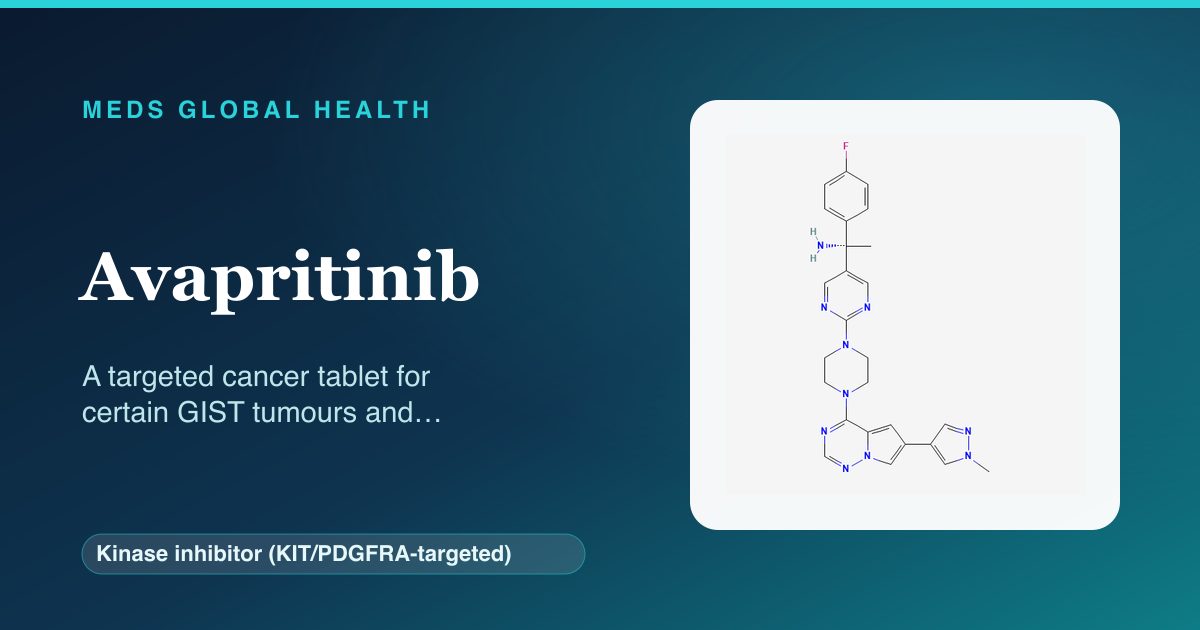
Avapritinib is a targeted cancer medicine known as a kinase inhibitor. It is designed to block specific faulty signals (from proteins called KIT and PDGFRA) that drive the growth of certain cancers. It is used for some gastrointestinal stromal tumours (GIST), a type of tumour in the digestive tract that carries a particular gene change, and for advanced forms of systemic mastocytosis, a condition in which too many mast cells build up in the body. It is taken by mouth as a tablet and is prescribed and closely supervised by a cancer specialist team.
How it works
Certain cancers grow because of faulty proteins, called KIT and PDGFRA, that send constant 'grow' signals to the cells. Avapritinib is a kinase inhibitor that blocks these faulty signals, which slows or stops the cancer cells from growing and dividing. By targeting these specific drivers, it is aimed at the underlying problem in tumours that carry the matching gene change, which is why testing for the right gene change helps decide who it suits. Because these signalling proteins also play roles elsewhere in the body, blocking them can lead to side effects such as bleeding, fluid build-up and effects on thinking.
Company & origin
A specialist targeted cancer medicine used in the UK for certain gastrointestinal stromal tumours (GIST) and advanced systemic mastocytosis, given under cancer-specialist care.
Practical use
How to take Avapritinib
General, dose-free guidance — always follow your prescriber's and the leaflet's specific instructions.
- Take it by mouth exactly as your cancer specialist directs, at about the same time each day.
- Report any signs of bleeding straight away, such as a severe headache, unusual bruising, blood in vomit or stools, or weakness.
- Tell your team about any forgetfulness, confusion or trouble concentrating, as the dose may need adjusting.
- Avoid grapefruit and grapefruit juice, and give your team a full list of your medicines, as several interact with it.
- Use reliable contraception as advised, because it can harm an unborn baby.
Weighing it up
Advantages & disadvantages of Avapritinib
Advantages
- Targets the specific gene-driven signals behind certain GIST tumours and advanced systemic mastocytosis.
- Taken by mouth as a tablet rather than by infusion.
- Offers a treatment option for cancers that carry the matching gene change.
Disadvantages
- Carries an important risk of bleeding, including, uncommonly, bleeding into the brain.
- Can affect thinking and memory and cause fluid build-up and swelling.
- Needs close specialist monitoring and interacts with several medicines and with grapefruit.
Practical use
Good to know
The single most important thing to understand about avapritinib is its risk of bleeding. This ranges from nosebleeds and bruising to more serious internal bleeding and, uncommonly, bleeding into the brain, which can be very serious; any sign such as a sudden severe headache, weakness, confusion, vomiting blood, black stools or unusual bruising must be acted on urgently. It can also affect thinking and memory, causing forgetfulness, confusion or trouble concentrating, which should be reported as the dose may need changing. Fluid build-up causing swelling of the face, limbs or around the eyes is another known effect. Because it is a powerful targeted medicine, it needs regular monitoring, and it interacts with several other medicines and with grapefruit, so a full medicines list is important. It can harm an unborn baby, so reliable contraception is needed.
Who should not take it / use with caution
- People who have had a serious allergic reaction to avapritinib should not take it.
- It must not be used in pregnancy, as it can harm an unborn baby, and reliable contraception is needed.
- It is used with particular caution in people at higher risk of bleeding or with bleeding in the brain, under specialist judgement.
Monitoring
- Watching closely for any signs of bleeding, including symptoms that could suggest bleeding in the brain.
- Checking thinking and memory, and reviewing for swelling and fluid build-up.
- Regular blood tests and scans to follow the cancer and check for side effects.
Side effects
- Bleeding, from nosebleeds and easy bruising to more serious internal bleeding, including, uncommonly, bleeding into the brain.
- Effects on thinking and memory, such as forgetfulness, confusion or trouble concentrating.
- Fluid build-up causing swelling of the face, limbs or around the eyes.
- Tiredness, nausea, diarrhoea and changes in blood tests.
- Rarely, more serious reactions that need urgent specialist attention.
Key interactions
- Medicines that affect how the liver processes it can raise or lower its level, so some need avoiding or adjusting.
- Grapefruit and grapefruit juice can raise its level and should be avoided.
- Medicines that increase bleeding risk, such as some blood thinners, need careful review given its bleeding risk.
Available as: Tablets taken by mouth.
Answers
Avapritinib: frequently asked questions
What is avapritinib used for?
It is a targeted kinase inhibitor used for certain gastrointestinal stromal tumours (GIST) with a particular gene change and for advanced systemic mastocytosis.
What is its most important risk?
Its most important risk is bleeding, which can range from nosebleeds and bruising to serious internal bleeding and, uncommonly, bleeding into the brain.
Can it affect my memory or thinking?
Yes, it can cause forgetfulness, confusion or trouble concentrating; tell your team if you notice this, as the dose may need adjusting.
Why must I avoid grapefruit?
Grapefruit and grapefruit juice can raise the level of avapritinib in the body, which can increase side effects, so they should be avoided.
Is it safe in pregnancy?
No. It can harm an unborn baby, so it must not be used in pregnancy and reliable contraception is needed during treatment.
Authoritative sources
- BNF
- NICE CKS
Building a medicines information resource?
We create evidence-led, dose-free drug and formulary references for teams.