A tablet to raise low platelet counts
Avatrombopag
A tablet used to raise low platelet counts, helping reduce the risk of bleeding before a procedure or in long-term low-platelet conditions.
What is Avatrombopag?
Avatrombopag is a specialist tablet used to raise low platelet counts. It is used to prepare people with chronic liver disease for a planned procedure or operation where bleeding is a concern, and in some people with long-term immune thrombocytopenia (a condition where the immune system destroys platelets). It works by prompting the bone marrow to make more platelets. It is taken by mouth with food. The main safety concern is that raising platelets can increase the risk of blood clots, so the dose is matched carefully to the platelet count and not pushed higher than needed.
Education and reference only. This is a plain-language guide to Avatrombopag — it deliberately contains no doses. Doses depend on the person, the brand and the reason for treatment, and belong with your prescriber. Always check the BNF, the product labelling (SmPC) and follow medical advice.
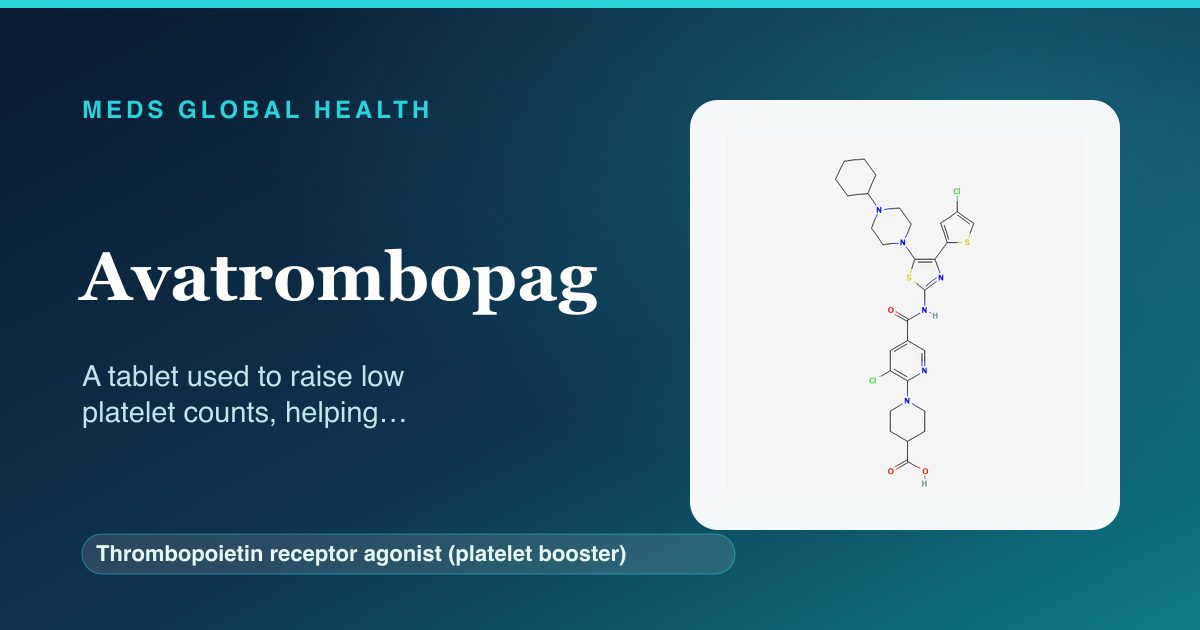
What it is
Avatrombopag is a medicine that boosts the number of platelets, the tiny blood cells that help blood to clot. It is used in two main situations: to raise platelets in people with chronic liver disease who need a planned procedure or operation, lowering the risk of bleeding; and to treat long-term immune thrombocytopenia in adults whose platelet counts stay low despite other treatments. It is taken by mouth as a tablet, with food, under specialist supervision. It is one of a group of medicines that copy the natural signal the body uses to make platelets.
How it works
Platelets are made in the bone marrow in response to a natural hormone called thrombopoietin. Avatrombopag acts on the same receptor that thrombopoietin uses, switching on the cells that produce platelets so more are released into the blood. This raises the platelet count over a number of days, which helps reduce the risk of bleeding. Because the goal is to bring platelets up to a safe level rather than as high as possible, the dose and timing are matched carefully to the situation, especially when it is used to prepare for a procedure.
Company & origin
A specialist medicine used in the UK to raise low platelet counts, for example before a planned procedure in people with chronic liver disease, or in some people with long-term immune thrombocytopenia.
Practical use
How to take Avatrombopag
General, dose-free guidance — always follow your prescriber's and the leaflet's specific instructions.
- Take the tablets by mouth with food, which helps the medicine be absorbed.
- When used before a procedure, start it the recommended number of days beforehand so platelets are at the right level on the day.
- Have your platelet count checked as arranged, so the dose can be matched to your needs.
- Do not take more than prescribed, as raising platelets too high can increase the risk of a blood clot.
- Report any signs of a clot, such as a swollen or painful leg, chest pain or sudden breathlessness, straight away.
Weighing it up
Advantages & disadvantages of Avatrombopag
Advantages
- An oral tablet that raises low platelet counts without the need for an injection.
- Can be taken with food, with fewer dietary restrictions than some similar medicines.
- Useful both to prepare people with liver disease for procedures and to manage long-term immune thrombocytopenia.
Disadvantages
- Raising platelets increases the risk of blood clots, so the dose must be controlled carefully.
- Needs platelet-count blood tests to guide treatment.
- When used before a procedure, the timing has to be planned in advance.
Practical use
Good to know
The most important thing to understand is that raising platelets also raises the chance of an unwanted blood clot, so the dose is set to reach a safe platelet level and no higher; pushing the count too high is avoided. Avatrombopag should be taken with food, which helps it be absorbed properly. When it is used before a planned procedure, the timing matters: it is started a set number of days beforehand so the platelets are at the right level on the day, and the procedure is usually carried out within a recommended window afterwards. Platelet counts are checked before and during treatment to guide the dose. Tell your team straight away about any signs of a clot, such as swelling or pain in a leg, chest pain or breathlessness.
Who should not take it / use with caution
- People who have had a serious allergic reaction to avatrombopag should not take it.
- It is used with caution in people who already have a high risk of blood clots, under specialist judgement.
- It should only be used under specialist supervision, with regular platelet monitoring.
Monitoring
- Platelet counts before and during treatment to guide the dose.
- Watching for signs of blood clots throughout treatment.
- Reviewing how well the platelet count responds, especially around a planned procedure.
Side effects
- Tiredness, headache or feeling generally unwell.
- Swelling, particularly of the ankles, or nausea and tummy upset.
- Less commonly but importantly, blood clots, which can be serious and need urgent attention.
Key interactions
- Some medicines that affect liver enzymes can change avatrombopag levels, so give a full medicines list.
- It is used with care alongside other medicines that affect clotting or bleeding.
- Tell your team about all your medicines, including anything bought over the counter.
Available as: Tablets taken by mouth with food.
Answers
Avatrombopag: frequently asked questions
What is avatrombopag used for?
It is used to raise low platelet counts, for example to prepare people with chronic liver disease for a procedure, or to treat long-term immune thrombocytopenia in some adults.
How does it work?
It copies a natural body signal that tells the bone marrow to make more platelets, so the platelet count rises over a few days.
Why must I take it with food?
Taking it with food helps the medicine be absorbed properly, so it is taken with a meal rather than on an empty stomach.
What is the main risk?
Raising platelets increases the chance of a blood clot, so the dose is set to reach a safe level and no higher, and you should report any signs of a clot straight away.
Why do I need blood tests?
Platelet counts are checked before and during treatment so the dose can be matched to your needs and the count is not raised too high.
Authoritative sources
- BNF
- NICE CKS
Building a medicines information resource?
We create evidence-led, dose-free drug and formulary references for teams.