An older, now obsolete anticonvulsant
Beclamide
An older, now obsolete anticonvulsant once used to help control seizures, now replaced by modern epilepsy medicines.
What is Beclamide?
Beclamide is an older anticonvulsant medicine that was once used to help control seizures. Its most notable effect was sedation, meaning it tended to cause drowsiness. It has long been superseded by modern epilepsy medicines that are more effective and better tolerated, so it is now obsolete and is essentially of historical interest rather than something prescribed today. If you have come across the name, it is most likely in older records or as background to the history of epilepsy treatment.
Education and reference only. This is a plain-language guide to Beclamide — it deliberately contains no doses. Doses depend on the person, the brand and the reason for treatment, and belong with your prescriber. Always check the BNF, the product labelling (SmPC) and follow medical advice.
What it is
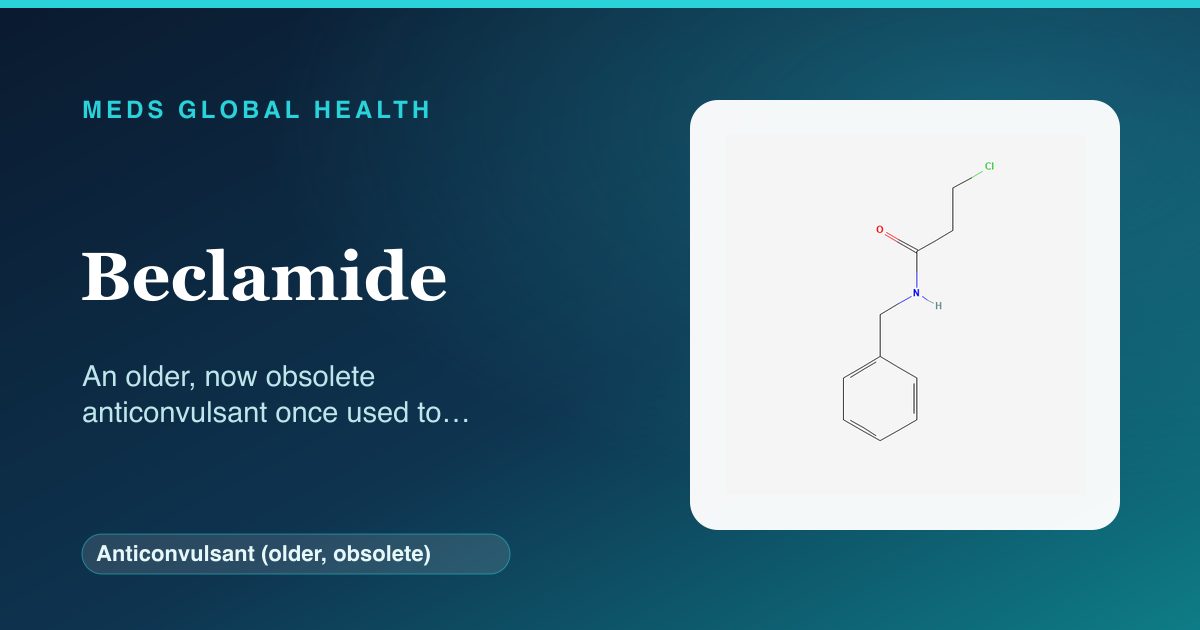
Beclamide is an older anticonvulsant, a type of medicine once used to help reduce seizures in epilepsy. It belongs to an early generation of epilepsy treatments and has since been replaced by modern medicines that control seizures more effectively and with fewer problems. As a result, beclamide is now considered obsolete and is not part of current epilepsy treatment in the UK. It is mentioned mainly for completeness and historical context rather than as a medicine that would be started today.
How it works
Like other anticonvulsants, beclamide was thought to work by calming overactive electrical activity in the brain, which is what drives a seizure. By dampening this excess activity, it aimed to make seizures less likely. However, its effect came alongside noticeable sedation, and it was less effective and less well tolerated than the medicines that followed it. Because the understanding of epilepsy and the range of available treatments have advanced so much, the way beclamide worked is now mainly of historical interest, and modern medicines are used instead.
Company & origin
An older anticonvulsant once used to help control seizures, now obsolete and replaced by modern epilepsy medicines; of mainly historical interest in the UK.
Practical use
How to take Beclamide
General, dose-free guidance — always follow your prescriber's and the leaflet's specific instructions.
- Beclamide is an obsolete medicine and is not prescribed in current epilepsy care, so there is no current way it is taken.
- If you have epilepsy, your treatment will be one of the modern anticonvulsants, taken exactly as your specialist directs.
- Never stop or change an epilepsy medicine suddenly, as this can trigger seizures; always seek your specialist's advice.
- If you come across beclamide in old records, ask your doctor or pharmacist to explain what it was used for.
- Discuss any historical medicines with your prescriber so your current treatment can be reviewed.
Weighing it up
Advantages & disadvantages of Beclamide
Advantages
- Was once an option to help control seizures before modern medicines were available.
- Taken by mouth rather than by injection.
- Of historical interest in showing how epilepsy treatment has developed over time.
Disadvantages
- Caused noticeable sedation and drowsiness.
- Less effective and less well tolerated than modern anticonvulsants.
- Now obsolete and no longer used in current epilepsy care.
Practical use
Good to know
The key thing to know about beclamide is that it is an obsolete medicine; it is not used in current epilepsy care, having been replaced by modern anticonvulsants that work better and cause fewer problems. Its most characteristic feature was sedation, so drowsiness was a common effect. If you see beclamide mentioned, it is almost certainly in older medical records, historical texts or discussions of how epilepsy treatment has changed over the years, rather than as a medicine anyone would be prescribed now. Anyone with epilepsy today would be offered one of the current, well-established treatments, chosen to suit their seizure type and circumstances, rather than an outdated medicine like this one.
Who should not take it / use with caution
- As an obsolete medicine, beclamide is not prescribed today, so it is not suitable for anyone in current practice.
- Anyone with epilepsy should use one of the modern, well-established anticonvulsants under specialist care instead.
- People who had a serious allergic reaction to it would, historically, not have been able to take it.
Monitoring
- Beclamide is no longer used, so there is no current monitoring associated with it.
- People on modern epilepsy medicines have their seizure control and side effects reviewed regularly.
- Any old records mentioning beclamide can be reviewed with a doctor to keep treatment up to date.
Side effects
- Sedation and drowsiness, which was its most characteristic effect.
- Stomach upset in some people.
- Other effects typical of older anticonvulsants, which are now mainly of historical record.
Key interactions
- As an obsolete medicine, its interactions are mainly of historical interest rather than current concern.
- Like other sedating medicines, it would have added to drowsiness with alcohol or other sedatives.
- Anyone taking modern epilepsy medicines should give their prescriber a full medicines list, as those can interact.
Available as: Tablets taken by mouth (historical).
Answers
Beclamide: frequently asked questions
What was beclamide used for?
It was an older anticonvulsant once used to help control seizures in epilepsy, before being replaced by modern medicines.
Is beclamide still used?
No. It is obsolete and is not part of current epilepsy treatment, having been superseded by modern anticonvulsants.
What was its main side effect?
Its most characteristic effect was sedation, meaning it tended to cause drowsiness.
Why was it replaced?
Modern epilepsy medicines control seizures more effectively and are better tolerated, so beclamide is no longer used.
What should I do if I see it in old records?
Ask your doctor or pharmacist to explain what it was used for, and have your current epilepsy treatment reviewed if needed.
Authoritative sources
- BNF
- NICE CKS
Building a medicines information resource?
We create evidence-led, dose-free drug and formulary references for teams.