A cholinergic medicine that helps the bladder and bowel empty
Bethanechol
A cholinergic medicine used to help the bladder, and sometimes the bowel, empty when they are not working well.
What is Bethanechol?
Bethanechol is a cholinergic medicine used to help the bladder empty when it is not emptying properly, in certain types of urinary retention that are not caused by a blockage, and sometimes to help a sluggish bowel after surgery. It works by stimulating the muscles of the bladder and bowel to contract. Its main drawbacks are cholinergic side effects such as sweating, stomach cramps, watery eyes, a slow heart rate and the urge to pass urine. It must not be used when there is a physical blockage, and is avoided in asthma, peptic ulcer disease and some heart conditions.
Education and reference only. This is a plain-language guide to Bethanechol — it deliberately contains no doses. Doses depend on the person, the brand and the reason for treatment, and belong with your prescriber. Always check the BNF, the product labelling (SmPC) and follow medical advice.
What it is
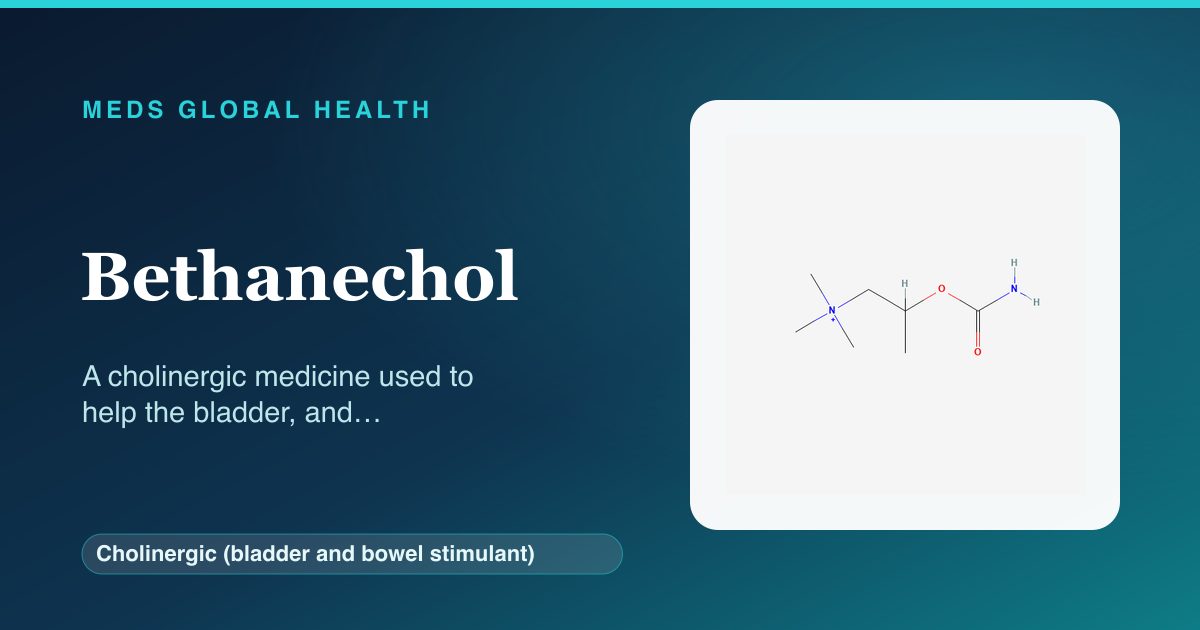
Bethanechol is a cholinergic medicine, meaning it acts like the body's own chemical that tells certain muscles to contract. It is used mainly to help the bladder empty in some forms of urinary retention where the bladder is underactive rather than blocked, and it is sometimes used to help the bowel get moving again, for example after an operation. It works on smooth muscle in the bladder and gut, encouraging it to squeeze and empty. It is taken by mouth and used under medical supervision because of its effects on the heart, gut and breathing.
How it works
Bethanechol mimics acetylcholine, a natural body chemical that signals certain muscles to contract. By acting on receptors in the bladder and bowel, it makes the muscle in their walls squeeze, helping them empty. This is useful when the bladder or bowel has become underactive and is not emptying on its own. Because the same kind of chemical signal also affects the heart, glands and airways, the medicine can also slow the heart, increase sweating and saliva, and tighten the airways, which is why it must be used carefully in certain conditions.
Company & origin
A cholinergic medicine used in the UK to help the bladder empty in certain types of urinary retention, and sometimes to help a sluggish bowel.
Practical use
How to take Bethanechol
General, dose-free guidance — always follow your prescriber's and the leaflet's specific instructions.
- Take it by mouth exactly as prescribed, usually on an empty stomach to reduce nausea.
- It must not be used if there is a physical blockage of the bladder or bowel.
- Tell your prescriber if you have asthma, a stomach ulcer, or a heart condition before starting.
- Be near a toilet after taking it, as it can cause a sudden, strong urge to pass urine.
- Report faintness, severe cramps, wheezing or a very slow heartbeat.
Weighing it up
Advantages & disadvantages of Bethanechol
Advantages
- Helps an underactive bladder empty when it is not emptying properly, avoiding the need for a catheter in some cases.
- Can help get a sluggish bowel moving again, for example after surgery.
- Taken by mouth and acts on the bladder and bowel muscle directly.
Disadvantages
- Commonly causes cholinergic effects such as sweating, cramps, watery eyes and the urge to pass urine.
- Can slow the heart and tighten the airways, so it is unsuitable in some heart and lung conditions.
- Must never be used when there is a physical blockage of the bladder or bowel.
Practical use
Good to know
The key safety point is that bethanechol must never be used when the bladder or bowel cannot empty because of a physical blockage, as forcing the muscle to squeeze against an obstruction can cause serious harm. Because it stimulates the same system throughout the body, it commonly causes cholinergic effects such as sweating, watery eyes, increased saliva, stomach cramps, nausea, a strong urge to pass urine and a slow heart rate. For these reasons it is avoided or used with great care in people with asthma (it can tighten the airways), peptic ulcer disease (it increases stomach acid and movement), and certain heart conditions. It is usually taken on an empty stomach to reduce nausea, and any faintness, severe cramps, wheeze or very slow heartbeat should be reported.
Who should not take it / use with caution
- People with a physical blockage of the bladder or bowel must not use it.
- It is avoided in people with asthma, as it can tighten the airways.
- It is avoided in people with peptic ulcer disease, an overactive thyroid, or certain heart conditions such as a very slow heart rate.
Monitoring
- Checking how well the bladder or bowel is emptying.
- Watching for cholinergic side effects such as a slow heart rate or wheezing.
- Reviewing whether continued treatment is needed.
Side effects
- Sweating, watery eyes and increased saliva.
- Stomach cramps, nausea or diarrhoea.
- A strong, sudden urge to pass urine.
- A slow heart rate, faintness, or wheezing, which should be reported.
Key interactions
- Other cholinergic medicines can add to its effects and side effects.
- Some medicines used for the bladder or stomach work in the opposite way and may reduce its effect.
- Certain heart and blood-pressure medicines can add to slowing of the heart, so tell your prescriber what you take.
Available as: Tablets taken by mouth.
Answers
Bethanechol: frequently asked questions
What is bethanechol used for?
It is used to help the bladder empty in some types of urinary retention that are not caused by a blockage, and sometimes to help a sluggish bowel get moving again.
How does it work?
It mimics a natural body chemical that tells muscle to contract, making the muscle in the bladder and bowel squeeze so they empty more effectively.
Why must there be no blockage?
If the bladder or bowel is physically blocked, making the muscle squeeze harder against the obstruction can cause serious harm, so it must not be used in that situation.
What side effects are common?
It can cause sweating, watery eyes, more saliva, stomach cramps, a strong urge to pass urine and a slow heart rate, because it stimulates the same system throughout the body.
Why is it avoided in asthma?
Bethanechol can tighten the airways, which can be dangerous in asthma, so it is avoided or used only with great care in people with asthma.
Authoritative sources
- BNF
- NICE CKS
Building a medicines information resource?
We create evidence-led, dose-free drug and formulary references for teams.