An older, now obsolete blood-pressure medicine
Bethanidine
An older, now obsolete blood-pressure medicine notable for causing severe dizziness on standing, now replaced by modern treatments.
What is Bethanidine?
Bethanidine is an older blood-pressure medicine, a type called an adrenergic-neurone blocker, once used to treat high blood pressure. Its most notable problem was severe postural hypotension, meaning a sharp drop in blood pressure when standing up that could cause dizziness or fainting. Because of this and the arrival of safer, easier-to-use medicines, it is now obsolete and is essentially of historical interest. Anyone needing blood-pressure treatment today would be offered a modern medicine instead.
Education and reference only. This is a plain-language guide to Bethanidine — it deliberately contains no doses. Doses depend on the person, the brand and the reason for treatment, and belong with your prescriber. Always check the BNF, the product labelling (SmPC) and follow medical advice.
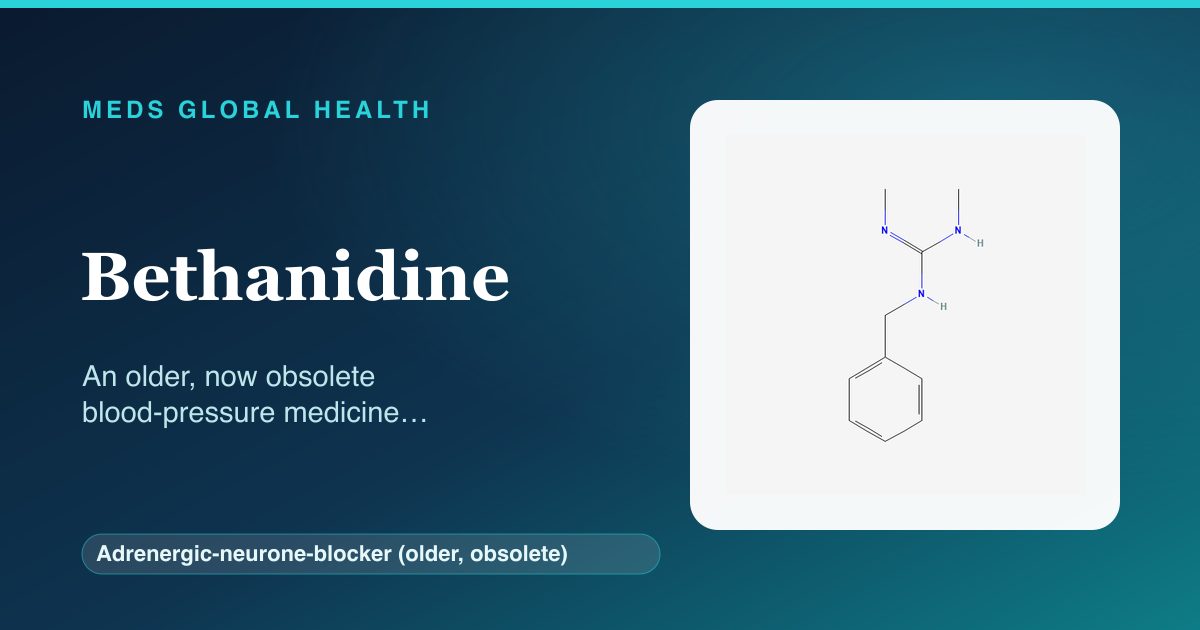
What it is
Bethanidine is an older medicine that was used to lower high blood pressure. It belongs to a group called adrenergic-neurone blockers, which work on the nervous system's control of blood vessels. It was used in an earlier era of blood-pressure treatment but has long been replaced by modern medicines that lower blood pressure more smoothly and with fewer troublesome effects. As a result, bethanidine is now considered obsolete and is not part of current treatment in the UK; it is mentioned mainly for historical context.
How it works
Bethanidine worked by interfering with the nerve signals that normally tighten blood vessels, which lowered blood pressure. The trouble was that this effect was hard to control and was strongly affected by body position: when a person stood up, blood pressure could fall sharply because the nervous system could not respond normally, causing dizziness or fainting. This severe postural drop in blood pressure was its defining drawback. Modern blood-pressure medicines lower pressure more steadily without this problem, which is why bethanidine and similar older medicines fell out of use.
Company & origin
An older blood-pressure medicine, an adrenergic-neurone blocker, once used for high blood pressure but now obsolete because of severe drops in blood pressure on standing; of mainly historical interest in the UK.
Practical use
How to take Bethanidine
General, dose-free guidance — always follow your prescriber's and the leaflet's specific instructions.
- Bethanidine is an obsolete medicine and is not used in current blood-pressure treatment, so there is no current way it is taken.
- If you need blood-pressure treatment, your medicine will be a modern one, taken exactly as your prescriber directs.
- Never stop or change a blood-pressure medicine suddenly without advice, as this can affect your blood pressure.
- Historically, people taking it were advised to stand up slowly to reduce dizziness from the drop in blood pressure.
- If you see bethanidine in old records, ask your doctor or pharmacist to explain it and review your current treatment.
Weighing it up
Advantages & disadvantages of Bethanidine
Advantages
- Was once an option to lower high blood pressure before modern medicines were available.
- Taken by mouth rather than by injection.
- Of historical interest in showing how high-blood-pressure treatment has developed.
Disadvantages
- Caused severe postural hypotension, a sharp drop in blood pressure on standing, with dizziness or fainting.
- Its effect was hard to control compared with modern medicines.
- Now obsolete and no longer used in current treatment.
Practical use
Good to know
The defining thing to know about bethanidine is that it caused severe postural hypotension, a sharp fall in blood pressure on standing that could lead to dizziness, light-headedness or fainting, which made it difficult and unsafe to use. This, together with the development of safer and more convenient blood-pressure treatments, is why it is now obsolete and no longer prescribed. If you come across the name bethanidine, it is most likely in older medical records or in discussions of how the treatment of high blood pressure has changed over time. Anyone with high blood pressure today would be offered one of the modern, well-established medicines, chosen to suit their circumstances, rather than an outdated medicine like this one.
Who should not take it / use with caution
- As an obsolete medicine, bethanidine is not prescribed today, so it is not suitable for anyone in current practice.
- Anyone with high blood pressure should use one of the modern, well-established medicines under medical care instead.
- People who had a serious allergic reaction to it would, historically, not have been able to take it.
Monitoring
- Bethanidine is no longer used, so there is no current monitoring associated with it.
- People on modern blood-pressure medicines have their blood pressure checked and reviewed regularly.
- Any old records mentioning bethanidine can be reviewed with a doctor to keep treatment up to date.
Side effects
- Severe postural hypotension, with dizziness or fainting on standing up, which was its defining problem.
- Tiredness or weakness.
- Other effects typical of older blood-pressure medicines, now mainly of historical record.
Key interactions
- As an obsolete medicine, its interactions are mainly of historical interest rather than current concern.
- Other medicines that lower blood pressure would have added to the risk of dizziness and fainting.
- Anyone on modern blood-pressure medicines should give their prescriber a full medicines list, as those can interact.
Available as: Tablets taken by mouth (historical).
Answers
Bethanidine: frequently asked questions
What was bethanidine used for?
It was an older medicine, an adrenergic-neurone blocker, once used to lower high blood pressure before modern treatments were available.
Is bethanidine still used?
No. It is obsolete and is not part of current treatment for high blood pressure, having been replaced by modern medicines.
What was its main problem?
Its defining problem was severe postural hypotension, a sharp drop in blood pressure on standing that could cause dizziness or fainting.
Why was it replaced?
Modern blood-pressure medicines lower pressure more smoothly and safely, so bethanidine is no longer used.
What should I do if I see it in old records?
Ask your doctor or pharmacist to explain what it was used for, and have your current blood-pressure treatment reviewed if needed.
Authoritative sources
- BNF
- NICE CKS
Building a medicines information resource?
We create evidence-led, dose-free drug and formulary references for teams.