A mild antiseptic used in some ear, eye and vaginal preparations
Boric acid
A mild antiseptic found in some ear, eye and vaginal preparations, used in limited ways because it can be toxic if swallowed or misused.
What is Boric acid?
Boric acid is a mild antiseptic that appears in some ear, eye and vaginal preparations. Its use is fairly limited because, although gentle when used correctly on small areas, it can be toxic if swallowed, or if used over large or broken areas of skin where it can be absorbed. It is not suitable for babies and is used with caution in young children. It should only be used as directed, on intact skin or the area it is intended for, and kept well away from where it could be swallowed.
Education and reference only. This is a plain-language guide to Boric acid — it deliberately contains no doses. Doses depend on the person, the brand and the reason for treatment, and belong with your prescriber. Always check the BNF, the product labelling (SmPC) and follow medical advice.
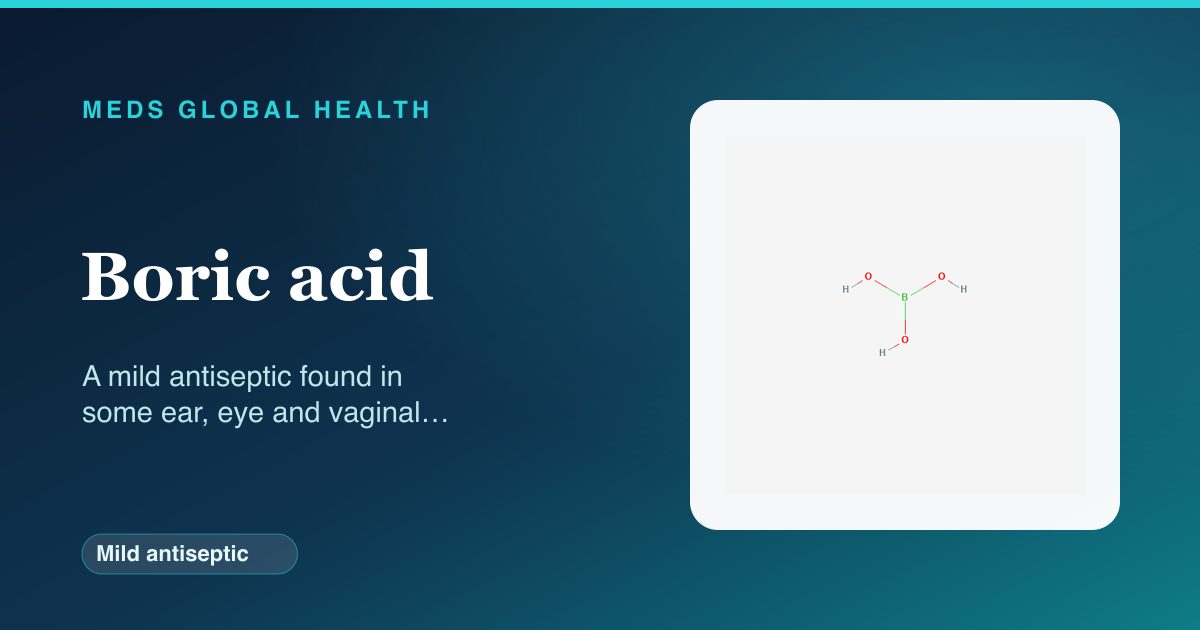
What it is
Boric acid is a mild antiseptic, meaning it helps discourage the growth of germs. It is found in some specific preparations, such as certain ear drops, eye washes and vaginal preparations, rather than being a widely used general antiseptic. Its use is deliberately limited because it can be harmful if it gets into the body in larger amounts, for example if swallowed or absorbed through large areas of broken skin. When used correctly, for its intended purpose and on small intact areas, it is generally well tolerated. It should always be used as directed.
How it works
Boric acid works as a mild antiseptic by creating conditions that make it harder for some germs, such as certain bacteria and yeasts, to grow. This is why it appears in some preparations aimed at keeping an area clean or settling certain mild infections. It is meant to act on the surface where it is applied rather than to be taken into the body. The problem is that if it is swallowed, or absorbed through large or broken areas, enough can build up inside the body to be harmful, which is why its use is kept limited and controlled.
Company & origin
A mild antiseptic used in the UK in some ear, eye and vaginal preparations, with limited use because it can be toxic if misused.
Practical use
How to take Boric acid
General, dose-free guidance — always follow your prescriber's and the leaflet's specific instructions.
- Use it only as directed for the specific preparation, on the area it is intended for.
- Never swallow it, and do not apply it to large or broken areas of skin where it can be absorbed.
- Do not use it on babies, and use it only with caution and advice in young children.
- Store it safely out of the reach of children, as it can be harmful if swallowed.
- Seek medical advice straight away if it is accidentally swallowed or if a large area is exposed.
Weighing it up
Advantages & disadvantages of Boric acid
Advantages
- A mild antiseptic that can help keep certain areas clean when used correctly.
- Used in some specific ear, eye and vaginal preparations.
- Generally well tolerated when used as directed on small, intact areas.
Disadvantages
- Can be toxic if swallowed or absorbed through large or broken areas of skin.
- Not suitable for babies and used with caution in young children.
- Has limited uses rather than being a general-purpose antiseptic.
Practical use
Good to know
The main thing to know about boric acid is that it is only mild and safe when used correctly, but can be toxic if misused. It must never be swallowed, and it should not be applied to large areas of broken or damaged skin, where enough can be absorbed to cause harm. It is not suitable for babies and is used cautiously in young children, who are more vulnerable to its effects. Because of all this, it tends to be used only in specific preparations and for specific purposes, rather than as a general-purpose antiseptic. Always follow the instructions for the particular preparation, use it only on the area it is intended for, store it safely out of reach of children, and seek medical advice if it is accidentally swallowed.
Who should not take it / use with caution
- It must not be used on babies, who are especially vulnerable to its effects.
- It must not be applied to large areas of broken or damaged skin, where enough can be absorbed to cause harm.
- People who have had a reaction to it should not use it, and it should be kept away from anyone who might swallow it.
Monitoring
- Checking that it is being used correctly, on the right area and not swallowed.
- Watching for signs of irritation or any reaction where it is applied.
- Seeking urgent advice if it is swallowed or used over a large or broken area.
Side effects
- Local irritation, stinging or redness where it is applied.
- If absorbed in larger amounts, more serious effects such as nausea, vomiting, rash or, in severe cases, harm to organs.
- Allergic-type reactions in some people.
Key interactions
- It is mainly used on the surface, so routine medicine interactions are uncommon.
- Combining it with other products on the same area may increase irritation, so follow instructions.
- Tell your pharmacist or prescriber about other treatments you are using on the same area.
Available as: Found in some ear drops, eye washes, dusting preparations and vaginal preparations.
Answers
Boric acid: frequently asked questions
What is boric acid used for?
It is a mild antiseptic found in some specific ear, eye and vaginal preparations, used to help keep an area clean or settle certain mild problems.
Is it safe?
It is generally safe when used correctly on small, intact areas, but it can be toxic if swallowed or absorbed through large or broken areas of skin.
Can it be used on babies?
No. It is not suitable for babies and is used only with caution and advice in young children, who are more vulnerable to its effects.
What should I do if it is swallowed?
Seek medical advice straight away, as swallowing it can be harmful; it should always be stored safely out of the reach of children.
Why is its use limited?
Because enough can build up in the body to be harmful if it is swallowed or absorbed, so it is used only in specific preparations and for specific purposes.
Authoritative sources
- BNF
- NICE CKS
Building a medicines information resource?
We create evidence-led, dose-free drug and formulary references for teams.