An old injectable medicine for dangerous heart rhythms
Bretylium
An old hospital-only injection once used for life-threatening fast heart rhythms; now largely obsolete.
What is Bretylium?
Bretylium is an older injectable antiarrhythmic medicine that was once used in hospital, usually in emergencies, to treat life-threatening fast heart rhythms arising from the lower chambers of the heart (ventricular arrhythmias) when other treatments had not worked. A characteristic and important effect is on blood pressure: it can cause severe low blood pressure, and it may briefly raise blood pressure and worsen the rhythm when first given before the rhythm settles. It is given only by specialists in a monitored setting with the heart rhythm and blood pressure watched closely. It is now largely obsolete and rarely, if ever, used in modern practice.
Education and reference only. This is a plain-language guide to Bretylium — it deliberately contains no doses. Doses depend on the person, the brand and the reason for treatment, and belong with your prescriber. Always check the BNF, the product labelling (SmPC) and follow medical advice.
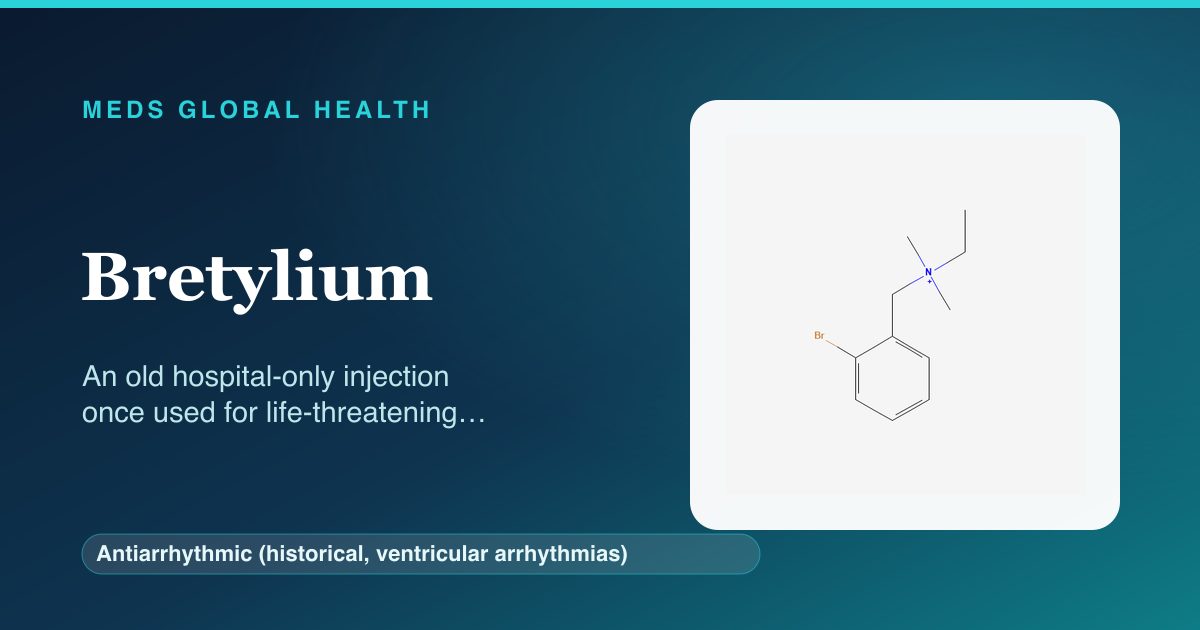
What it is
Bretylium is a medicine from an older generation of antiarrhythmic drugs, used to control dangerous fast heart rhythms that come from the ventricles, the lower pumping chambers of the heart. It was used in hospital emergencies, given by injection or drip, when life-threatening rhythms such as ventricular tachycardia or fibrillation had not responded to other treatments. Because of its strong effects on blood pressure and the heart, and because better and safer treatments are now available, it has become a historical medicine that is rarely used today. Any use was always under close specialist supervision with continuous heart and blood-pressure monitoring.
How it works
Bretylium acts on the electrical system of the heart and on the nerves that control blood vessels and the heartbeat. It changes how the heart's electrical signals recover between beats, which can help stop a dangerous repeating rhythm in the ventricles. At the same time, it affects the nerve endings that release the body's natural adrenaline-like chemicals, which is why it has a strong and sometimes unpredictable effect on blood pressure. When first given, there can be a brief rise in blood pressure and even a temporary worsening of the rhythm before its main effect takes over and blood pressure may then fall, sometimes severely.
Company & origin
An older injectable medicine once used in hospitals to treat life-threatening fast heart rhythms coming from the lower chambers of the heart.
Practical use
How to take Bretylium
General, dose-free guidance — always follow your prescriber's and the leaflet's specific instructions.
- It is given only in hospital, by injection or drip, by specialist staff; it is never taken at home.
- It is given with the heart rhythm and blood pressure monitored continuously throughout.
- It is usually given with the person lying down because of the risk of a sharp fall in blood pressure.
- The dose and timing are controlled entirely by the hospital team based on the heart's response.
- It is reserved for life-threatening rhythms that have not responded to other emergency treatments.
Weighing it up
Advantages & disadvantages of Bretylium
Advantages
- Could control some life-threatening ventricular rhythms that had not responded to other treatments.
- Worked through a different mechanism from many other antiarrhythmic medicines.
- Was an additional emergency option in a hospital setting at the time it was used.
Disadvantages
- Can cause severe low blood pressure, particularly on sitting or standing up.
- May briefly raise blood pressure and even worsen the rhythm when first given.
- Is now largely obsolete, replaced by safer and more reliable treatments.
Practical use
Good to know
The most important thing to understand about bretylium is its effect on blood pressure: it can cause severe low blood pressure, especially when standing or sitting up, and when first given it may briefly raise blood pressure and even make the rhythm worse before settling it. For this reason it was only ever used in a monitored hospital setting, usually with the person lying down and with the heart rhythm and blood pressure watched continuously. It is an emergency, last-resort type of medicine rather than something taken at home. In modern practice it has been replaced by other treatments and is regarded as largely obsolete, so most people will never encounter it. If it is ever mentioned, it is in the context of intensive hospital care under specialist control.
Who should not take it / use with caution
- People who have had a serious allergic reaction to bretylium should not be given it.
- It is used with extreme caution, if at all, in people who already have very low blood pressure.
- It should only ever be used in a monitored hospital setting under specialist supervision.
Monitoring
- Continuous monitoring of the heart rhythm while it is being used.
- Close and frequent monitoring of blood pressure, including on changing position.
- Watching for the early rise in blood pressure and any worsening of the rhythm after it is first given.
Side effects
- Severe low blood pressure, especially when sitting or standing up.
- A brief rise in blood pressure and possible temporary worsening of the heart rhythm when first given.
- Nausea and vomiting, particularly if it is given quickly.
- Dizziness or fainting linked to the drop in blood pressure.
Key interactions
- It can add to the blood-pressure-lowering effect of other medicines that lower blood pressure.
- It may interact with other medicines that affect the heart rhythm, so the full medicines list matters.
- Its effects can be altered by medicines acting on the body's adrenaline-like system, so use is specialist-controlled.
Available as: A solution given by injection or drip in hospital only.
Answers
Bretylium: frequently asked questions
What was bretylium used for?
It was an older injectable medicine used in hospital emergencies to treat life-threatening fast heart rhythms from the lower chambers of the heart when other treatments had not worked.
Why does it affect blood pressure so much?
It acts on the nerves controlling blood vessels and the heart, which can cause severe low blood pressure and, when first given, a brief rise in blood pressure before it settles.
Is bretylium still used?
It is now largely obsolete and rarely, if ever, used in modern practice, having been replaced by safer and more reliable treatments.
Could I take it at home?
No. It was only ever given in hospital by injection or drip, with the heart rhythm and blood pressure monitored continuously by specialist staff.
Why was the person kept lying down?
Because bretylium can cause a sharp fall in blood pressure on sitting or standing, people were usually kept lying down while it was being given.
Authoritative sources
- BNF
- NICE CKS
Building a medicines information resource?
We create evidence-led, dose-free drug and formulary references for teams.