A GnRH analogue that lowers sex hormones
Buserelin
A hormone medicine that lowers the body's sex hormones, used in prostate cancer, endometriosis and assisted conception.
What is Buserelin?
Buserelin is a hormone medicine, a GnRH analogue, that lowers the body's sex hormones such as testosterone or oestrogen. It is used in prostate cancer, where lowering testosterone helps slow the cancer, in endometriosis, where lowering oestrogen reduces symptoms, and as part of assisted conception such as IVF, where it helps control the timing of treatment. It is given as a nasal spray or as an injection. When first started it can briefly raise hormone levels, sometimes causing a short-lived 'flare' of symptoms, before levels fall. Side effects are mostly those of low sex hormones, such as hot flushes.
Education and reference only. This is a plain-language guide to Buserelin — it deliberately contains no doses. Doses depend on the person, the brand and the reason for treatment, and belong with your prescriber. Always check the BNF, the product labelling (SmPC) and follow medical advice.
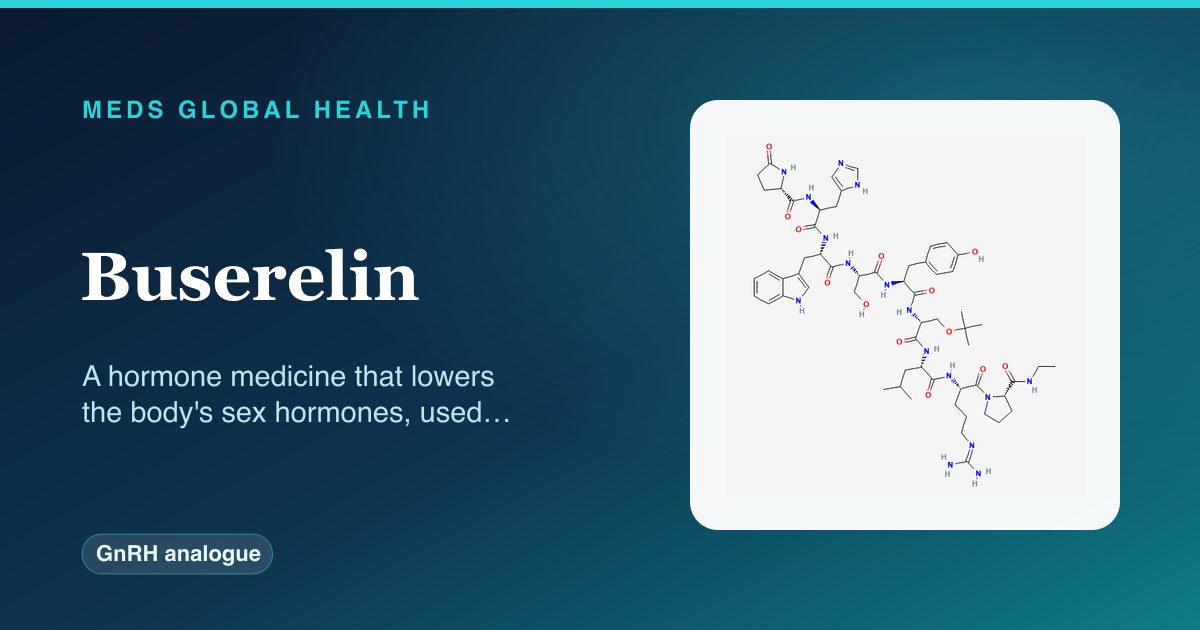
What it is
Buserelin is a man-made hormone known as a GnRH analogue. The body normally controls its sex hormones, testosterone in men and oestrogen in women, through signals from a gland in the brain. Buserelin works on that system to lower these hormones. It is used in several situations: in prostate cancer, which is often driven by testosterone; in endometriosis, where oestrogen feeds the condition; and as part of assisted conception, such as IVF, where carefully switching hormones off helps doctors control the treatment cycle. It is given either as a nasal spray or as an injection under the skin, under specialist care.
How it works
Buserelin acts on the gland in the brain that controls sex hormones. At first it stimulates that gland, which briefly raises hormone levels, but with continued use it switches the signal off, so the body makes much less testosterone or oestrogen. In prostate cancer, the resulting drop in testosterone helps slow a cancer that depends on it. In endometriosis, lower oestrogen calms the tissue that causes pain. In assisted conception, switching the natural hormones off lets the fertility team take precise control of the cycle. The early rise explains why symptoms can briefly flare when treatment starts.
Company & origin
A hormone medicine used in the UK to lower sex hormone levels in prostate cancer, endometriosis and as part of assisted conception such as IVF.
Practical use
How to take Buserelin
General, dose-free guidance — always follow your prescriber's and the leaflet's specific instructions.
- Use it exactly as prescribed, either as a nasal spray into the nose or as an injection, as your specialist team arranges.
- If you use the nasal spray, follow the instructions on how and when to spray, and ask for advice if your nose is very blocked.
- Do not stop it suddenly without advice, as it is usually part of a planned course of treatment.
- Expect that symptoms may briefly worsen when you first start, and report it if this is troublesome.
- Keep to your appointments, as treatment is monitored and its length is often planned in advance.
Weighing it up
Advantages & disadvantages of Buserelin
Advantages
- An effective way to lower sex hormones for prostate cancer, endometriosis and assisted conception.
- Available as a nasal spray as well as an injection, giving some choice in how it is taken.
- Its effect wears off after treatment stops, so hormone levels usually recover.
Disadvantages
- Can cause a short-lived 'flare' of symptoms when first started, as hormones briefly rise.
- Often causes menopause-like or low-testosterone effects such as hot flushes and reduced sex drive.
- With longer use, lower hormone levels can weaken the bones, so treatment length is watched.
Practical use
Good to know
An important thing to understand is the 'flare' that can happen at the start: because buserelin briefly raises hormones before lowering them, symptoms can get worse for a short time when it is first used, and in prostate cancer another medicine is often given around then to cover this. Most of its side effects come from having low sex hormones and feel like the menopause or low testosterone, including hot flushes, sweats, changes in mood and reduced sex drive. With longer use, lower oestrogen can weaken the bones, so in conditions like endometriosis the length of treatment is limited or protective 'add-back' hormones may be given. If you use the nasal spray, a blocked or runny nose can affect how much is absorbed, so follow the advice you are given. The specialist team will explain how long you will use it and what to expect.
Who should not take it / use with caution
- It must not be used in pregnancy, and pregnancy should be excluded before some uses; non-hormonal contraception may be advised.
- It is used with care in people at risk of weak bones (osteoporosis), as it can lower bone strength.
- People who have had a serious allergic reaction to buserelin or similar medicines should not use it.
- It should only be used under specialist supervision for the condition being treated.
Monitoring
- Reviewing how well the condition responds, such as cancer markers in prostate cancer or symptoms in endometriosis.
- Watching for menopause-like or low-testosterone side effects and managing them.
- Considering bone health with longer use, and using protective measures where needed.
Side effects
- Hot flushes, sweating and other menopause-like or low-testosterone effects.
- Changes in mood, headaches and reduced sex drive.
- Irritation of the nose with the nasal spray, and, with longer use, gradual weakening of the bones.
Key interactions
- It is generally used as a planned part of treatment, but tell your team about all your medicines.
- In prostate cancer it may be combined with another medicine to cover the early flare, under specialist guidance.
- Other hormone treatments and fertility medicines are timed carefully around it by the specialist team.
Available as: A nasal spray and a solution for injection under the skin.
Answers
Buserelin: frequently asked questions
What is buserelin used for?
It lowers the body's sex hormones and is used in prostate cancer, in endometriosis, and as part of assisted conception such as IVF to help control the treatment cycle.
Why might my symptoms get worse at first?
When first started, buserelin briefly raises hormone levels before lowering them, which can cause a short-lived 'flare' of symptoms; in prostate cancer another medicine is often given to cover this.
Is it a spray or an injection?
It can be given as a nasal spray or as an injection under the skin, depending on the condition and what your specialist team recommends.
What side effects should I expect?
Most side effects come from having low sex hormones, such as hot flushes, sweating, mood changes and reduced sex drive; longer use can also weaken the bones.
Will my hormones recover after I stop?
Yes, its effect wears off after treatment ends, so sex hormone levels usually return over time, though your specialist will advise on what to expect for your situation.
Authoritative sources
- BNF
- NICE CKS
Building a medicines information resource?
We create evidence-led, dose-free drug and formulary references for teams.