An injectable calcium salt, gentler on veins than calcium chloride
Calcium gluconate
An injectable calcium salt for low calcium, high potassium, magnesium toxicity and hydrofluoric-acid burns, gentler on veins than calcium chloride but still tissue-damaging if it leaks.
What is Calcium gluconate?
Calcium gluconate is an injectable calcium salt used in hospital to treat low blood calcium, to protect the heart when potassium is dangerously high, to counter the effects of too much magnesium, and to treat burns from hydrofluoric acid. It is gentler on the veins than calcium chloride, which is why it is often the preferred choice, but it can still cause tissue damage if it leaks out of the vein. It is given slowly into a vein with heart monitoring, and it can also be used as a gel on hydrofluoric-acid burns of the skin. It is handled by trained staff and, like calcium chloride, must not be mixed with bicarbonate.
Education and reference only. This is a plain-language guide to Calcium gluconate — it deliberately contains no doses. Doses depend on the person, the brand and the reason for treatment, and belong with your prescriber. Always check the BNF, the product labelling (SmPC) and follow medical advice.
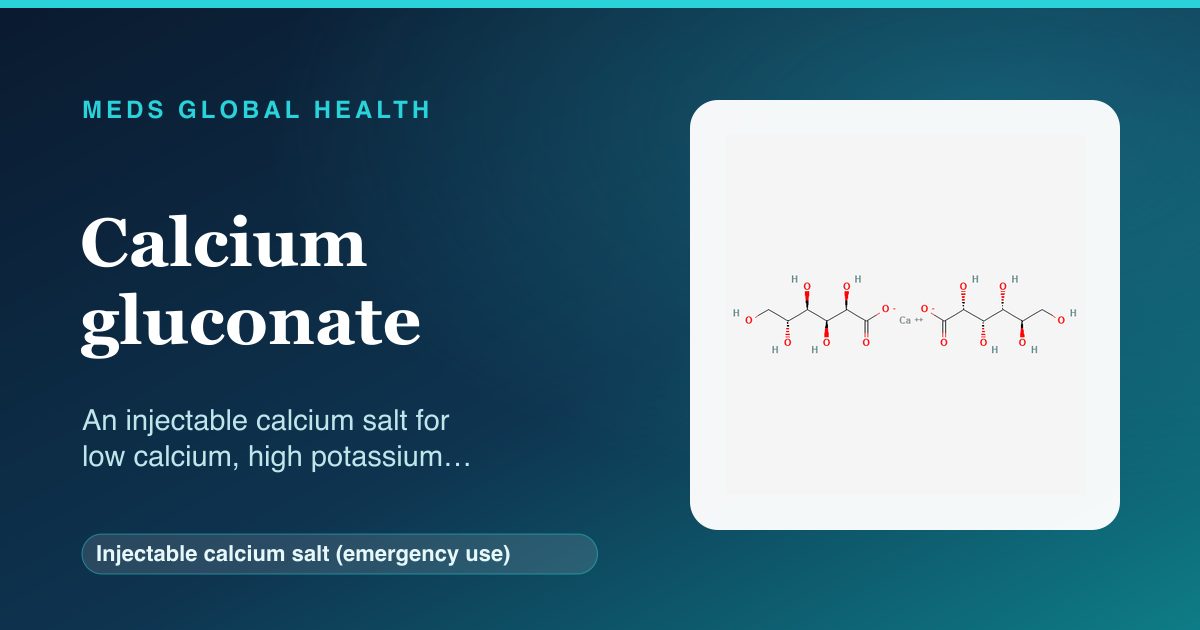
What it is
Calcium gluconate is an injectable form of calcium given into a vein, usually in hospital. It is used when blood calcium is too low, to steady the heart when potassium is dangerously high, to reverse the effects of too much magnesium (for example during treatment of certain pregnancy complications), and to treat painful burns caused by hydrofluoric acid, which can pull calcium out of the body. Compared with calcium chloride it is gentler on the veins, so it is often chosen when intravenous access is less secure. For skin burns from hydrofluoric acid it can also be applied as a gel. It is given by trained healthcare staff.
How it works
Calcium keeps nerves, muscles and especially the heart working normally. When blood calcium falls too low, or potassium rises too high, the heart's electrical activity can become unstable, and giving calcium restores and steadies it. In magnesium toxicity, calcium acts against magnesium's effects. In hydrofluoric-acid exposure, the acid binds and removes the body's calcium, so giving calcium replaces what is lost and neutralises the harm. It is given slowly into a vein with heart monitoring so its powerful effect on the heart can be watched and controlled.
Company & origin
An injectable calcium salt used in UK hospitals for low calcium, high potassium, magnesium toxicity and hydrofluoric-acid burns.
Practical use
How to take Calcium gluconate
General, dose-free guidance — always follow your prescriber's and the leaflet's specific instructions.
- It is given by trained hospital staff as an injection into a vein, not something you take yourself.
- It is given slowly and with heart monitoring, because giving it too fast can disturb the heart's rhythm.
- The injection site is watched closely, because leakage from the vein can still cause tissue damage.
- For hydrofluoric-acid burns of the skin, a calcium gluconate gel may also be applied as directed.
- It is never mixed in the same line with bicarbonate or phosphate, which would form a harmful precipitate.
Weighing it up
Advantages & disadvantages of Calcium gluconate
Advantages
- Gentler on the veins than calcium chloride, making it a common first choice.
- Treats low calcium, protects the heart in high potassium, counters magnesium toxicity, and treats hydrofluoric-acid burns.
- Can be given into a vein or, for hydrofluoric-acid skin burns, applied as a gel.
Disadvantages
- Still tissue-damaging if it leaks from the vein, though less so than calcium chloride.
- Can cause a slow heartbeat or heart-rhythm changes if given too fast.
- Must not be mixed with bicarbonate or phosphate, and is for hospital use under monitoring.
Practical use
Good to know
Calcium gluconate is gentler on the veins than calcium chloride, which is why it is often the first choice, but it is still important to know that it can cause tissue damage if it leaks out of the vein, so the injection site is watched and it is given carefully. It is given slowly with heart monitoring, because giving it too fast can cause a slow heartbeat, flushing or heart-rhythm changes. A useful point is its special role in hydrofluoric-acid burns, where it can be applied as a gel to the skin as well as given into a vein. As with calcium chloride, it must not be mixed in the same line with bicarbonate or phosphate, which would form a harmful precipitate, and it is used with great caution in people taking digoxin. It is a hospital medicine given by trained staff.
Who should not take it / use with caution
- It is avoided in people whose blood calcium is already high.
- It is used with great caution, or avoided, in people taking digoxin, because calcium can worsen digoxin's effects on the heart.
- It is given only by trained staff in a monitored setting, with care over the choice of vein.
Monitoring
- Heart monitoring during and after the injection.
- Watching the injection site for any sign of leakage and tissue damage.
- Checking blood calcium, potassium, magnesium and other minerals to guide treatment.
Side effects
- Tissue damage if it leaks out of the vein, though less severe than with calcium chloride.
- A slow heartbeat, heart-rhythm changes, flushing or a feeling of heat, especially if given too fast.
- A chalky taste, nausea or a fall in blood pressure during the injection.
Key interactions
- It can dangerously increase the effects of digoxin on the heart, so the two are used together only with great care.
- It forms a harmful precipitate if mixed with sodium bicarbonate or phosphate in the same line.
- It can affect how some other medicines and minerals behave, so it is given on its own under supervision.
Available as: A solution for injection into a vein; also a gel for hydrofluoric-acid skin burns.
Answers
Calcium gluconate: frequently asked questions
What is calcium gluconate used for?
It is used in hospital for low blood calcium, to protect the heart when potassium is high, to counter too much magnesium, and to treat hydrofluoric-acid burns.
Is it safer than calcium chloride?
It is gentler on the veins than calcium chloride, so it is often the first choice, but it can still cause tissue damage if it leaks from the vein.
Why is it given slowly?
Giving calcium too fast can cause a slow heartbeat or heart-rhythm changes, so it is given slowly into a vein with heart monitoring.
How does it help with hydrofluoric-acid burns?
Hydrofluoric acid removes the body's calcium, so calcium gluconate replaces it; it can be given into a vein and also applied as a gel to the skin.
Can I have it at home?
No. It is an emergency hospital medicine given by trained staff with heart monitoring, not something used at home.
Authoritative sources
- BNF
- NICE CKS
Building a medicines information resource?
We create evidence-led, dose-free drug and formulary references for teams.