A targeted tablet for certain advanced breast cancers
Capivasertib
A targeted cancer tablet used for certain advanced breast cancers, usually alongside hormone therapy.
What is Capivasertib?
Capivasertib is a specialist targeted cancer medicine used to treat certain advanced breast cancers, usually given together with a hormone therapy. It is taken as a tablet by mouth, typically on a pattern of several days on and a few days off. It works by blocking a signal called AKT that helps these cancers grow. The most common problems are diarrhoea and raised blood sugar, and a less common but serious risk is a severe skin rash, so any widespread or blistering rash must be reported urgently. It can harm a developing baby, so reliable contraception is essential.
Education and reference only. This is a plain-language guide to Capivasertib — it deliberately contains no doses. Doses depend on the person, the brand and the reason for treatment, and belong with your prescriber. Always check the BNF, the product labelling (SmPC) and follow medical advice.
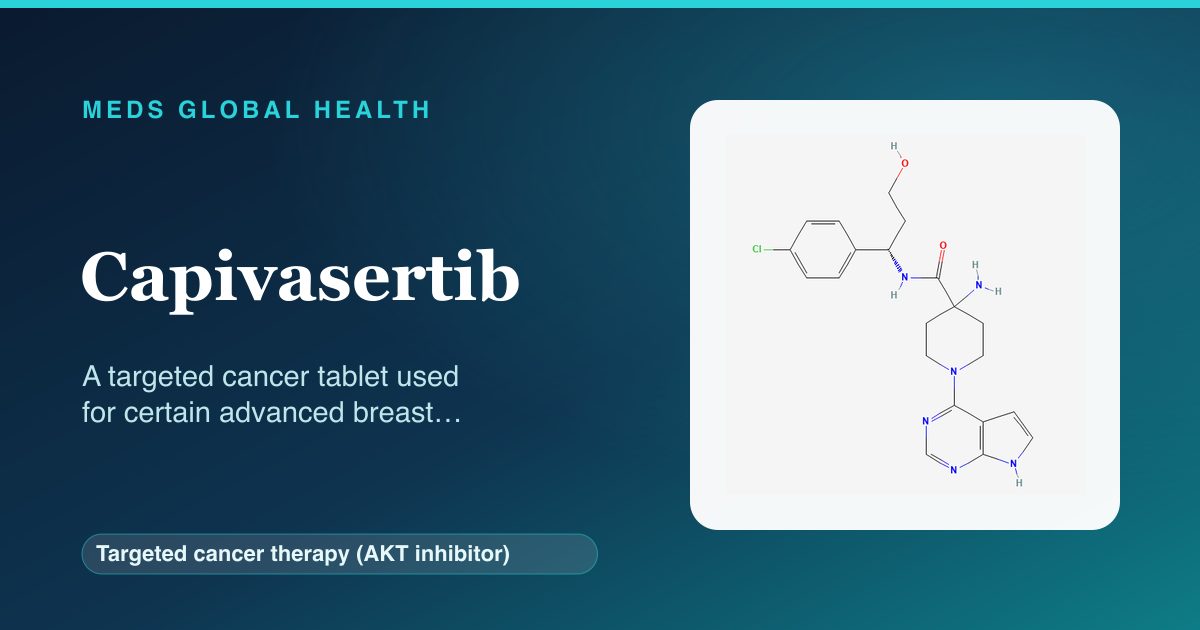
What it is
Capivasertib is a targeted cancer medicine, sometimes called an AKT inhibitor, used to treat certain advanced breast cancers, often those that have specific genetic changes. It is usually given together with a hormone therapy and is taken by mouth as a tablet, typically in cycles of several days on the medicine followed by a few days off. It is prescribed and supervised by a cancer specialist. Rather than acting like standard chemotherapy, it targets a growth pathway that these cancers rely on.
How it works
Many breast cancers grow using a signalling pathway in which a protein called AKT plays a central role in telling cancer cells to grow and survive. Capivasertib blocks AKT, switching off this growth signal so the cancer is slowed and, combined with hormone therapy, controlled for longer. It is taken in an on-and-off pattern, which helps balance its effect against the cancer with the side effects it can cause. Because the AKT pathway is also involved in how the body handles blood sugar, blocking it can raise blood sugar levels, which is why this is monitored.
Company & origin
A specialist targeted medicine used in the UK to treat certain advanced breast cancers, usually together with hormone therapy.
Practical use
How to take Capivasertib
General, dose-free guidance — always follow your prescriber's and the leaflet's specific instructions.
- Take the tablets by mouth in the on-and-off cycle your team sets, such as several days on followed by a few days off.
- Swallow them whole with water at about the same times, and avoid grapefruit while taking it.
- Start any diarrhoea treatment promptly as advised, and drink enough fluids.
- Report a severe, widespread or blistering rash, or symptoms of high blood sugar such as great thirst, straight away.
- Use reliable contraception during treatment and for the time afterwards your team advises, as it can harm a baby.
Weighing it up
Advantages & disadvantages of Capivasertib
Advantages
- A targeted treatment that, with hormone therapy, can control certain advanced breast cancers for longer.
- Taken as a tablet at home rather than as an infusion.
- Aimed at the AKT growth pathway that these cancers rely on.
Disadvantages
- Commonly causes diarrhoea and can raise blood sugar, needing monitoring and management.
- Can rarely cause a serious skin reaction needing urgent attention.
- Can harm a developing baby, so reliable contraception is essential, and it interacts with other medicines.
Practical use
Good to know
Capivasertib is usually taken in cycles, often four days on followed by three days off each week, so it helps to be clear on the exact pattern. Diarrhoea is very common and is best managed early, so ask your team for a plan and anti-diarrhoea advice. It can raise blood sugar, which is checked with blood tests, and you should report symptoms such as feeling very thirsty, passing a lot of urine or feeling drowsy. A serious but less common risk is a severe skin reaction, so any widespread, blistering or peeling rash, or a rash with mouth sores or fever, must be reported urgently. Nausea, tiredness and mouth soreness can also occur. Because it can harm a developing baby, reliable contraception is essential, and you should tell your team about all your other medicines.
Who should not take it / use with caution
- It must not be used in pregnancy, as it can harm a developing baby.
- People who have had a serious allergic or skin reaction to capivasertib should not take it.
- It is used with caution in people with diabetes or poorly controlled blood sugar, under specialist supervision.
Monitoring
- Regular blood tests to check blood sugar.
- Watching for diarrhoea, skin reactions and signs of high blood sugar.
- Reviewing how well the cancer is controlled and checking liver function and general blood tests.
Side effects
- Diarrhoea, which is common and best treated early.
- Raised blood sugar, with symptoms such as great thirst, passing a lot of urine or feeling drowsy.
- Nausea, tiredness, mouth soreness and reduced appetite.
- Less commonly but seriously, a severe skin rash that may blister or peel, needing urgent attention.
Key interactions
- Some medicines and grapefruit can raise capivasertib levels and increase side effects.
- Other medicines and supplements, such as St John's wort, can lower its levels and make it less effective.
- Medicines that affect blood sugar may need reviewing, so give your team a full list of what you take.
Available as: Tablets taken by mouth.
Answers
Capivasertib: frequently asked questions
What is capivasertib used for?
It is a targeted medicine used, usually with hormone therapy, to treat certain advanced breast cancers, by blocking a growth signal called AKT.
Why do I take it some days but not others?
It is given in an on-and-off pattern, such as several days on followed by a few days off, which helps balance its effect against the cancer with its side effects.
Why does it raise blood sugar?
The pathway it blocks is also involved in how the body handles sugar, so it can raise blood sugar; this is checked with blood tests and you should report great thirst or drowsiness.
What rash should I worry about?
Report any widespread, blistering or peeling rash, or a rash with mouth sores or fever, straight away, as these can be signs of a serious skin reaction.
Can I take it if I might become pregnant?
It can harm a developing baby, so you should use reliable contraception during treatment and for the time afterwards your team advises, and it is not used in pregnancy.
Authoritative sources
- BNF
- NICE CKS
Building a medicines information resource?
We create evidence-led, dose-free drug and formulary references for teams.