A MEK inhibitor used with vemurafenib for advanced melanoma
Cobimetinib
A targeted cancer medicine taken with vemurafenib to treat advanced melanoma that has a BRAF gene change.
What is Cobimetinib?
Cobimetinib is a specialist targeted cancer medicine used together with another medicine, vemurafenib, to treat advanced melanoma (a serious skin cancer) that has a particular change in the BRAF gene. It blocks a growth signal called MEK inside cancer cells, helping to slow the cancer down. It is taken as tablets in cycles, with a break in each cycle. Important safety points include effects on the eyes, the heart's pumping strength, the liver, the muscles and the skin in sunlight, so regular monitoring is needed. It must not be used in pregnancy, and reliable contraception is essential.
Education and reference only. This is a plain-language guide to Cobimetinib — it deliberately contains no doses. Doses depend on the person, the brand and the reason for treatment, and belong with your prescriber. Always check the BNF, the product labelling (SmPC) and follow medical advice.
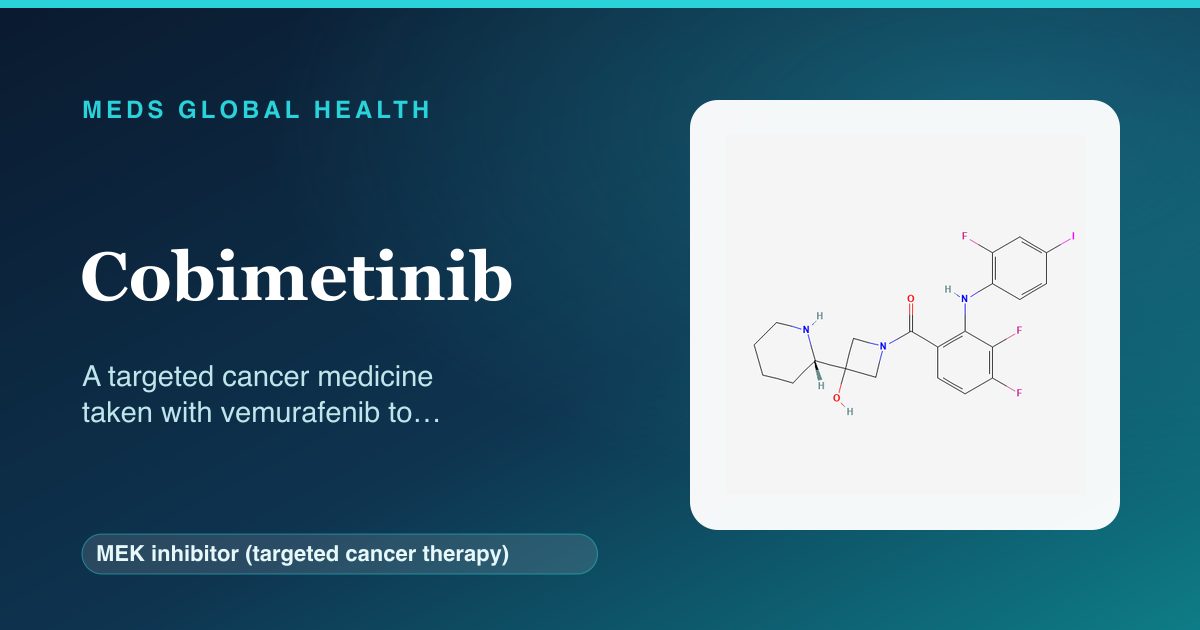
What it is
Cobimetinib is a targeted cancer medicine known as a MEK inhibitor. It is used together with vemurafenib to treat advanced or spreading melanoma, a serious form of skin cancer, in people whose tumour has a specific change in a gene called BRAF. The two medicines are used as a pair because together they block a faulty growth signal more completely than either alone. Cobimetinib is taken by mouth as tablets in repeating cycles, with a built-in break partway through each cycle, under the care of a cancer specialist.
How it works
In some melanomas, a change in the BRAF gene switches on a growth pathway that drives the cancer to keep dividing. Vemurafenib blocks the faulty BRAF step, and cobimetinib blocks the next step down the same pathway, called MEK. By blocking two points on the same signal, the pair can slow or shrink the cancer more effectively and can delay the cancer learning to get around the treatment. Because the medicines act on a pathway that also matters in healthy tissues such as the eyes, heart, skin and muscle, they need careful monitoring while they work.
Company & origin
A specialist targeted cancer medicine used in the UK alongside vemurafenib to treat advanced melanoma with a particular gene change.
Practical use
How to take Cobimetinib
General, dose-free guidance — always follow your prescriber's and the leaflet's specific instructions.
- Take the tablets by mouth exactly as prescribed, following the cycle schedule with its planned break.
- Take it together with vemurafenib as directed, as the two medicines are designed to work as a pair.
- Protect your skin from the sun with clothing, a hat and a high-protection sunscreen, as you can burn more easily.
- Report any changes in your vision, breathlessness, severe muscle pain or yellowing of the skin promptly.
- Use reliable contraception throughout treatment and for the advised time afterwards, and tell your team at once if you might be pregnant.
Weighing it up
Advantages & disadvantages of Cobimetinib
Advantages
- Works together with vemurafenib to slow or shrink advanced melanoma with a BRAF gene change.
- Taken by mouth as tablets rather than by infusion.
- Blocks a second point on the cancer's growth pathway, which can delay resistance.
Disadvantages
- Can affect the eyes, the heart's pumping strength, the liver, the muscles and the skin in sunlight, needing regular monitoring.
- Must be taken with vemurafenib and on a specific cycle, which takes organisation.
- Can seriously harm an unborn baby, so strict contraception is required.
Practical use
Good to know
Cobimetinib is always given with vemurafenib, never on its own, and is taken in cycles with a planned break, so following the exact schedule matters. Several side effects need watching for: changes in vision or a problem with the back of the eye (the retina), a fall in the heart's pumping strength, raised liver blood tests, muscle aches with a blood marker (CK) that can signal muscle breakdown, and a tendency to burn easily in sunlight. Sun protection is very important, and any new or changing skin spots should be reported. A crucial safety point is that this treatment can seriously harm an unborn baby, so it must not be used in pregnancy and effective contraception is needed during treatment and for a time afterwards. Regular eye checks, heart scans and blood tests are part of treatment.
Who should not take it / use with caution
- People who have had a serious allergic reaction to cobimetinib should not take it.
- It must not be used in pregnancy because it can seriously harm an unborn baby.
- It is used with caution in people with heart, liver or eye problems, under specialist supervision.
Monitoring
- Regular eye checks, including for changes at the back of the eye.
- Heart scans to check the heart's pumping strength.
- Blood tests for liver function and the muscle marker CK, plus regular skin checks.
Side effects
- Diarrhoea, feeling sick and tiredness.
- Sensitivity to sunlight and skin rashes, so the skin burns more easily.
- Changes in vision or a retinal problem at the back of the eye.
- Less commonly but importantly, a fall in the heart's pumping strength, raised liver blood tests, bleeding, or muscle breakdown shown by a high CK level.
Key interactions
- Some medicines and grapefruit can raise cobimetinib levels and the risk of side effects, so tell your team about everything you take.
- It is used as a pair with vemurafenib, so their combined effects are taken into account.
- Other medicines that affect the liver or that increase bleeding risk may need review.
Available as: Tablets taken by mouth.
Answers
Cobimetinib: frequently asked questions
What is cobimetinib used for?
It is used together with vemurafenib to treat advanced melanoma, a serious skin cancer, in people whose tumour has a particular change in the BRAF gene.
Why is it taken with another medicine?
Cobimetinib blocks one point on the cancer's growth pathway and vemurafenib blocks another, so the pair works better together and can delay the cancer becoming resistant.
Why do I need eye and heart checks?
Cobimetinib can affect the back of the eye and the heart's pumping strength, so regular eye checks and heart scans are used to catch any problems early.
Why must I protect my skin from the sun?
It makes the skin burn more easily, so covering up and using a high-protection sunscreen is important, and any new or changing skin spots should be reported.
Can I take it if I might become pregnant?
No. It can seriously harm an unborn baby, so it must not be used in pregnancy and reliable contraception is essential during and after treatment.
Authoritative sources
- BNF
- NICE CKS
Building a medicines information resource?
We create evidence-led, dose-free drug and formulary references for teams.