A hospital vaptan for low sodium from too much water
Conivaptan
A hospital medicine given into a vein to treat certain types of low blood sodium caused by holding on to too much water.
What is Conivaptan?
Conivaptan is a vaptan, a medicine that blocks the action of vasopressin, the hormone that tells the kidneys to hold on to water. It is used in hospital to treat certain types of low blood sodium (hyponatraemia) that happen when the body retains too much water and dilutes the sodium. By helping the kidneys pass extra water while keeping salt, it gently raises the sodium level. It is given into a vein under close supervision because the sodium must not be corrected too quickly; raising it too fast can cause serious brain injury, so frequent blood tests are essential.
Education and reference only. This is a plain-language guide to Conivaptan — it deliberately contains no doses. Doses depend on the person, the brand and the reason for treatment, and belong with your prescriber. Always check the BNF, the product labelling (SmPC) and follow medical advice.
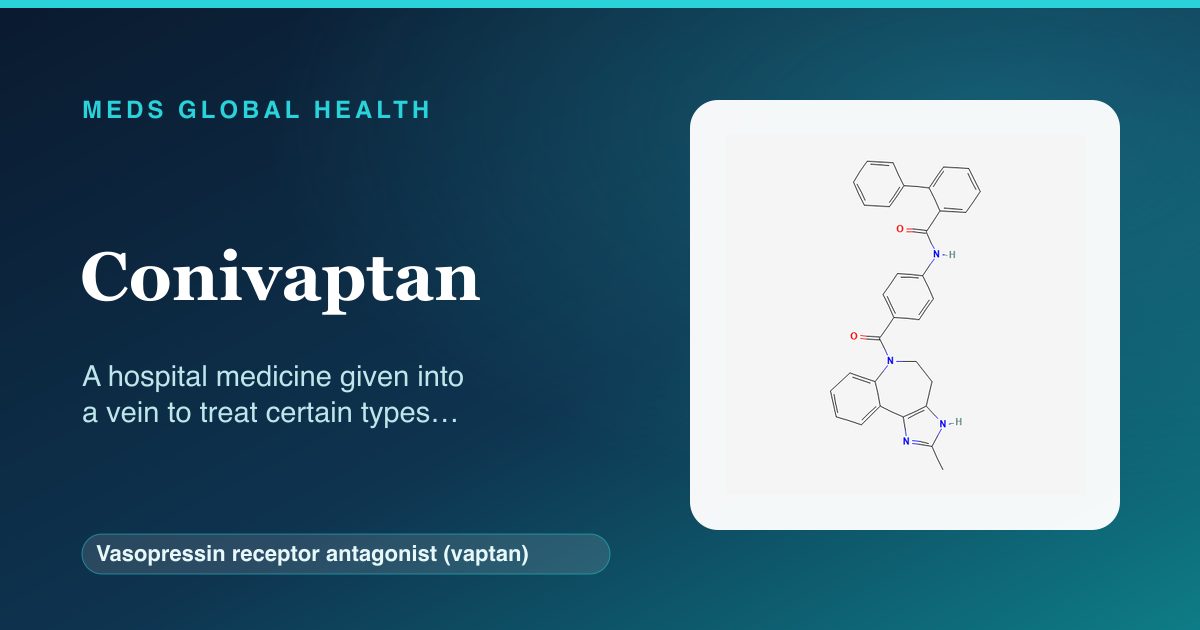
What it is
Conivaptan is a vasopressin receptor antagonist, often called a vaptan. It is a hospital medicine, given as an infusion into a vein, used to treat some forms of low blood sodium, known as hyponatraemia, where the problem is the body holding on to too much water rather than losing salt. By blocking the hormone vasopressin, it lets the kidneys clear the excess water while keeping the body's salt, which raises the sodium concentration back towards normal. It is a specialist, closely monitored treatment, not something used outside hospital.
How it works
Vasopressin, also called antidiuretic hormone, normally tells the kidneys to hold on to water. In some illnesses too much of it, or too strong an effect, makes the body retain water, which dilutes the blood and lowers the sodium level. Conivaptan blocks the receptors that vasopressin acts on, so the kidneys release the extra water as urine while holding on to salt. The result is a rise in the blood sodium. Because that rise has to be slow and controlled, the medicine is given in hospital with very frequent blood tests, and it is stopped or slowed if sodium climbs too quickly.
Company & origin
A hospital-only medicine, given into a vein, used to treat certain types of low blood sodium caused by holding on to too much water.
Practical use
How to take Conivaptan
General, dose-free guidance — always follow your prescriber's and the leaflet's specific instructions.
- It is given in hospital as an infusion into a vein, not taken at home.
- Frequent blood tests are done to make sure the sodium rises slowly and not too fast.
- Tell the team if you feel very thirsty, dizzy or unwell during treatment.
- The infusion may be slowed or stopped if your sodium is rising too quickly.
- It is used only for the specific types of low sodium it is meant for, under specialist care.
Weighing it up
Advantages & disadvantages of Conivaptan
Advantages
- Can raise the blood sodium in certain types of hyponatraemia caused by holding on to too much water.
- Works by clearing extra water while keeping the body's salt.
- Given and monitored closely in hospital, so the response can be watched carefully.
Disadvantages
- Carries a serious risk if the sodium is corrected too quickly, which can injure the brain.
- Must be given into a vein in hospital, with frequent blood tests.
- Suitable only for specific causes of low sodium, not all of them.
Practical use
Good to know
The single most important point about conivaptan is the danger of correcting the sodium too quickly. Raising a low sodium level too fast can cause a serious and sometimes permanent brain injury called osmotic demyelination, so the medicine is given in hospital with frequent blood tests, and the rate is slowed or stopped if sodium is rising too fast. It is used only for certain kinds of low sodium, those linked to holding on to too much water, and not for low sodium caused by losing salt and fluid, where it could be harmful. It is given into a vein, so it can irritate the vein at the drip site. People are watched closely for thirst, changes in blood pressure and how much urine they are passing. It is always a specialist, hospital-based treatment.
Who should not take it / use with caution
- People whose low sodium is caused by losing salt and fluid (rather than holding on to water) should not have it.
- People who have had a serious allergic reaction to conivaptan should not have it.
- It is avoided or used with great caution in certain heart and liver conditions, under specialist judgement.
Monitoring
- Very frequent blood tests for sodium to make sure it rises slowly.
- Watching blood pressure, fluid balance and how much urine is passed.
- Checking the drip site and overall response throughout treatment.
Side effects
- Irritation, redness or pain at the drip site in the vein.
- Thirst, headache, low blood pressure or passing a lot of urine.
- Most seriously, harm from the sodium rising too fast, which the frequent blood tests are there to prevent.
Key interactions
- It can affect, and be affected by, several other medicines, so the hospital team reviews everything you take.
- Other medicines that change sodium or fluid balance need careful consideration.
- Tell the team about all your medicines so interactions can be managed.
Available as: A solution given as an infusion into a vein, in hospital.
Answers
Conivaptan: frequently asked questions
What is conivaptan used for?
It is a hospital medicine used to treat certain types of low blood sodium (hyponatraemia) caused by the body holding on to too much water.
Why does it have to be given in hospital?
The blood sodium must be raised slowly and watched with frequent blood tests, because correcting it too fast can cause serious brain injury.
How does it work?
It blocks vasopressin, the hormone that makes the kidneys hold on to water, so the kidneys clear extra water while keeping salt, raising the sodium level.
Is it used for all types of low sodium?
No, only for certain types caused by holding on to too much water; it is not suitable for low sodium caused by losing salt and fluid.
What is the main danger?
Raising the sodium too quickly can cause a serious brain injury, which is why it is given in hospital with very frequent blood tests.
Authoritative sources
- BNF
- NICE CKS
Building a medicines information resource?
We create evidence-led, dose-free drug and formulary references for teams.