An ointment for mild-to-moderate eczema
Crisaborole
A non-steroid ointment used to treat mild-to-moderate eczema (atopic dermatitis).
What is Crisaborole?
Crisaborole is an ointment used to treat mild-to-moderate eczema (atopic dermatitis), the common itchy, inflamed skin condition. It is a non-steroid treatment that works by calming inflammation in the skin through blocking an enzyme called PDE4. It is rubbed into the affected areas of skin. The most common side effect is stinging or burning where it is applied, which usually settles. It is generally well tolerated and offers an option for people who want to avoid or reduce the use of steroid creams.
Education and reference only. This is a plain-language guide to Crisaborole — it deliberately contains no doses. Doses depend on the person, the brand and the reason for treatment, and belong with your prescriber. Always check the BNF, the product labelling (SmPC) and follow medical advice.
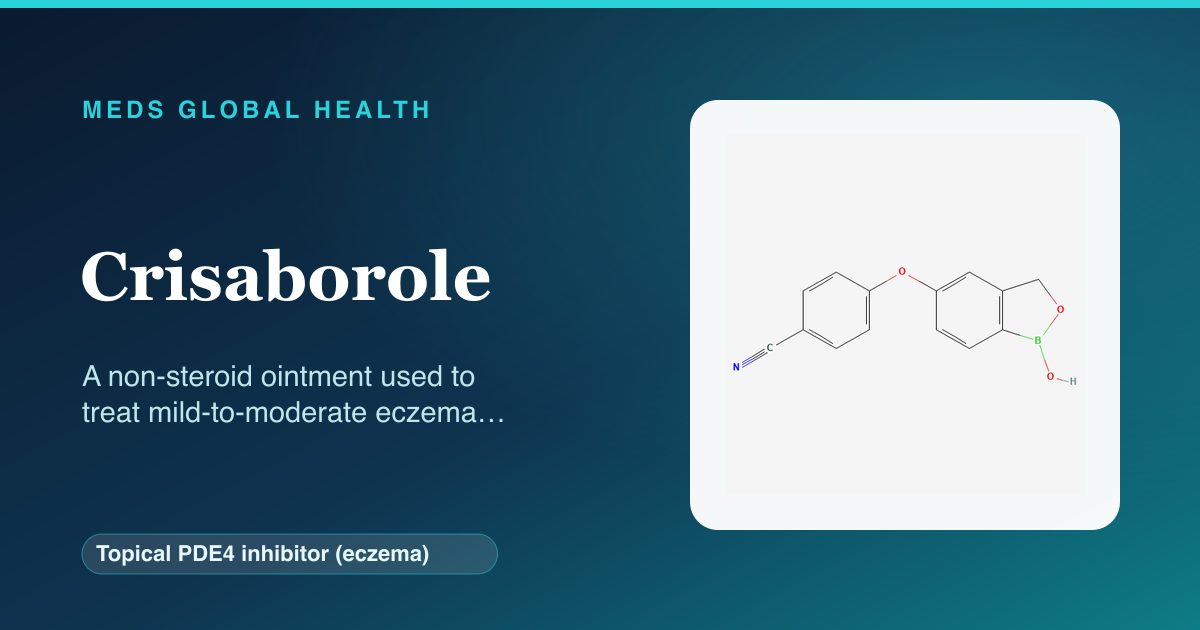
What it is
Crisaborole is a medicine used as an ointment to treat mild-to-moderate eczema, also called atopic dermatitis, a long-term condition that makes the skin dry, itchy, red and inflamed. Unlike steroid creams, it is a non-steroid treatment, which appeals to people who would rather not use steroids or who want an alternative for certain areas of skin. It works by acting on an enzyme involved in skin inflammation. It is applied directly to the affected patches of skin rather than taken by mouth.
How it works
Eczema involves inflammation in the skin driven partly by signalling chemicals that the immune system releases. Crisaborole blocks an enzyme called phosphodiesterase-4 (PDE4) inside skin cells; blocking this enzyme reduces the production of those inflammatory signals. The result is less redness, swelling and itch in the treated areas. Because it works on the skin where it is applied rather than throughout the whole body, it targets the eczema patches directly, which is why it is used as an ointment.
Company & origin
A medicine used in the UK as an ointment for mild-to-moderate eczema (atopic dermatitis), offering a non-steroid option to put on the skin.
What it treats
Conditions Crisaborole is used for
Practical use
How to take Crisaborole
General, dose-free guidance — always follow your prescriber's and the leaflet's specific instructions.
- Apply a thin layer to the affected areas of skin as directed, usually after washing your hands.
- Expect some stinging or burning at first; this is common and usually settles after the early days.
- Keep using your regular moisturiser as part of everyday eczema care, alongside the ointment.
- Avoid getting it in the eyes, and wash your hands after applying it unless your hands are being treated.
- Let your prescriber know if the skin becomes more sore, weepy or looks infected rather than improving.
Weighing it up
Advantages & disadvantages of Crisaborole
Advantages
- A non-steroid option for mild-to-moderate eczema, useful for people wanting to avoid steroid creams.
- Applied directly to the skin, so it targets the affected patches.
- Generally well tolerated, with stinging that usually settles being the main complaint.
Disadvantages
- Can cause stinging or burning where it is applied, especially in the first days.
- Suited to mild-to-moderate eczema rather than severe disease.
- Needs to be applied regularly and used alongside good general skin care.
Practical use
Good to know
The most useful things to know about crisaborole are that it is a non-steroid ointment for mild-to-moderate eczema and that it is generally well tolerated. The most common side effect is stinging or burning where it is applied, especially in the first days; this usually settles and can be eased by applying it to skin that is not broken and using a regular moisturiser alongside. It is applied to the affected areas as directed, and ordinary moisturisers should still be used as part of looking after eczema-prone skin. As a treatment that works mainly on the skin, it offers an option for people who want to avoid or cut down on steroid creams. If the skin becomes more sore, weepy or shows signs of infection, that should be reviewed rather than simply continuing the ointment.
Who should not take it / use with caution
- People who have had a serious allergic reaction to crisaborole should not use it.
- It is for use on the skin only and should be kept away from the eyes.
- It is used under guidance in young children, following the advice given for their age.
Monitoring
- Reviewing how well the eczema responds to treatment.
- Watching for ongoing stinging, irritation or signs of skin infection.
- Checking that good general skin care, including moisturising, is being kept up.
Side effects
- Stinging or burning where it is applied, which usually settles.
- Redness or irritation of the treated skin in some people.
- Rarely, an allergic skin reaction, which should be reported.
Key interactions
- There are few well-established interactions, as it works mainly on the skin where it is applied.
- It is usually used alongside ordinary moisturisers as part of eczema care.
- Tell your prescriber about other creams or ointments you use on the same areas.
Available as: An ointment applied to the skin.
Answers
Crisaborole: frequently asked questions
What is crisaborole used for?
It is an ointment used to treat mild-to-moderate eczema (atopic dermatitis), calming inflammation in the skin where it is applied.
Is it a steroid?
No, crisaborole is a non-steroid treatment, which makes it an option for people who want to avoid or cut down on steroid creams.
Why does it sting when I put it on?
Stinging or burning where it is applied is the most common side effect, especially in the first days, and it usually settles with continued use.
Do I still need to moisturise?
Yes, you should keep using your regular moisturiser as part of everyday eczema care alongside the ointment.
Can I use it anywhere on my body?
It is applied to affected areas of skin as directed but should be kept away from the eyes; follow the advice you are given for where and how to use it.
Authoritative sources
- BNF
- NICE CKS
Building a medicines information resource?
We create evidence-led, dose-free drug and formulary references for teams.