A short-term muscle relaxant that causes marked drowsiness
Cyclobenzaprine
A muscle relaxant used for short-term relief of muscle spasm, which causes marked drowsiness.
What is Cyclobenzaprine?
Cyclobenzaprine is a muscle relaxant used for the short-term relief of painful muscle spasm, usually alongside rest and physiotherapy. It is largely a US product and is not commonly used in the UK. The dominant feature is that it causes marked drowsiness and dry mouth and other 'antimuscarinic' effects, so it can make you very sleepy and is meant for short courses only. It must not be taken with a type of antidepressant called MAOIs, and it is avoided soon after a heart attack or with certain heart-rhythm problems.
Education and reference only. This is a plain-language guide to Cyclobenzaprine — it deliberately contains no doses. Doses depend on the person, the brand and the reason for treatment, and belong with your prescriber. Always check the BNF, the product labelling (SmPC) and follow medical advice.
What it is
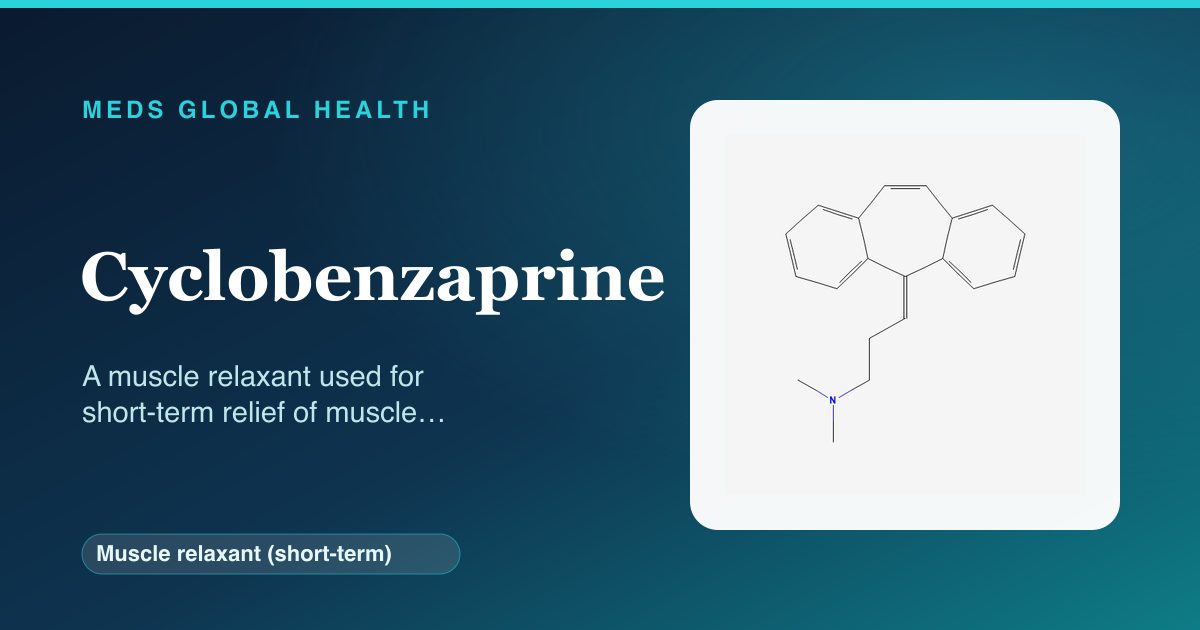
Cyclobenzaprine is a muscle relaxant used to ease painful muscle spasms, for example after a strain or injury, usually for a short time and together with measures such as rest and physiotherapy. It is closely related to a group of older antidepressants in its chemical make-up, which is why it shares some of their effects. It is used mainly in the United States and is not a medicine commonly prescribed in the UK. It is taken by mouth as a tablet and is intended for short-term use rather than ongoing treatment.
How it works
Cyclobenzaprine works mainly in the brain and central nervous system to reduce the over-activity in the nerves that drives muscle spasm, helping the muscles relax. It does not act directly on the muscles themselves. Because it is chemically similar to older tricyclic antidepressants, it also causes sedation (drowsiness) and 'antimuscarinic' effects such as dry mouth and blurred vision. Its calming effect on the nervous system is part of how it relieves spasm, but it is also why it makes people so sleepy, and why it is used only for short periods.
Company & origin
Originated / developed by: Generic (largely US product).
A muscle relaxant used mainly in the United States for short-term muscle spasm; it is not a commonly used UK medicine.
Practical use
How to take Cyclobenzaprine
General, dose-free guidance — always follow your prescriber's and the leaflet's specific instructions.
- Take it by mouth for a short course only, exactly as prescribed, alongside rest and physiotherapy.
- Do not drive or use machinery until you know how sleepy it makes you.
- Avoid alcohol while taking it, as it adds to the drowsiness.
- Tell your prescriber about all your medicines, especially any antidepressant of the MAOI type, which must not be combined.
- Mention any heart problems, recent heart attack, heart-rhythm trouble or overactive thyroid before starting.
Weighing it up
Advantages & disadvantages of Cyclobenzaprine
Advantages
- Can give short-term relief from painful muscle spasm, helping you rest and move more comfortably.
- Taken by mouth as a simple tablet.
- Works alongside other measures such as rest and physiotherapy.
Disadvantages
- Causes marked drowsiness and antimuscarinic effects such as dry mouth, blurred vision and constipation.
- Must not be combined with MAOI antidepressants and is avoided in recent heart attack or certain heart-rhythm problems.
- Intended for short-term use only and is largely a US rather than a UK medicine.
Practical use
Good to know
The thing to expect most with cyclobenzaprine is drowsiness: it can make you very sleepy, so do not drive or operate machinery until you know how it affects you, and avoid alcohol, which adds to the effect. It also commonly causes dry mouth, blurred vision and constipation, the so-called antimuscarinic effects. Two important safety points are that it must not be taken with, or close to, a type of antidepressant called MAOIs, and that it is avoided soon after a heart attack or with certain heart-rhythm problems or an overactive thyroid, because of its effects on the heart. It is meant for short-term use only, typically a couple of weeks at most, alongside other measures, rather than as a long-term treatment.
Who should not take it / use with caution
- People taking, or who have recently taken, an MAOI antidepressant must not use it.
- People soon after a heart attack, with certain heart-rhythm problems, heart failure or an overactive thyroid should not use it.
- People who have had a serious allergic reaction to cyclobenzaprine should not take it.
Monitoring
- Reviewing whether it is still needed, as it is meant for short-term use.
- Checking how drowsy it makes you and whether it is affecting daily activities.
- Watching for heart-related effects in people with heart problems.
Side effects
- Drowsiness and tiredness, which can be marked.
- Dry mouth, blurred vision and constipation.
- Dizziness, especially when standing up.
- Rarely, fast or irregular heartbeat, or a serious reaction when combined with certain other medicines.
Key interactions
- It must not be combined with MAOI antidepressants, because of a risk of a serious reaction.
- Alcohol and other sedating medicines add to its drowsiness.
- Combined with some antidepressants and other medicines it can raise the risk of a reaction called serotonin syndrome, so tell your prescriber everything you take.
Available as: Tablets taken by mouth.
Answers
Cyclobenzaprine: frequently asked questions
What is cyclobenzaprine used for?
It is a muscle relaxant used for the short-term relief of painful muscle spasm, usually together with rest and physiotherapy.
Why does it make me so sleepy?
Drowsiness is its most common effect, as it calms the nervous system; do not drive or use machinery until you know how it affects you, and avoid alcohol.
Is it used in the UK?
It is largely a US product and is not commonly prescribed in the UK, where other approaches to muscle spasm are usually used.
Can I take it with my antidepressant?
It must not be taken with, or close to, an MAOI antidepressant, and can interact with some others, so tell your prescriber about all your medicines.
How long should I take it for?
It is meant for short-term use only, typically up to a couple of weeks, alongside other measures, rather than as a long-term treatment.
The wider class
About Muscle relaxant (short-term)
Cyclobenzaprine belongs to the muscle relaxant (short-term) class. For how the class as a whole works, its shared safety principles and monitoring, see the full guide.
Browse by body system
Authoritative sources
- BNF
- NICE CKS
Building a medicines information resource?
We create evidence-led, dose-free drug and formulary references for teams.