Eye drops that widen the pupil and relax focusing for eye exams
Cyclopentolate
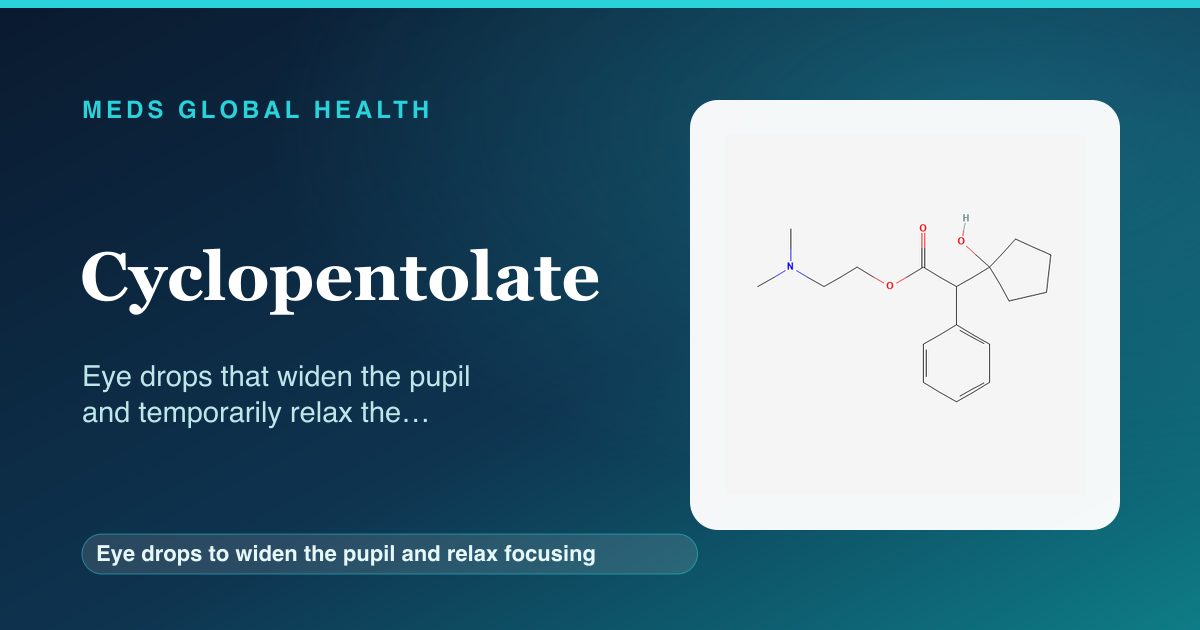
Eye drops that widen the pupil and temporarily relax the eye's focusing so the back of the eye can be examined.
What is Cyclopentolate?
Cyclopentolate is an eye drop used to widen (dilate) the pupil and temporarily relax the eye's focusing muscle, so the doctor or optometrist can examine the inside of the eye or measure the eye properly. The effects last for several hours, during which vision is blurred (especially for close work) and the eye is very sensitive to bright light, so you should not drive until your sight has fully returned to normal and wear sunglasses if helpful. In young children it can rarely cause restlessness or confusion, so the lowest effective strength is used.
Education and reference only. This is a plain-language guide to Cyclopentolate — it deliberately contains no doses. Doses depend on the person, the brand and the reason for treatment, and belong with your prescriber. Always check the BNF, the product labelling (SmPC) and follow medical advice.
What it is
Cyclopentolate is an eye drop used during eye examinations. It does two things: it widens the pupil so the doctor or optometrist can see the structures at the back of the eye clearly, and it temporarily relaxes the muscle that focuses the eye, which is especially useful when measuring a child's glasses prescription. It is put in by an eye-care professional in a clinic. It is a short-term, examination medicine rather than a treatment you take regularly, although similar drops are sometimes used to rest the eye in certain inflammatory conditions.
How it works
The size of the pupil and the eye's ability to focus are controlled by tiny muscles inside the eye. Cyclopentolate blocks the natural signals to these muscles, so the pupil opens wide and the focusing muscle relaxes. With the pupil dilated, far more of the inside of the eye can be seen and examined, and with focusing relaxed the true spectacle prescription can be measured, especially in children whose focusing is otherwise very active. The effects wear off on their own over several hours as the medicine clears.
Company & origin
Eye drops used in UK eye clinics to widen the pupil and relax the eye's focusing so the eye can be examined.
Practical use
How to take Cyclopentolate
General, dose-free guidance — always follow your prescriber's and the leaflet's specific instructions.
- The drops are put in by an eye-care professional in the clinic, so there is nothing for you to take yourself.
- Expect blurred vision, especially for close work, and sensitivity to bright light for several hours afterwards.
- Do not drive until your vision has fully returned to normal; arrange another way home if needed.
- Wear sunglasses if bright light is uncomfortable while your pupils are still wide.
- For a child, follow the team's advice; gently pressing the inner corner of the eye after the drop can reduce how much is absorbed.
Weighing it up
Advantages & disadvantages of Cyclopentolate
Advantages
- Widens the pupil so the inside and back of the eye can be examined clearly.
- Relaxes focusing, which helps measure an accurate glasses prescription, especially in children.
- Works for a few hours and then wears off on its own.
Disadvantages
- Blurs vision and causes sensitivity to bright light for several hours, so you cannot drive until it clears.
- Can sting briefly when put in.
- In young children it can rarely cause restlessness, drowsiness or confusion.
Practical use
Good to know
The most important things to know are about the after-effects, which last several hours: your pupils stay wide, so bright light feels uncomfortable, and your near vision in particular is blurred. Because of this you should not drive until your vision has completely returned to normal, and sunglasses can make bright light more comfortable. The drops may sting briefly when put in. In babies and young children the drops can occasionally cause more general effects such as a flushed face, restlessness, drowsiness or confusion, which is why the lowest effective strength is chosen and children are watched; pressing gently on the inner corner of the eye after the drop can reduce how much is absorbed. People with narrow-angle glaucoma need particular care, as dilating the pupil can rarely trigger a rise in eye pressure. Let the eye-care team know about your health and any past reactions to eye drops.
Who should not take it / use with caution
- People who have had a serious allergic reaction to cyclopentolate should not use it.
- It is used with great caution, or avoided, in people with narrow-angle glaucoma, as dilating the pupil can raise eye pressure.
- It is used carefully, at the lowest effective strength, in babies and very young children because of the risk of more general effects.
Monitoring
- Checking the pupil has widened enough for a clear examination.
- Watching young children for any general effects such as restlessness or drowsiness.
- Being alert to eye pain or a rise in eye pressure in people prone to narrow-angle glaucoma.
Side effects
- Blurred vision, especially for close work, and sensitivity to bright light for several hours.
- Brief stinging when the drop is put in.
- In children, occasionally a flushed face, restlessness, drowsiness or confusion.
- Rarely, in people prone to it, a rise in eye pressure (acute glaucoma), which needs urgent attention.
Key interactions
- Few routine interactions, but tell the eye-care team about other eye drops and medicines you use.
- Other medicines with similar drying or pupil-widening effects may add to its action.
- Tell the team about any eye conditions, particularly narrow-angle glaucoma.
Available as: Eye drops, put in by an eye-care professional.
Answers
Cyclopentolate: frequently asked questions
What is cyclopentolate used for?
It is an eye drop used to widen the pupil and relax focusing so the eye can be examined and an accurate glasses prescription measured, especially in children.
How long will my vision stay blurred?
Vision, particularly for close work, is usually blurred and sensitive to bright light for several hours until the drops wear off on their own.
Can I drive afterwards?
No, not until your vision has fully returned to normal, as the drops blur sight and make you sensitive to light; arrange another way home if needed.
Is it safe for my child?
Yes, it is widely used in children at the lowest effective strength; rarely it can cause restlessness or drowsiness, so children are watched after the drops.
Why do my eyes hurt in bright light afterwards?
The drops keep the pupil wide for a few hours, letting in more light, so bright light feels uncomfortable; sunglasses can help until it wears off.
Authoritative sources
- BNF
- NICE CKS
Building a medicines information resource?
We create evidence-led, dose-free drug and formulary references for teams.