An oral medicine for anaemia caused by chronic kidney disease
Daprodustat
An oral treatment for anaemia in chronic kidney disease that stabilises hypoxia-inducible factor, used in people on and off dialysis.
What is Daprodustat?
Daprodustat is a medicine used to treat anaemia (low haemoglobin) in people with chronic kidney disease, where the kidneys do not make enough of the hormone that drives red blood cell production. It works in the same way as similar medicines, by switching on the body's natural response to low oxygen so it makes more red blood cells and uses iron better. It is taken by mouth as a tablet rather than by injection. Because raising haemoglobin too quickly or too high carries risks such as blood clots and raised blood pressure, the haemoglobin level is monitored and kept within a target range.
Education and reference only. This is a plain-language guide to Daprodustat — it deliberately contains no doses. Doses depend on the person, the brand and the reason for treatment, and belong with your prescriber. Always check the BNF, the product labelling (SmPC) and follow medical advice.
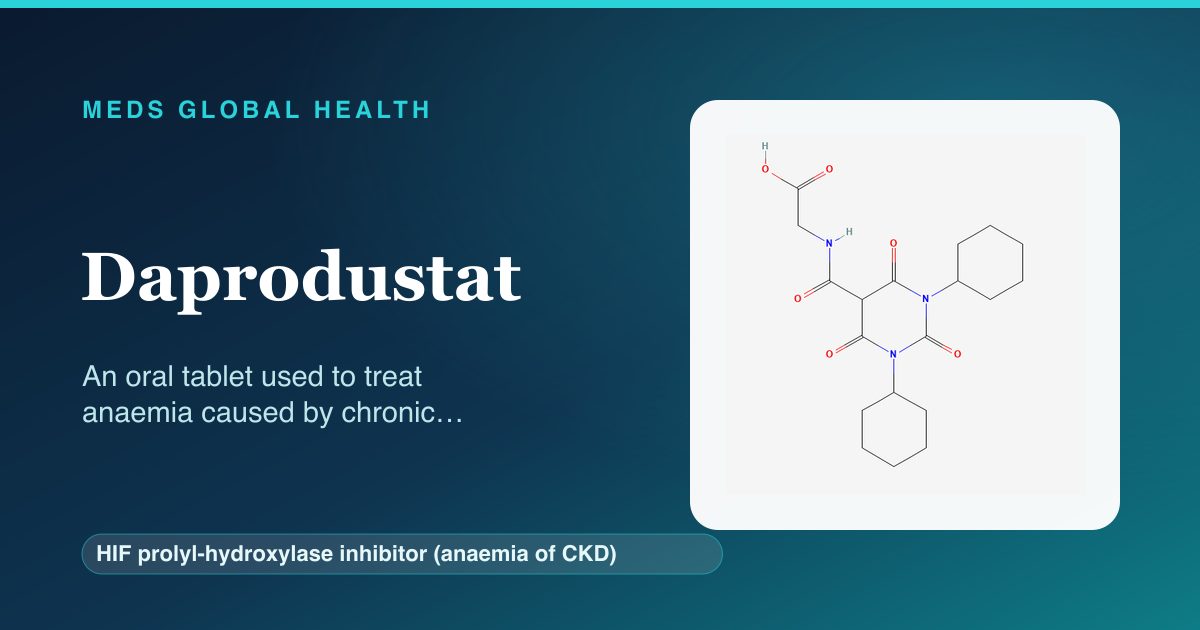
What it is
Daprodustat is a medicine used to treat anaemia in people with chronic kidney disease. In kidney disease the kidneys make less of the hormone (erythropoietin) that tells the bone marrow to produce red blood cells, leading to anaemia and symptoms such as tiredness and breathlessness. Daprodustat is taken by mouth as a tablet, offering an alternative to the older injectable treatments. It works on the body's own oxygen-sensing system to increase red blood cell production, and is used with regular blood tests under specialist or kidney-team supervision to keep haemoglobin in a safe range.
How it works
The body senses when oxygen is low and responds by switching on a signal (HIF) that increases red blood cell production and improves how iron is used. An enzyme normally keeps this signal switched off when oxygen levels are fine. Daprodustat blocks that enzyme (the prolyl-hydroxylase), so the body acts as if it needs more red blood cells, making more of its own erythropoietin and using iron more effectively to raise haemoglobin. Because raising haemoglobin too fast or too high can be harmful, the dose is adjusted using blood tests to keep haemoglobin within a target range.
Company & origin
An oral medicine used to treat anaemia in people with chronic kidney disease, offering a tablet alternative to injections.
What it treats
Conditions Daprodustat is used for
Practical use
How to take Daprodustat
General, dose-free guidance — always follow your prescriber's and the leaflet's specific instructions.
- Take the tablet by mouth once a day, at about the same time, with or without food as advised.
- Swallow it whole and keep taking it on schedule, as it works to raise haemoglobin steadily.
- Go for your blood tests so haemoglobin and iron can be checked and the dose adjusted.
- Have your blood pressure checked, as it can rise during treatment.
- Give your team a full list of your medicines, as it can interact with some of them.
Weighing it up
Advantages & disadvantages of Daprodustat
Advantages
- Treats anaemia of chronic kidney disease with a daily tablet rather than an injection.
- Works with the body's own oxygen-sensing system and helps it use iron better.
- An oral option that some people find more convenient than injectable treatments.
Disadvantages
- Raising haemoglobin too quickly or too high is linked to blood clots and other risks.
- Can raise blood pressure, which needs monitoring.
- Can interact with some medicines, so a full medicines list is needed.
Practical use
Good to know
Like other medicines in its group, daprodustat lets kidney-related anaemia be treated with a daily tablet rather than an injection. The central safety idea is that haemoglobin should be brought up steadily and kept within a target range rather than as high as possible, because rising too quickly or too high is linked to blood clots and raised blood pressure; blood tests guide the dose. It can also raise blood pressure, which is checked during treatment. Because the body needs iron to make red blood cells, iron levels are monitored and iron may be given alongside. It can interact with some other medicines, so a full medicines list is important. It is taken once a day, usually at about the same time, with or without food as advised.
Who should not take it / use with caution
- People who have had a serious allergic reaction to daprodustat should not take it.
- It is used with caution in people at higher risk of blood clots or with poorly controlled blood pressure.
- It is generally avoided in pregnancy and breastfeeding unless the team advises otherwise.
Monitoring
- Regular blood tests to keep haemoglobin within a target range, not too high.
- Checking iron levels, as iron is needed to make red blood cells.
- Monitoring blood pressure during treatment.
Side effects
- Raised blood pressure, which is monitored during treatment.
- A higher risk of blood clots, particularly if haemoglobin rises too far.
- Nausea, headache or swelling in some people.
Key interactions
- It can interact with some medicines that affect the same liver enzymes, so these may need reviewing.
- Tell your team about all your medicines and supplements before starting.
- Iron and how it is given may be coordinated alongside treatment.
Available as: Tablets taken by mouth.
Answers
Daprodustat: frequently asked questions
What is daprodustat used for?
It is used to treat anaemia (low haemoglobin) caused by chronic kidney disease, by prompting the body to make more red blood cells.
How is it taken?
It is taken by mouth as a tablet, usually once a day, offering an alternative to the older injectable treatments.
Why is my haemoglobin kept within a range?
Letting haemoglobin rise too quickly or too high is linked to risks such as blood clots and raised blood pressure, so blood tests guide the dose.
Do I still need iron?
Often yes, because the body needs iron to make red blood cells, so iron levels are checked and iron may be given alongside.
Can it raise my blood pressure?
Yes, it can raise blood pressure, so this is monitored during treatment along with your haemoglobin level.
Authoritative sources
- BNF
- NICE CKS
Building a medicines information resource?
We create evidence-led, dose-free drug and formulary references for teams.