An oral iron-removing medicine
Deferasirox
An oral specialist medicine that removes excess iron caused by repeated blood transfusions.
What is Deferasirox?
Deferasirox is a specialist medicine taken by mouth to remove excess iron from the body, which can build up in people who have many blood transfusions, for example in thalassaemia or sickle cell disease. Too much iron can harm the heart, liver and other organs, so removing it protects them. It is prescribed and monitored by a specialist team. It can affect the kidneys and liver and, rarely, cause serious stomach or bowel problems, so regular blood and urine tests are important. It is taken once a day as a tablet.
Education and reference only. This is a plain-language guide to Deferasirox — it deliberately contains no doses. Doses depend on the person, the brand and the reason for treatment, and belong with your prescriber. Always check the BNF, the product labelling (SmPC) and follow medical advice.
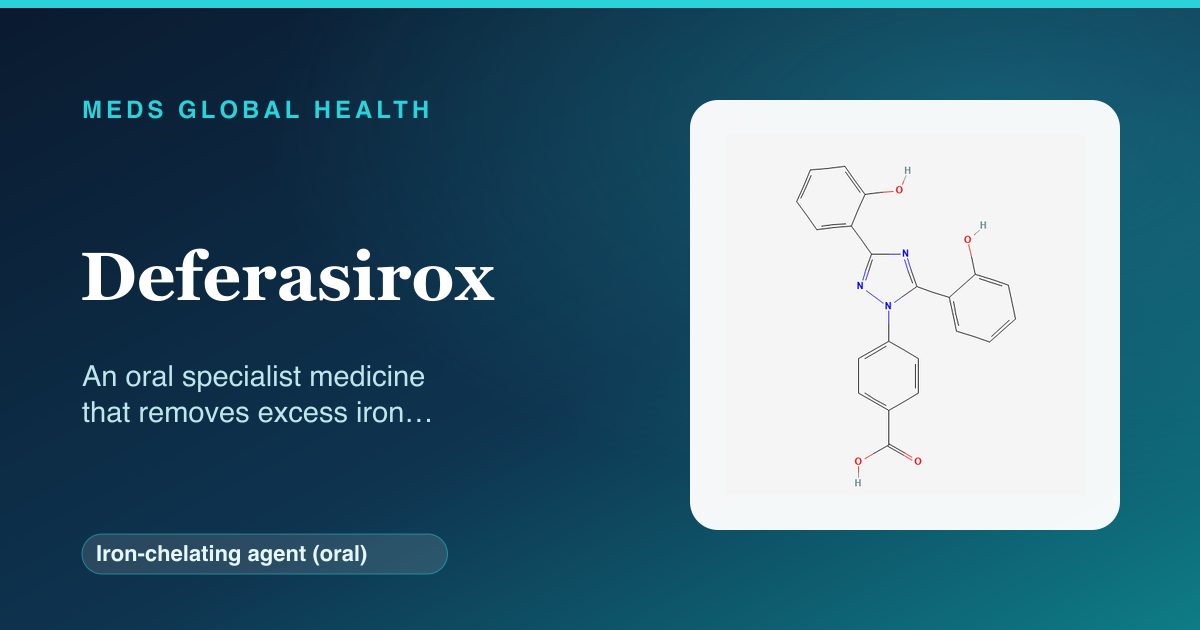
What it is
Deferasirox is a prescription-only medicine called an iron chelator, which means it binds to iron so the body can get rid of it. People who need regular blood transfusions, such as those with thalassaemia or sickle cell disease, slowly build up too much iron, because each transfusion adds iron the body cannot easily remove. This excess iron can damage the heart, liver and hormone glands. Deferasirox is taken by mouth, usually once a day, to lower iron levels and protect these organs, and it is supervised by a specialist team with regular monitoring.
How it works
Deferasirox attaches to excess iron in the body, forming a compound that is then mostly removed in the stools. By steadily mopping up the iron that builds up from repeated transfusions, it lowers the overall iron load and helps protect organs such as the heart and liver from iron damage. It is taken regularly over the long term, with the dose adjusted according to how much iron the body is carrying, which is judged from blood tests and sometimes scans.
Company & origin
Originated / developed by: Novartis.
A specialist medicine used in the UK to remove excess iron caused by repeated blood transfusions.
Practical use
How to take Deferasirox
General, dose-free guidance — always follow your prescriber's and the leaflet's specific instructions.
- Take it once a day as directed by your specialist team, at about the same time each day.
- Follow the advice for your particular tablet about whether to take it with or without food, as different forms differ.
- Drink fluids well and stay hydrated unless you have been told otherwise.
- Attend all your blood and urine tests so your kidneys, liver and iron levels can be checked.
- Report severe stomach pain, vomiting blood, black stools, or changes in hearing or vision straight away.
Weighing it up
Advantages & disadvantages of Deferasirox
Advantages
- Removes excess iron from repeated transfusions, helping protect the heart, liver and other organs.
- Taken by mouth once a day, which is more convenient than treatments given by infusion.
- The dose can be adjusted over time to match each person's iron load.
Disadvantages
- Can affect the kidneys and liver, so regular blood and urine tests are needed.
- Rarely causes serious stomach or bowel problems, including bleeding or ulcers.
- Must be taken consistently over the long term, as iron builds up again if it is stopped.
Practical use
Good to know
Deferasirox is a long-term treatment, and regular monitoring is a central part of using it safely. It can affect the kidneys and the liver, so blood and urine tests are done before starting and regularly during treatment, and the dose may be adjusted if results change. Rarely, it can cause serious stomach or bowel problems, including bleeding or ulcers, so report severe stomach pain, vomiting blood or black stools urgently. It can also affect hearing and eyesight, so checks are sometimes arranged. Staying well hydrated is important. It must be taken regularly to keep iron under control, and you should not stop it without advice, as iron can build up again.
Who should not take it / use with caution
- It is used with great caution, or avoided, in people with significant kidney or liver problems.
- It is not suitable for people with certain other serious blood or bone-marrow conditions, as judged by a specialist.
- It is generally avoided in pregnancy unless a specialist decides it is necessary.
Monitoring
- Regular blood and urine tests to check the kidneys, liver and iron levels.
- Hearing and eyesight checks at intervals, as advised by your team.
- Reviewing the dose against how much iron the body is carrying, judged from tests and sometimes scans.
Side effects
- Nausea, stomach upset, diarrhoea and skin rash are among the more common effects.
- Changes in kidney or liver blood tests, which is why these are monitored regularly.
- Rarely, serious stomach or bowel problems, or effects on hearing and eyesight, which need prompt review.
Key interactions
- Some indigestion remedies (antacids) containing aluminium are usually avoided around the same time.
- It can affect the levels of certain other medicines, so the combination is reviewed by your team.
- Other medicines that affect the kidneys, liver or stomach lining may add to its risks.
Available as: Tablets taken by mouth, including tablets to swallow and forms to disperse in liquid depending on the brand.
Answers
Deferasirox: frequently asked questions
What is deferasirox used for?
It removes excess iron that builds up in people who have many blood transfusions, such as in thalassaemia or sickle cell disease, to protect the heart, liver and other organs.
Why do I need regular blood and urine tests?
It can affect the kidneys and liver, so these are checked regularly so the dose can be adjusted and any problem caught early.
What stomach symptoms should I report urgently?
Report severe stomach pain, vomiting blood or black stools straight away, as it can rarely cause serious stomach or bowel problems.
Can I stop it once my iron is lower?
Do not stop it without advice, as iron builds up again with continued transfusions; your team will guide any changes.
Does it affect my eyes or hearing?
Rarely it can affect eyesight or hearing, so checks may be arranged; report any changes in your vision or hearing.
Authoritative sources
- BNF
- NICE CKS
Building a medicines information resource?
We create evidence-led, dose-free drug and formulary references for teams.