An iron-removing infusion (also spelled desferrioxamine)
Deferoxamine
A specialist iron-removing medicine given by infusion for iron overload and acute iron poisoning.
What is Deferoxamine?
Deferoxamine, also spelled desferrioxamine, is a specialist medicine that removes excess iron from the body. It is used for iron overload from repeated blood transfusions and to treat acute iron poisoning. Because it is not well absorbed by mouth, it is given by a slow infusion under the skin or into a vein. It is prescribed and monitored by a specialist team. It can affect the eyes and hearing and the growth of children, and it often turns the urine a reddish colour, which is harmless. It is given as an infusion.
Education and reference only. This is a plain-language guide to Deferoxamine — it deliberately contains no doses. Doses depend on the person, the brand and the reason for treatment, and belong with your prescriber. Always check the BNF, the product labelling (SmPC) and follow medical advice.
What it is
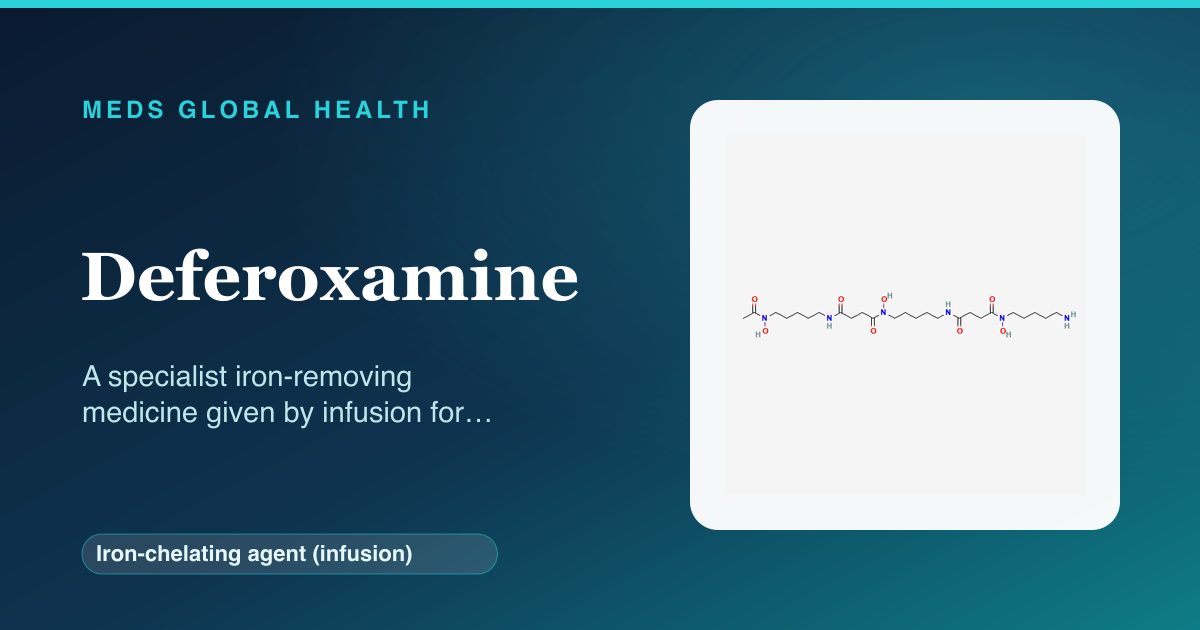
Deferoxamine is a prescription-only iron chelator, a medicine that binds to iron so the body can remove it. It is used to treat iron overload, which builds up in people who have many blood transfusions, such as those with thalassaemia, and it is also used as an emergency treatment for serious iron poisoning. Because it is not absorbed well when swallowed, it is given by a slow infusion under the skin (often overnight using a small pump) or into a vein in hospital. It is supervised by a specialist team with regular monitoring.
How it works
Deferoxamine attaches to excess iron in the body, forming a compound that is then removed, mainly in the urine, which can give it a reddish colour. By steadily clearing iron that builds up from repeated transfusions, it lowers the overall iron load and helps protect organs such as the heart and liver. In iron poisoning, it binds the excess iron quickly to limit harm. Because it is given by infusion rather than by mouth, the way it is delivered is tailored to the situation, from regular home infusions for overload to urgent hospital treatment for poisoning.
Company & origin
Originated / developed by: Novartis.
A long-established specialist medicine used in the UK to remove excess iron and to treat acute iron poisoning.
Practical use
How to take Deferoxamine
General, dose-free guidance — always follow your prescriber's and the leaflet's specific instructions.
- It is given by a slow infusion under the skin or into a vein, as arranged by your specialist team.
- For long-term iron overload, you may be taught to set up overnight under-the-skin infusions at home using a small pump.
- Attend your regular eye and hearing checks, and report any change in your vision or hearing.
- Do not be alarmed if your urine turns a reddish colour, as this is harmless and expected.
- Look after the infusion site and tell your team about redness, swelling or pain there.
Weighing it up
Advantages & disadvantages of Deferoxamine
Advantages
- Effectively removes excess iron and is also a key treatment for serious iron poisoning.
- Long established, with decades of experience in protecting organs from iron damage.
- Can often be given at home as an overnight under-the-skin infusion once you are trained.
Disadvantages
- Has to be given by infusion rather than by mouth, which is less convenient.
- Can affect the eyes and hearing, and growth and bones in children, so regular checks are needed.
- Commonly causes reactions at the infusion site, such as redness, swelling or pain.
Practical use
Good to know
Deferoxamine is given by infusion, and for long-term iron overload this is often done under the skin overnight using a small portable pump, which takes some getting used to. It can affect the eyes and hearing, so eye and hearing checks are arranged regularly, and any change in vision or hearing should be reported. In children it can affect growth and bones, so growth is monitored. It commonly turns the urine a reddish colour, which is harmless. Reactions at the infusion site, such as redness or swelling, are common. It is a long-term treatment for overload that needs to be used regularly to keep iron under control, with the approach guided by your specialist team.
Who should not take it / use with caution
- It is used with extra caution in people with significant kidney problems.
- Existing eye or hearing problems mean closer monitoring is needed during treatment.
- It is used in pregnancy only when a specialist judges it necessary, weighing the risks and benefits.
Monitoring
- Regular eye and hearing checks during long-term treatment.
- Monitoring of growth and bone development in children.
- Checking iron levels and kidney function so the treatment can be adjusted to the person's iron load.
Side effects
- Reactions at the infusion site, such as redness, swelling or pain, and reddish urine, which is harmless.
- Effects on the eyes or hearing, which is why regular checks are arranged.
- In children, effects on growth and bones; rarely, allergic-type reactions during the infusion.
Key interactions
- Vitamin C is sometimes used alongside it under supervision, as it can change how much iron is removed.
- Other medicines that affect the kidneys, eyes or hearing may add to its risks.
- Tell your team about all your medicines and supplements before and during treatment.
Available as: A solution given by slow infusion under the skin or into a vein.
Answers
Deferoxamine: frequently asked questions
Why is deferoxamine given by infusion and not as a tablet?
It is not absorbed well when swallowed, so it is given by a slow infusion under the skin or into a vein to work properly.
What is it used for?
It removes excess iron that builds up from repeated blood transfusions and is also used as an emergency treatment for serious iron poisoning.
Why has my urine turned reddish?
Iron is removed mainly in the urine, which can turn it a reddish colour; this is harmless and expected.
Can it affect my eyes or hearing?
Yes, it can affect the eyes and hearing, so regular checks are arranged; report any change in your vision or hearing.
Can I do the infusion at home?
For long-term iron overload, many people are taught to give overnight under-the-skin infusions at home using a small pump.
Authoritative sources
- BNF
- NICE CKS
Building a medicines information resource?
We create evidence-led, dose-free drug and formulary references for teams.