A specialist tablet for drug-resistant tuberculosis
Delamanid
A specialist tablet used, always alongside other medicines, to treat multidrug-resistant tuberculosis.
What is Delamanid?
Delamanid is a specialist medicine used to treat multidrug-resistant tuberculosis (MDR-TB), a form of TB that does not respond to the usual first-choice antibiotics. It is always used as part of a combination of several anti-TB medicines, never on its own, to stop the bacteria becoming resistant to it as well. The most important safety point is that it can affect the heart's electrical rhythm (the QT interval), so heart tracings (ECGs) are checked before and during treatment. It is taken with food and used under a specialist TB service.
Education and reference only. This is a plain-language guide to Delamanid — it deliberately contains no doses. Doses depend on the person, the brand and the reason for treatment, and belong with your prescriber. Always check the BNF, the product labelling (SmPC) and follow medical advice.
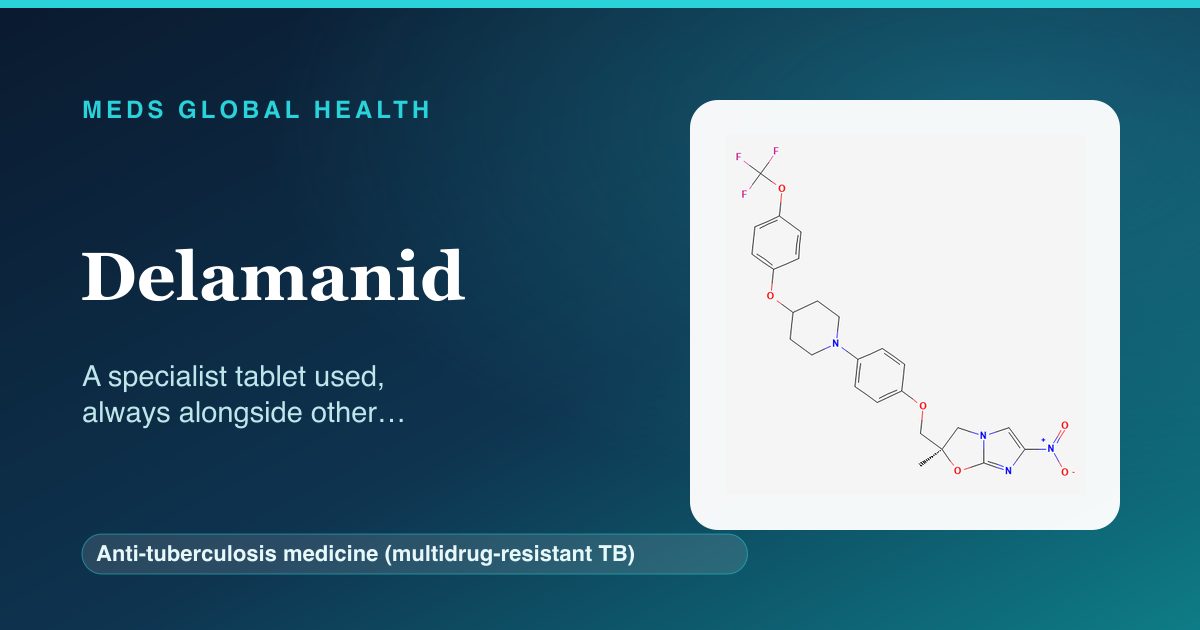
What it is
Delamanid is a medicine used to treat multidrug-resistant tuberculosis, a serious lung (and sometimes other organ) infection caused by TB bacteria that have stopped responding to the standard first-choice antibiotics. It is taken by mouth as a tablet and is always given as one part of a longer combination of several anti-TB medicines. It is reserved for difficult, drug-resistant TB and is prescribed and closely supervised by a specialist TB team, because treatment is long and needs careful monitoring.
How it works
Delamanid attacks the TB bacteria by stopping them building part of their protective cell wall, which they need to survive. Because TB bacteria can quickly become resistant to a single medicine, delamanid is always combined with several other anti-TB drugs so the bacteria are hit in different ways at once; this protects each medicine, including delamanid, from losing its effect. Treatment is taken every day for a long time so that all the bacteria, including slow-growing ones, are cleared and the infection does not come back.
Company & origin
A specialist medicine used in the UK as part of combination treatment for multidrug-resistant tuberculosis (MDR-TB).
Practical use
How to take Delamanid
General, dose-free guidance — always follow your prescriber's and the leaflet's specific instructions.
- Take it with food, which helps your body absorb it properly.
- Take it exactly as prescribed and always alongside your other anti-TB medicines, never on its own.
- Do not miss doses or stop early, even when you feel better, as the TB can return and become harder to treat.
- Attend your appointments for heart tracings (ECGs) and blood tests so your team can monitor your heart rhythm.
- Tell your team about all other medicines you take, especially any that can affect the heart's rhythm.
Weighing it up
Advantages & disadvantages of Delamanid
Advantages
- An effective option as part of combination treatment for multidrug-resistant TB, where choices are limited.
- Taken by mouth as a tablet rather than by injection.
- Works in a different way from older anti-TB medicines, helping when bacteria are resistant to them.
Disadvantages
- Can affect the heart's electrical rhythm (the QT interval), so regular ECGs are needed.
- Must always be used in combination, never alone, and as part of a long course of treatment.
- Needs close specialist supervision with regular monitoring throughout.
Practical use
Good to know
The single most important thing to understand about delamanid is that it is never used on its own: it is always part of a combination of anti-TB medicines, because using it alone would let the bacteria become resistant to it. A key safety point is that it can affect the heart's electrical rhythm, lengthening what is called the QT interval, so a heart tracing (ECG) is done before treatment and repeated during it, and blood salts such as potassium are kept in the normal range. It is taken with food, which helps it be absorbed. Treatment for drug-resistant TB is long and demanding, so taking every dose as scheduled is vital; missing doses risks the infection coming back and becoming harder to treat. The specialist team watches closely for side effects and for any heart-rhythm changes.
Who should not take it / use with caution
- People who have had a serious allergic reaction to delamanid should not take it.
- It is used with great caution, or avoided, in people with certain heart-rhythm problems or a long QT interval.
- It should only be used under a specialist TB service, with ECG and blood monitoring.
Monitoring
- Heart tracings (ECGs) before and during treatment to watch the QT interval.
- Blood tests for salts such as potassium, and for liver function.
- Reviewing how the TB is responding and watching for side effects throughout the long course.
Side effects
- Changes in the heart's electrical rhythm (a longer QT interval), which monitoring is designed to catch.
- Nausea, vomiting or stomach upset.
- Headache, dizziness, or feelings of anxiety or low mood in some people.
Key interactions
- Other medicines that can affect the heart's QT interval add to the risk and must be reviewed.
- Some medicines can change the levels of delamanid in the body, so a full medicines list is important.
- Low blood potassium or other salt imbalances can worsen heart-rhythm effects and are corrected first.
Available as: Tablets taken by mouth.
Answers
Delamanid: frequently asked questions
What is delamanid used for?
It is used as part of combination treatment for multidrug-resistant tuberculosis, a form of TB that does not respond to the usual first-choice antibiotics.
Why is it never taken on its own?
Using a single TB medicine alone lets the bacteria become resistant to it, so delamanid is always combined with several other anti-TB medicines.
Why do I need heart tracings (ECGs)?
Delamanid can lengthen the heart's QT interval, so ECGs are done before and during treatment to keep your heart rhythm safe.
Should I take it with food?
Yes, it is taken with food, which helps your body absorb it properly.
Can I stop once I feel better?
No. Drug-resistant TB needs a long, full course; stopping early risks the infection returning and becoming harder to treat.
Authoritative sources
- BNF
- NICE CKS
Building a medicines information resource?
We create evidence-led, dose-free drug and formulary references for teams.