A fast on-and-off inhaled anaesthetic gas
Desflurane
An inhaled anaesthetic that works and wears off quickly; very pungent, so used only to maintain anaesthesia, with notable environmental concerns.
What is Desflurane?
Desflurane is an inhaled general anaesthetic, breathed in as a vapour to keep people asleep during surgery. It is given by an anaesthetist, who monitors breathing, heart rate, blood pressure and consciousness. Its advantage is that it works and wears off very quickly, allowing fast recovery, which can be useful in longer operations or in people where rapid waking matters. However, it is very pungent and irritates the airway, so it is not used to send people to sleep by mask, only to keep them asleep. It is also a potent greenhouse gas, so its use is increasingly limited for environmental reasons.
Education and reference only. This is a plain-language guide to Desflurane — it deliberately contains no doses. Doses depend on the person, the brand and the reason for treatment, and belong with your prescriber. Always check the BNF, the product labelling (SmPC) and follow medical advice.
What it is
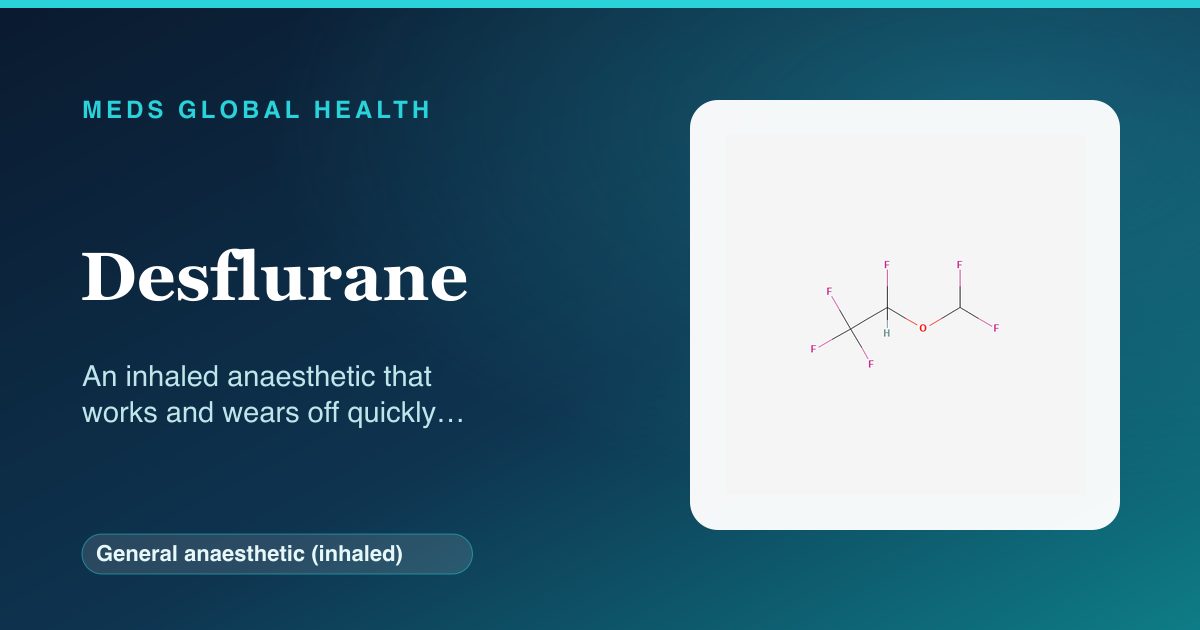
Desflurane is a general anaesthetic given as a vapour that the person breathes in, mixed with oxygen, usually through a breathing tube. It is given and supervised by anaesthetists, who monitor breathing, heart rate, blood pressure and consciousness. It is used to keep people asleep during surgery (maintenance) after they have been sent to sleep by another method. Its distinctive feature is that it acts and wears off very quickly, allowing rapid waking. Because it is very irritating to breathe, it is not used to send people to sleep by mask.
How it works
Desflurane is absorbed and cleared by the lungs very rapidly, so the depth of anaesthesia changes quickly when the anaesthetist alters how much is breathed, and people tend to wake quickly when it is stopped. This fast on-and-off behaviour is its main advantage. The downside is that it is highly pungent and irritant to the airway, causing coughing, breath-holding or airway spasm if used to send someone to sleep, so it is reserved for keeping a person asleep once they already are.
Company & origin
An inhaled anaesthetic used in the UK to keep people asleep during surgery, valued for quick recovery but limited by airway irritation and environmental concerns.
Practical use
How to take Desflurane
General, dose-free guidance — always follow your prescriber's and the leaflet's specific instructions.
- Desflurane is breathed in as a vapour, given and adjusted by an anaesthetist, usually through a breathing tube; it is not something you take yourself.
- Tell the anaesthetic team about your medicines, allergies and any personal or family history of problems with anaesthesia beforehand.
- You will be sent to sleep by another method first, then kept asleep with desflurane.
- You will be monitored throughout, with the depth of anaesthesia adjusted by changing how much you breathe.
- Tell staff if you feel sick or muddled on waking, as this can occur, settles, and can be treated.
Weighing it up
Advantages & disadvantages of Desflurane
Advantages
- Works and wears off very quickly, allowing rapid recovery after surgery.
- Lets the anaesthetist adjust the depth of anaesthesia rapidly during an operation.
- Can be useful in longer operations or where fast waking is an advantage.
Disadvantages
- Very pungent and irritant to the airway, so it cannot be used to send people to sleep by mask.
- A potent greenhouse gas, so its use is increasingly limited for environmental reasons.
- Can lower blood pressure and, like all anaesthetic vapours, very rarely trigger malignant hyperthermia.
Practical use
Good to know
Desflurane is given by an anaesthetist who monitors you closely and adjusts the amount you breathe. Its key strength is speed: it works and wears off very quickly, so recovery can be rapid, which can be helpful in some longer operations. Its main drawbacks are that it is very pungent and irritant, so it cannot be used to send people to sleep by mask and is reserved for maintaining anaesthesia, and that it is a potent greenhouse gas. Because of this environmental impact, many UK hospitals are reducing or stopping its use in favour of alternatives. Like all anaesthetic vapours, it can lower blood pressure and, very rarely, trigger the serious inherited reaction malignant hyperthermia, which anaesthetists are trained to recognise and treat.
Who should not take it / use with caution
- People with a personal or family history of malignant hyperthermia must not be given desflurane or other triggering anaesthetics.
- It is not used to send people to sleep by mask because it is too irritating to breathe.
- As with all anaesthetics, the team must know about any previous serious reactions to anaesthesia.
Monitoring
- Continuous monitoring of breathing, oxygen levels, the amount of vapour breathed, heart rate, blood pressure and consciousness.
- Watching closely for any early signs of malignant hyperthermia, such as a rising temperature.
- Reviewing recovery, including any nausea or confusion, after the anaesthetic.
Side effects
- Coughing, breath-holding or airway spasm if breathed in while still awake, which is why it is not used for gas induction.
- A fall in blood pressure, managed by the anaesthetic team.
- Nausea or confusion on waking, and very rarely the serious inherited reaction malignant hyperthermia.
Key interactions
- Its effects add to those of other anaesthetics, sedatives and strong painkillers; the team balances all of these.
- Care is taken alongside medicines that affect blood pressure or heart rate.
- The anaesthetic team manages its use with muscle relaxants and other agents during surgery.
Available as: Vapour breathed in through a breathing tube, given by an anaesthetist in hospital.
Answers
Desflurane: frequently asked questions
What is the advantage of desflurane?
It works and wears off very quickly, so recovery can be rapid, which can be useful in some longer operations.
Why isn't it used to send me to sleep by mask?
Desflurane is very pungent and irritating, which can cause coughing or airway spasm, so it is only used to keep you asleep, not to send you to sleep.
Is desflurane bad for the environment?
Yes, it is a potent greenhouse gas, which is why many UK hospitals are reducing or stopping its use in favour of alternatives.
What is malignant hyperthermia?
It is a very rare, serious inherited reaction to certain anaesthetics in which temperature and muscle activity rise dangerously; anaesthetists are trained to recognise and treat it.
Will I be aware during my operation?
No. Desflurane keeps you asleep, and the anaesthetist monitors you throughout to keep you at the right depth.
Authoritative sources
- BNF
- NICE CKS
Building a medicines information resource?
We create evidence-led, dose-free drug and formulary references for teams.