A sedative drip used in intensive care and for procedures
Dexmedetomidine
A sedative given as a hospital drip to keep people calm in intensive care and during some procedures.
What is Dexmedetomidine?
Dexmedetomidine is a specialist sedative used in hospital, mainly in intensive care and for certain procedures, to keep people calm and comfortable. It is given as a drip into a vein under close monitoring. A useful feature is that it can sedate while still allowing people to be roused fairly easily. Its main risks are slowing of the heartbeat and a fall in blood pressure, which is why heart rate and blood pressure are watched continuously. It is used only by trained staff in a monitored setting, not as a medicine to take at home.
Education and reference only. This is a plain-language guide to Dexmedetomidine — it deliberately contains no doses. Doses depend on the person, the brand and the reason for treatment, and belong with your prescriber. Always check the BNF, the product labelling (SmPC) and follow medical advice.
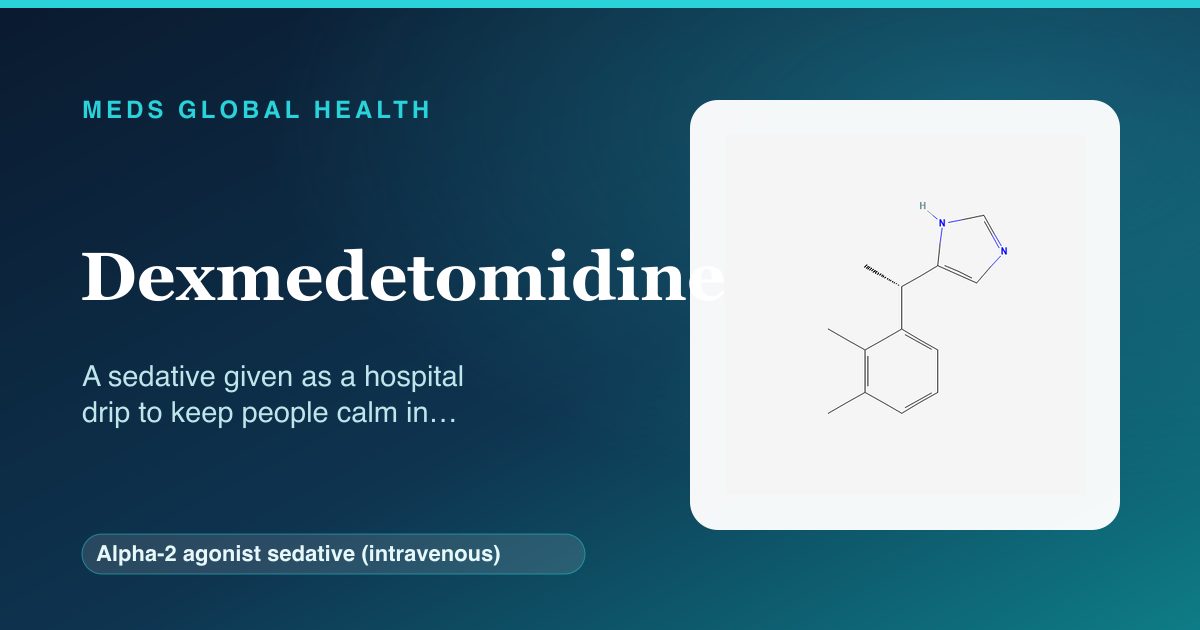
What it is
Dexmedetomidine is a sedative medicine used in hospital to keep people calm and comfortable, particularly those on a breathing machine in intensive care and during some procedures or scans. It is given as a drip into a vein rather than as a tablet. A distinctive feature is that it provides sedation while often still allowing the person to be roused and to respond, which can be helpful. Because it can affect heart rate and blood pressure, it is used only in monitored settings by staff trained to watch for and manage these effects.
How it works
Dexmedetomidine acts on receptors in the brain (alpha-2 receptors) that turn down the body's alertness and stress signals. By calming this part of the nervous system, it produces sedation and relief of anxiety, and it can also reduce the need for some other sedatives or painkillers. Because these same signals help control heart rate and blood pressure, dampening them can slow the heartbeat and lower blood pressure. It is given as a controlled drip so the depth of sedation can be adjusted, and so its effects on the heart and circulation can be watched closely.
Company & origin
A specialist sedative used in hospital in the UK, mainly in intensive care and for certain procedures, given as a drip under close monitoring.
Practical use
How to take Dexmedetomidine
General, dose-free guidance — always follow your prescriber's and the leaflet's specific instructions.
- It is given only in hospital as a drip into a vein, with heart rate and blood pressure watched continuously.
- Expect the rate of the drip to be adjusted to keep you calm and comfortable at the right level of sedation.
- Tell the team if you have a history of a slow heartbeat or low blood pressure, as these can be affected.
- It is managed by trained staff in a monitored setting and is not a medicine to take at home.
- After longer use it is usually eased off gradually rather than stopped suddenly.
Weighing it up
Advantages & disadvantages of Dexmedetomidine
Advantages
- Provides sedation while often still allowing the person to be roused and to respond.
- Useful for keeping people calm in intensive care and during some procedures.
- Can reduce the need for some other sedatives or painkillers.
Disadvantages
- Can slow the heartbeat and lower blood pressure, needing continuous monitoring.
- Hospital-only and given by drip, not a medicine to take at home.
- After long use it usually needs easing off carefully to avoid a rebound rise in blood pressure or heart rate.
Practical use
Good to know
The most important things to know about dexmedetomidine are that it is a hospital-only sedative given by drip and that its main risks are a slow heartbeat and a drop in blood pressure, which is why heart rate and blood pressure are monitored continuously while it is running. A helpful feature is that it can keep people calm while still allowing them to be roused, which can be useful in intensive care. The team adjusts the drip to get the right depth of sedation and can slow or stop it if the heart slows too much or blood pressure falls. It is used by trained staff in a monitored setting and is not something taken at home. Stopping it abruptly after long use can sometimes cause a rebound rise in blood pressure or heart rate, so it is usually eased off carefully.
Who should not take it / use with caution
- People who have had a serious allergic reaction to dexmedetomidine should not be given it.
- It is used with great caution, or avoided, in people with a very slow heartbeat or certain heart-conduction problems.
- It is used with care in people with low blood pressure or unstable circulation, under close monitoring.
- It is given only by trained staff in a monitored hospital setting.
Monitoring
- Continuous monitoring of heart rate and blood pressure while the drip runs.
- Checking the depth of sedation and adjusting the drip to keep it at the right level.
- Easing the drip off carefully after long use to avoid a rebound rise in blood pressure or heart rate.
Side effects
- A slow heartbeat, which monitoring is designed to catch.
- A fall in blood pressure, with dizziness or faintness.
- A dry mouth or nausea.
- Sometimes a rise in blood pressure or heart rate if it is stopped suddenly after long use.
Key interactions
- Other sedatives, strong painkillers or anaesthetics can add to its calming and blood-pressure-lowering effects.
- Medicines that slow the heart or lower blood pressure can add to those effects, so they are watched closely.
- The team takes account of all your medicines when setting and adjusting the drip.
Available as: A solution given as a drip into a vein in hospital.
Answers
Dexmedetomidine: frequently asked questions
What is dexmedetomidine used for?
It is a sedative used in hospital, mainly in intensive care and for some procedures, to keep people calm and comfortable, given as a drip into a vein.
Will it put me fully to sleep?
It provides sedation but often still allows you to be roused and to respond, which can be helpful; the team adjusts the drip to get the right level.
What are its main risks?
Its main risks are a slow heartbeat and a fall in blood pressure, which is why your heart rate and blood pressure are monitored continuously while it runs.
Can I take it at home?
No, it is given only in hospital by trained staff as a drip, with continuous monitoring; it is not a medicine to take at home.
Why is it stopped slowly after long use?
Stopping it suddenly after long use can cause a rebound rise in blood pressure or heart rate, so it is usually eased off gradually.
Authoritative sources
- BNF
- NICE CKS
Building a medicines information resource?
We create evidence-led, dose-free drug and formulary references for teams.