An emergency antidote for severe cyanide poisoning
Dicobalt edetate
An emergency antidote for severe cyanide poisoning that is itself toxic, so it is used only when cyanide poisoning is certain and severe.
What is Dicobalt edetate?
Dicobalt edetate is an emergency antidote used in hospital for severe cyanide poisoning, given by injection into a vein. It works by binding cyanide so it can be removed from the body. The most important point is that the medicine is itself toxic, because it contains cobalt, so it is only used when cyanide poisoning is certain and severe, not as a precaution; giving it when there is no real cyanide poisoning can cause harm. It can cause vomiting, a fall in blood pressure, a fast heartbeat and allergic reactions. It is given only by trained emergency staff who can manage these effects.
Education and reference only. This is a plain-language guide to Dicobalt edetate — it deliberately contains no doses. Doses depend on the person, the brand and the reason for treatment, and belong with your prescriber. Always check the BNF, the product labelling (SmPC) and follow medical advice.
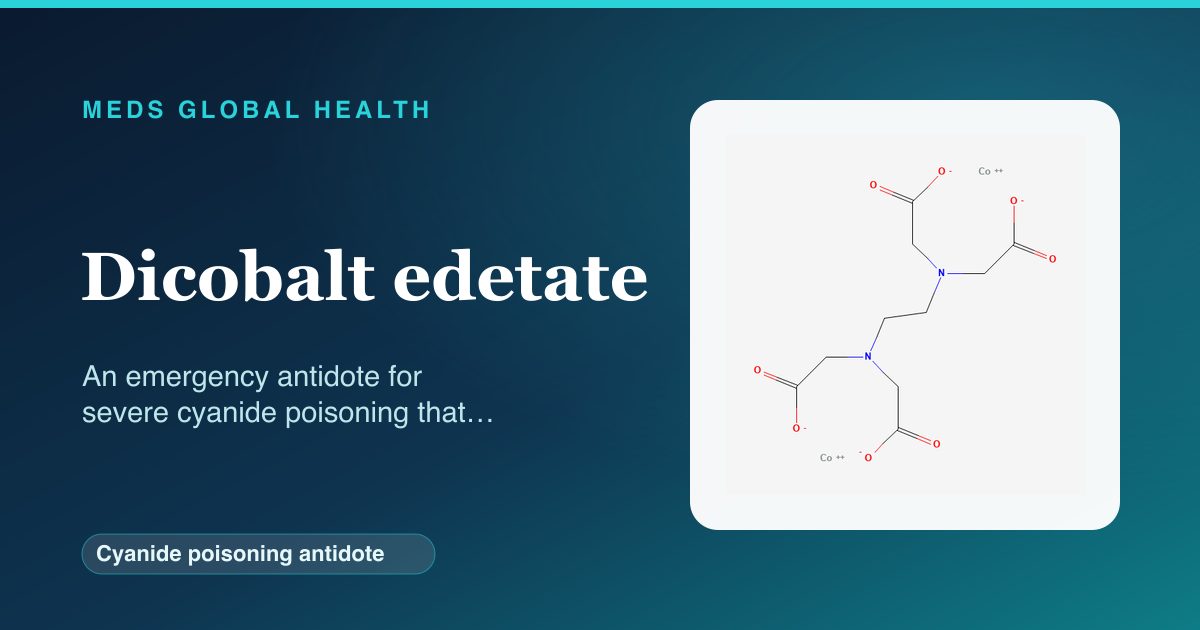
What it is
Dicobalt edetate is an antidote used in the emergency treatment of severe cyanide poisoning, which can happen from certain chemicals, industrial accidents or smoke from some fires. Cyanide is extremely dangerous because it stops cells using oxygen. Dicobalt edetate is given as an injection into a vein and works by mopping up cyanide. Crucially, the antidote is itself toxic because it contains cobalt, so it is reserved for cases where cyanide poisoning is certain and severe; in milder or uncertain cases, safer alternatives are used instead. It is used only in hospital by trained emergency staff.
How it works
Cyanide poisons the body by binding inside cells and blocking them from using oxygen, so the tissues quickly become starved of energy. Dicobalt edetate works because cobalt strongly binds cyanide, forming a compound that can be removed, which frees the cells to use oxygen again. Because cobalt itself is toxic, the antidote is a calculated trade-off: it is given when the danger from cyanide clearly outweighs the harm from the cobalt. This is why it is used only when cyanide poisoning is certain and severe, alongside other emergency support such as oxygen.
Company & origin
An emergency antidote used in UK hospitals for severe, confirmed cyanide poisoning.
Practical use
How to take Dicobalt edetate
General, dose-free guidance — always follow your prescriber's and the leaflet's specific instructions.
- It is given only by trained emergency hospital staff as an injection into a vein, not something you take yourself.
- It is used only when cyanide poisoning is certain and severe, because the antidote is itself toxic.
- It is given alongside other emergency support, such as oxygen, by staff ready to manage reactions.
- The patient is closely monitored during and after treatment for blood pressure, heart rhythm and allergic reactions.
- It is never given as a precaution in cases where cyanide poisoning is not clearly present.
Weighing it up
Advantages & disadvantages of Dicobalt edetate
Advantages
- Acts as a rapid antidote in severe, confirmed cyanide poisoning, which is otherwise quickly fatal.
- Binds cyanide so the body's cells can use oxygen again.
- A recognised emergency treatment used by experienced poisoning teams.
Disadvantages
- The antidote is itself toxic because it contains cobalt, so it is only for certain, severe poisoning.
- Can cause vomiting, a fall in blood pressure, a fast heartbeat and allergic reactions.
- Giving it when there is no real cyanide poisoning can cause serious harm.
Practical use
Good to know
The most important thing to understand about dicobalt edetate is that it is itself toxic, because of its cobalt content, so it is not given 'just in case': it is reserved for severe, confirmed cyanide poisoning where the risk from cyanide clearly outweighs the harm from the cobalt. Giving it to someone who is not actually poisoned with cyanide can cause serious cobalt-related effects, including vomiting, a fall in blood pressure, a fast or irregular heartbeat, chest tightness and facial or throat swelling. Because of these risks, it is given only in hospital by trained emergency staff who can monitor the patient and treat reactions, often alongside oxygen and other supportive care. It is an emergency-only medicine, and the decision to use it is made quickly but carefully by clinicians experienced in poisoning.
Who should not take it / use with caution
- It should not be given when cyanide poisoning is not clearly present, because the antidote itself is toxic.
- It is used with great caution in people known to react badly to cobalt-containing treatments.
- It is used only in hospital by trained emergency staff able to manage its reactions.
Monitoring
- Close monitoring of blood pressure, heart rhythm and breathing during and after treatment.
- Watching for allergic reactions, including facial or throat swelling.
- Reviewing the response to the antidote alongside other supportive care.
Side effects
- Vomiting and a fall in blood pressure.
- A fast or irregular heartbeat and chest tightness.
- Allergic-type reactions, including facial or throat swelling, which need immediate management.
Key interactions
- It is used alongside other emergency treatments and oxygen, managed together by the emergency team.
- Its toxic effects can add to those of the poisoning itself, so the patient is closely monitored.
- There are few routine medicine interactions, as it is used only in an emergency under close supervision.
Available as: A solution for injection into a vein, given in hospital.
Answers
Dicobalt edetate: frequently asked questions
What is dicobalt edetate used for?
It is an emergency antidote for severe cyanide poisoning, given by injection into a vein to bind cyanide so it can be removed from the body.
Why is it not used as a precaution?
The antidote is itself toxic because it contains cobalt, so it is reserved for certain, severe cyanide poisoning; giving it without real poisoning can cause serious harm.
What problems can it cause?
It can cause vomiting, a fall in blood pressure, a fast heartbeat, chest tightness and allergic reactions including facial or throat swelling, which is why it is given by trained staff.
How is it given?
It is given as an injection into a vein in hospital by trained emergency staff, alongside other support such as oxygen.
Is there an alternative for milder cases?
Yes. Because dicobalt edetate is toxic, safer alternatives are used in milder or uncertain cases, with this antidote reserved for severe, confirmed poisoning.
Authoritative sources
- BNF
- NICE CKS
Building a medicines information resource?
We create evidence-led, dose-free drug and formulary references for teams.