A stimulant appetite suppressant for short-term weight loss
Diethylpropion
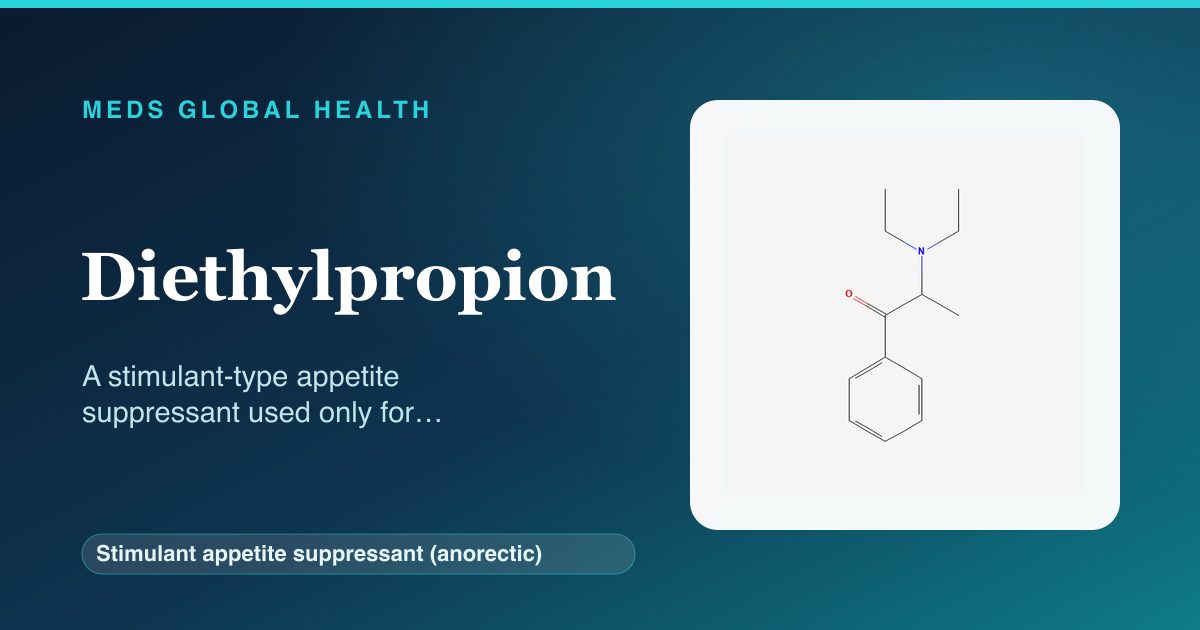
A stimulant-type appetite suppressant used only for short-term weight loss, with important heart and dependence risks.
What is Diethylpropion?
Diethylpropion is a stimulant-type appetite suppressant, used only for short-term help with weight loss alongside diet and exercise. The most important safety points are that it raises the heart rate and blood pressure, so it is not suitable for people with heart disease or uncontrolled high blood pressure, and that it is a stimulant with a potential for dependence and misuse, which is why it is a controlled drug and used only for a short time. It is rarely used in the UK now, with other approaches to weight management generally preferred.
Education and reference only. This is a plain-language guide to Diethylpropion — it deliberately contains no doses. Doses depend on the person, the brand and the reason for treatment, and belong with your prescriber. Always check the BNF, the product labelling (SmPC) and follow medical advice.
What it is
Diethylpropion is an older medicine that reduces appetite. It belongs to a stimulant-related group of appetite suppressants, sometimes called anorectics, and is used only as a short-term aid to weight loss in addition to a reduced-calorie diet and more physical activity. Because it is a stimulant, it carries risks to the heart and blood pressure and has a potential for dependence and misuse, so it is a controlled drug. It is rarely prescribed in the UK today, where lifestyle support and newer weight-management treatments are generally preferred, but it is still encountered in some settings and in other countries.
How it works
Diethylpropion works on the brain to reduce the feeling of hunger, making it easier to eat less while following a weight-loss diet. As a stimulant-related medicine, it also has effects on the rest of the body similar to those of the body's own 'fight or flight' signals, which is why it can increase the heart rate and blood pressure. Its effect on appetite tends to lessen over a few weeks, which is one reason it is only ever meant for short-term use; it is not a long-term solution and does not replace lasting changes to diet and activity.
Company & origin
An older stimulant-type appetite suppressant used for short-term weight loss; rarely used in the UK because of its risks and potential for misuse.
Practical use
How to take Diethylpropion
General, dose-free guidance — always follow your prescriber's and the leaflet's specific instructions.
- Take it exactly as prescribed, only for the short period advised, alongside a reduced-calorie diet and more activity.
- Take it earlier in the day to reduce the chance of difficulty sleeping.
- Never increase the dose, take it for longer than advised, or share it with anyone else.
- Report any chest pain, palpitations, breathlessness or marked anxiety promptly.
- Do not stop a longer course abruptly without advice, and tell your prescriber about all other medicines you take.
Weighing it up
Advantages & disadvantages of Diethylpropion
Advantages
- Can reduce appetite and give short-term help with weight loss alongside diet and exercise.
- Taken by mouth as a tablet.
- May give a useful early boost to a structured weight-loss plan in carefully selected people.
Disadvantages
- Raises the heart rate and blood pressure, so it is unsuitable for people with heart disease.
- Has a potential for dependence and misuse and is a controlled drug.
- Only works in the short term, and is rarely used in the UK with safer options preferred.
Practical use
Good to know
There are several important things to understand about diethylpropion. First, it is only ever a short-term aid: its appetite effect fades within weeks, and it is not a long-term treatment, so it works only as part of lasting changes to diet and activity. Second, as a stimulant it raises the heart rate and blood pressure, so it is not suitable for people with heart disease, an irregular heartbeat or uncontrolled high blood pressure, and any chest pain, palpitations or breathlessness should be reported at once. Third, it has a potential for dependence and misuse and is a controlled drug, so it must be taken exactly as prescribed and never shared. It can also cause restlessness, difficulty sleeping, a dry mouth and mood changes. Taking it earlier in the day can help reduce sleep problems. Because of these risks, it is rarely used in the UK, and other weight-management options are usually preferred.
Who should not take it / use with caution
- People with heart disease, an irregular heartbeat or uncontrolled high blood pressure should not take it.
- People with overactive thyroid, glaucoma, or a history of drug or alcohol misuse should not take it.
- People with current or past serious mental-health problems, such as severe anxiety or psychosis, should not take it.
- It should not be taken with, or close to, antidepressants called monoamine oxidase inhibitors (MAOIs).
Monitoring
- Checking heart rate and blood pressure before and during treatment.
- Reviewing how much weight is being lost and stopping if it is not effective.
- Watching for signs of dependence, mood changes or heart symptoms, and keeping use short.
Side effects
- A faster heartbeat, palpitations and raised blood pressure.
- Restlessness, anxiety, difficulty sleeping and a dry mouth.
- Mood changes, headache or dizziness.
- Rarely but seriously, dependence, or heart and blood-pressure problems that need urgent attention.
Key interactions
- It must not be combined with MAOI antidepressants, which can cause a dangerous rise in blood pressure.
- Other stimulants, decongestants and some other appetite suppressants add to its effects on the heart and blood pressure.
- Tell your prescriber about all medicines, as it can interact with several, including some for mood and blood pressure.
Available as: Tablets taken by mouth.
Answers
Diethylpropion: frequently asked questions
What is diethylpropion used for?
It is a stimulant-type appetite suppressant used only for short-term help with weight loss, alongside a reduced-calorie diet and more physical activity.
Why is it only used short-term?
Its effect on appetite fades within weeks, and it carries risks including dependence and effects on the heart, so it is only ever meant as a short-term aid.
Is it safe for my heart?
It raises the heart rate and blood pressure, so it is not suitable for people with heart disease, an irregular heartbeat or uncontrolled high blood pressure, and heart symptoms should be reported at once.
Can it be addictive?
As a stimulant it has a potential for dependence and misuse, which is why it is a controlled drug, must be taken exactly as prescribed and should never be shared.
Why is it rarely used in the UK?
Because of its risks to the heart and its potential for dependence, it is rarely prescribed in the UK, where lifestyle support and newer weight-management options are generally preferred.
Authoritative sources
- BNF
- NICE CKS
Building a medicines information resource?
We create evidence-led, dose-free drug and formulary references for teams.