Also called BAL; a heavy-metal antidote
Dimercaprol
An emergency antidote given by injection to treat poisoning with heavy metals such as arsenic, gold, mercury and lead.
What is Dimercaprol?
Dimercaprol, also called BAL, is a long-established antidote used to treat poisoning with certain heavy metals, including arsenic, gold, mercury and (alongside another medicine) lead. It works by binding to the metal so the body can get rid of it. It is given by deep injection into a muscle, which is often painful. Common effects include a rise in blood pressure and heart rate, fever (especially in children) and discomfort at the injection site. Importantly, it is prepared in peanut (arachis) oil, so it must be avoided in people with peanut allergy, and it is used with care in people with the inherited condition G6PD deficiency.
Education and reference only. This is a plain-language guide to Dimercaprol — it deliberately contains no doses. Doses depend on the person, the brand and the reason for treatment, and belong with your prescriber. Always check the BNF, the product labelling (SmPC) and follow medical advice.
What it is
Dimercaprol, also known as BAL, is an antidote used in hospital to treat poisoning with heavy metals such as arsenic, gold and mercury, and as part of the treatment of lead poisoning. It works by chelation, meaning it grabs hold of the metal so it can be removed from the body. It is given as a deep injection into a muscle, because it is prepared in an oily base, and the injection is often painful. It is a specialist, hospital-based emergency treatment given under close medical supervision.
How it works
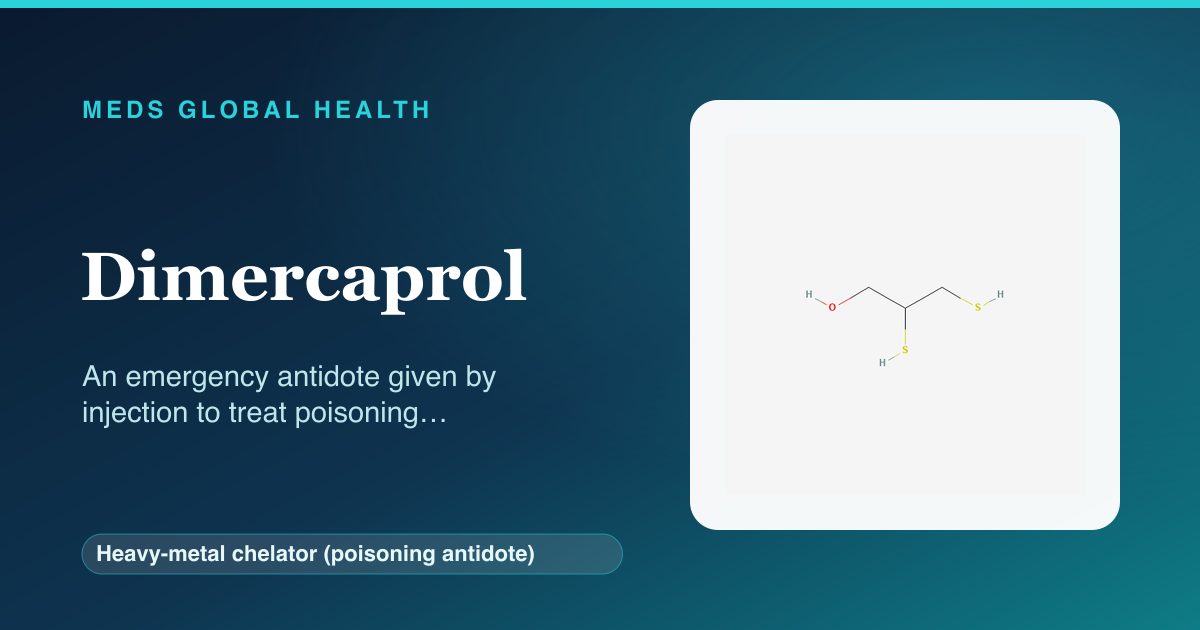
Heavy metals cause harm by attaching to important parts of the body's cells and stopping them working. Dimercaprol carries chemical 'hooks' that bind tightly to these metals, forming a stable, non-toxic package that the body can then remove, mainly through the kidneys. By mopping up the metal in this way, it reduces ongoing damage and helps clear the poison. Because it is broken down and cleared fairly quickly, it is given as repeated injections over a treatment course, with the schedule depending on the metal involved and how severe the poisoning is.
Company & origin
A long-established emergency antidote used in the UK to treat poisoning with heavy metals such as arsenic, gold, mercury and lead.
Practical use
How to take Dimercaprol
General, dose-free guidance — always follow your prescriber's and the leaflet's specific instructions.
- It is given by a healthcare professional as a deep injection into a muscle, on the schedule set for your treatment.
- Tell the team about any peanut allergy before it is given, as it is prepared in peanut oil and must be avoided in peanut allergy.
- Tell the team if you have the inherited condition G6PD deficiency, as it is used with caution in that case.
- Expect the injection to be painful and to possibly feel a temporary rise in heart rate or a flushed, warm feeling.
- Stay in hospital for monitoring throughout the treatment course as advised by the team.
Weighing it up
Advantages & disadvantages of Dimercaprol
Advantages
- An effective, long-established antidote for poisoning with several heavy metals.
- Binds the metal so the body can clear it, reducing ongoing harm.
- Can be life-saving in serious heavy-metal poisoning when given promptly.
Disadvantages
- Given as a deep injection into a muscle, which is often painful.
- Commonly causes a rise in blood pressure and heart rate, fever (especially in children) and other short-lived effects.
- Prepared in peanut oil, so it cannot be used in peanut allergy, and is used with caution in G6PD deficiency.
Practical use
Good to know
Two safety points stand out. First, dimercaprol is prepared in peanut (arachis) oil, so it must not be given to anyone with a peanut allergy because of the risk of a serious reaction; the team will always check for this. Second, it is used with caution in people with the inherited condition G6PD deficiency, because it can trigger breakdown of red blood cells. The injection is deep into a muscle and is often painful, and it commonly causes a temporary rise in blood pressure and heart rate, headache, a burning feeling in the mouth or throat, watering eyes and nausea; in children a fever is common. Keeping the urine on the alkaline side may be advised to protect the kidneys while the metal is being cleared. It is always given in hospital with close monitoring.
Who should not take it / use with caution
- People with a peanut allergy must not receive it, as it is prepared in peanut (arachis) oil.
- It is used with great caution in people with serious liver problems, under specialist judgement.
- It is used with caution in people with the inherited condition G6PD deficiency, because of the risk of red-blood-cell breakdown.
Monitoring
- Checking for peanut allergy and G6PD deficiency before treatment.
- Monitoring blood pressure, heart rate and temperature, particularly in children.
- Checking kidney function and metal levels during and after the treatment course.
Side effects
- A temporary rise in blood pressure and heart rate, sometimes with headache.
- Pain at the injection site, a burning feeling in the mouth, throat or eyes, and watering eyes.
- Nausea, vomiting and, especially in children, fever.
- Less commonly, allergic-type reactions or, in people with G6PD deficiency, breakdown of red blood cells.
Key interactions
- It should not usually be given together with iron supplements, as the combination can be harmful.
- The treatment plan depends on which heavy metal is involved, and may be combined with other chelating medicines.
- Tell the team about all medicines and any allergies, especially peanut allergy, before it is given.
Available as: A solution in an oily base for deep injection into a muscle.
Answers
Dimercaprol: frequently asked questions
What is dimercaprol used for?
It is an antidote used in hospital to treat poisoning with heavy metals such as arsenic, gold and mercury, and as part of treating lead poisoning.
Why is the injection painful?
Dimercaprol is prepared in an oily base and given as a deep injection into a muscle, which is often painful; it is given in hospital by trained staff.
Why does peanut allergy matter?
It is prepared in peanut (arachis) oil, so it must not be given to anyone with a peanut allergy because of the risk of a serious reaction.
What is G6PD deficiency and why is it relevant?
G6PD deficiency is an inherited condition that makes red blood cells more fragile; dimercaprol is used with caution because it can trigger their breakdown.
Why might my heart race after the injection?
A temporary rise in heart rate and blood pressure is a common effect of dimercaprol and usually settles; you are monitored closely while having treatment.
Authoritative sources
- BNF
- NICE CKS
Building a medicines information resource?
We create evidence-led, dose-free drug and formulary references for teams.