An antiarrhythmic for atrial fibrillation
Dofetilide
A specialist medicine used to maintain a normal heart rhythm in atrial fibrillation.
What is Dofetilide?
Dofetilide is a specialist antiarrhythmic medicine used to help maintain a normal heart rhythm in people with atrial fibrillation, an irregular and often fast heartbeat. It works on the heart's electrical timing, but for the same reason it can significantly lengthen the QT interval and trigger a dangerous rhythm called torsades de pointes. Because of this, it is started in hospital with continuous heart monitoring and careful checks of kidney function, since the kidneys clear it from the body. It also interacts with many other medicines, so a full medicines list is essential before and during treatment.
Education and reference only. This is a plain-language guide to Dofetilide — it deliberately contains no doses. Doses depend on the person, the brand and the reason for treatment, and belong with your prescriber. Always check the BNF, the product labelling (SmPC) and follow medical advice.
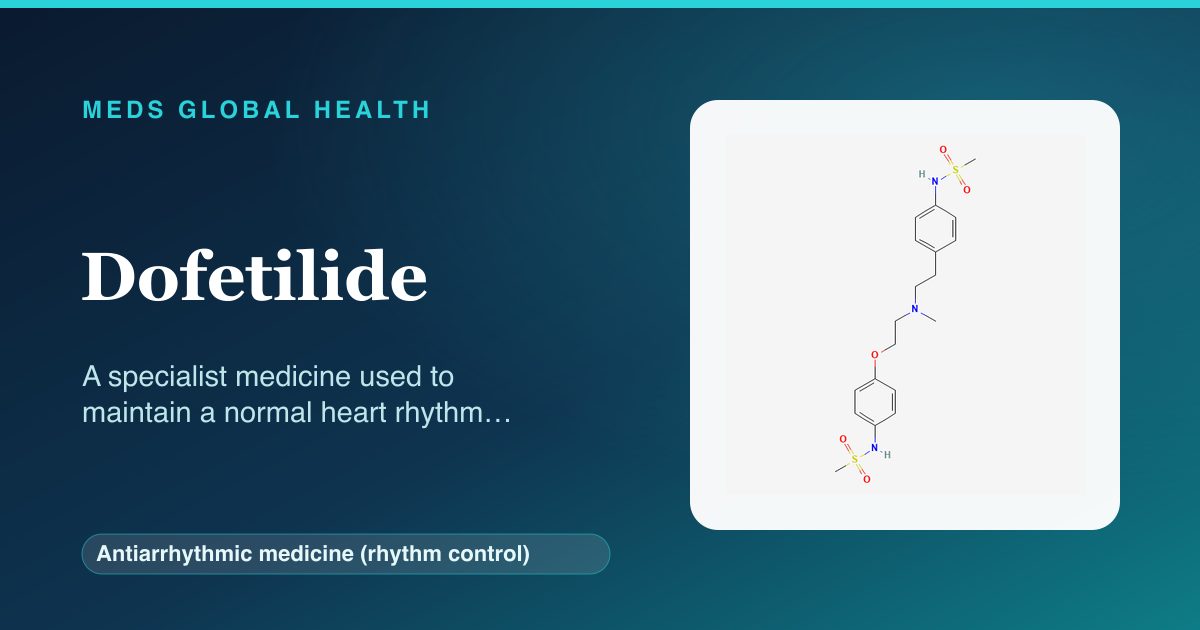
What it is
Dofetilide is an antiarrhythmic medicine, used to help keep the heart beating in a normal rhythm in people who have atrial fibrillation, a common condition where the heart's upper chambers beat in a fast, irregular way. It works on the electrical signals in the heart muscle. Because it can have powerful effects on the heart's electrical timing, it is treated as a specialist medicine that must be started under close supervision in hospital. It is taken by mouth and is mainly used to maintain a normal rhythm once it has been restored, rather than for everyday rate control.
How it works
Dofetilide acts on the heart's electrical system, lengthening the time the heart muscle takes to reset between beats. This helps prevent the chaotic electrical activity of atrial fibrillation from taking hold, so a normal rhythm can be maintained. The same lengthening effect, measured as the QT interval on a heart tracing, can become excessive in some people and trigger a dangerous rhythm called torsades de pointes. Because this risk depends on the amount in the body, and because the kidneys clear the medicine, kidney function and the QT interval are checked carefully when it is started and during treatment.
Company & origin
A specialist heart-rhythm medicine used to help maintain a normal rhythm in atrial fibrillation, started in hospital with close monitoring.
What it treats
Conditions Dofetilide is used for
Practical use
How to take Dofetilide
General, dose-free guidance — always follow your prescriber's and the leaflet's specific instructions.
- Take it exactly as prescribed; it is started in hospital so your heart can be monitored at the beginning.
- Never change the amount or take extra, as too much raises the risk of a dangerous heart rhythm.
- Give your team a full list of all your medicines, as dofetilide interacts with many of them.
- Attend all heart tracings and kidney blood tests, as these guide whether it is safe to continue.
- Seek urgent help for fainting, palpitations or feeling your heart racing or fluttering.
Weighing it up
Advantages & disadvantages of Dofetilide
Advantages
- Can help maintain a normal heart rhythm in people with atrial fibrillation.
- Taken by mouth once treatment has been safely started.
- Offers a rhythm-control option for selected patients under specialist care.
Disadvantages
- Can significantly lengthen the QT interval and trigger a dangerous rhythm (torsades de pointes).
- Must be started in hospital with continuous heart monitoring and kidney checks.
- Interacts with many other medicines, requiring careful review of everything you take.
Practical use
Good to know
The dominant safety issue with dofetilide is its effect on the heart's electrical timing. It can lengthen the QT interval enough to trigger a serious rhythm disturbance called torsades de pointes, which is why it is not simply started at home. Instead, treatment begins in hospital with continuous heart monitoring for the first few days, and heart tracings and kidney blood tests guide whether it is safe to continue. Because the kidneys remove it from the body, anyone with reduced kidney function needs extra care, and kidney function is rechecked over time. Dofetilide also interacts with many other medicines, some of which can dangerously raise its level or add to the QT effect, so a complete and up-to-date medicines list is essential, and new medicines should always be checked with the prescriber.
Who should not take it / use with caution
- People with significant QT prolongation or certain serious heart-rhythm problems should not take it.
- People with significantly reduced kidney function may not be able to take it, or need extra care.
- People taking certain interacting medicines that raise its level or the QT effect should not take it.
- People who have had a serious allergic reaction to it should not take it.
Monitoring
- Continuous heart monitoring when treatment is first started in hospital.
- Regular heart tracings to check the QT interval during treatment.
- Regular kidney blood tests, as the kidneys clear the medicine from the body.
Side effects
- Changes in the heart's rhythm, including, importantly, dangerous rhythms linked to QT prolongation.
- Headache, dizziness or palpitations.
- Chest discomfort or feeling faint, which should be reported.
- Effects that are more likely if kidney function falls or interacting medicines are added.
Key interactions
- Many medicines can raise dofetilide levels or add to the QT effect, so all medicines must be reviewed.
- Some water tablets and other medicines can lower body potassium, which increases the rhythm risk.
- Always check with your prescriber before starting any new medicine, including ones bought over the counter.
Available as: Capsules taken by mouth.
Answers
Dofetilide: frequently asked questions
What is dofetilide used for?
It is a specialist medicine used to help maintain a normal heart rhythm in people with atrial fibrillation, an irregular and often fast heartbeat.
Why is it started in hospital?
It can lengthen the heart's electrical timing (the QT interval) and trigger a dangerous rhythm, so it is started with continuous monitoring to make sure it is safe.
Why do my kidneys need checking?
The kidneys clear dofetilide from the body, so reduced kidney function can let it build up; kidney blood tests help keep the amount safe.
Why does my team need my full medicines list?
Dofetilide interacts with many medicines, some of which can dangerously raise its level or add to the rhythm risk, so a complete list is essential.
What warning signs should I report?
Seek urgent help for fainting, palpitations or feeling your heart racing or fluttering, as these can signal a serious rhythm problem.
Authoritative sources
- BNF
- NICE CKS
Building a medicines information resource?
We create evidence-led, dose-free drug and formulary references for teams.