A medicine studied in motor neurone disease (ALS)
Edaravone
A specialist medicine for motor neurone disease (ALS), given as an infusion in repeating cycles.
What is Edaravone?
Edaravone is a specialist medicine that has been used to treat motor neurone disease, also called amyotrophic lateral sclerosis (ALS), a condition in which the nerves that control movement gradually weaken. It is thought to work by mopping up harmful substances (free radicals) that may damage nerve cells. It is given as an infusion into a vein in repeating cycles, with days on and days off treatment. The most important safety point is the risk of allergic-type reactions during the infusion, and the injectable form contains a sulfite, so people with a sulfite sensitivity need caution. It is a specialist treatment, not a cure.
Education and reference only. This is a plain-language guide to Edaravone — it deliberately contains no doses. Doses depend on the person, the brand and the reason for treatment, and belong with your prescriber. Always check the BNF, the product labelling (SmPC) and follow medical advice.
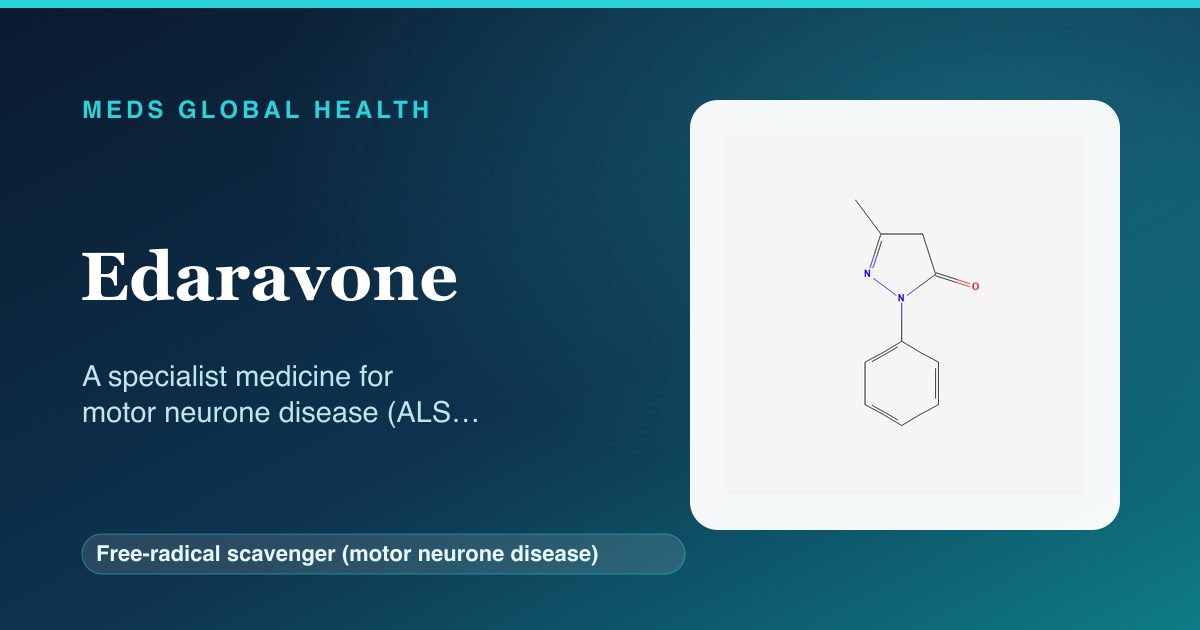
What it is
Edaravone is a medicine used in some countries to treat motor neurone disease (ALS), a condition in which the nerve cells controlling muscles slowly stop working, leading to weakness. It is given as an infusion into a vein, usually in cycles with a set number of treatment days followed by a break. It is thought to act as a free-radical scavenger, helping to protect nerve cells from a type of chemical damage. It does not cure the disease but is used as one part of overall specialist care, alongside other supportive treatments.
How it works
Nerve cells can be damaged by unstable molecules called free radicals, which cause a type of harm known as oxidative stress, and this may play a part in motor neurone disease. Edaravone is an antioxidant that 'mops up' these free radicals, which is thought to help slow some of the damage to the movement-controlling nerves. Because it is cleared from the body fairly quickly, it is given repeatedly in cycles rather than as a one-off. It is aimed at slowing the loss of function rather than reversing the disease or curing it.
Company & origin
A specialist medicine used in some countries for motor neurone disease (ALS), given by infusion in cycles.
Practical use
How to take Edaravone
General, dose-free guidance — always follow your prescriber's and the leaflet's specific instructions.
- Attend for the infusion into a vein on the scheduled days, following the cycle of treatment days and breaks.
- Tell the team about any sulfite sensitivity, as the injectable form contains a sulfite.
- Report any signs of a reaction during or after the infusion, such as rash, breathlessness, swelling or feeling faint, straight away.
- Keep using your other motor neurone disease treatments and supportive care as advised, as this is one part of overall care.
- Tell your team about all your other medicines and any allergies before treatment.
Weighing it up
Advantages & disadvantages of Edaravone
Advantages
- Aims to slow some of the damage to movement-controlling nerves in motor neurone disease.
- Given in defined cycles under specialist supervision.
- Used as part of broader supportive care for the condition.
Disadvantages
- Given as an infusion into a vein in repeating cycles, which takes time and attendance.
- Can cause allergic-type reactions, so infusions need monitoring.
- The injectable form contains a sulfite, which can rarely cause reactions in sensitive people; it is not a cure.
Practical use
Good to know
Edaravone is given as an infusion into a vein in cycles, so part of living with it is attending for the scheduled infusion days, which can be demanding. The most important safety point is the possibility of an allergic-type reaction during or shortly after the infusion, so the first doses in particular are watched closely; any rash, breathlessness, swelling or feeling faint should be reported straight away. The injectable form contains a sulfite, so people who are sensitive to sulfites need to tell their team, as this can rarely trigger reactions. It is a specialist treatment used as part of broader motor neurone disease care, not a cure, and realistic expectations about what it can achieve are important. The team monitors how treatment is tolerated and how the condition is progressing.
Who should not take it / use with caution
- People who have had a serious allergic reaction to edaravone should not have it.
- It is used with caution in people known to be sensitive to sulfites, as the injectable form contains one.
- It should only be used under specialist motor neurone disease care, with monitoring during infusions.
Monitoring
- Watching closely for reactions during and after infusions, especially the early ones.
- Reviewing how well treatment is tolerated over the cycles.
- Reviewing how the condition is progressing as part of overall care.
Side effects
- Bruising, headache or problems walking related to the disease itself.
- Allergic-type reactions during or after the infusion, which is why infusions are monitored.
- Reactions linked to the sulfite content in people who are sensitive to sulfites.
- Less commonly, breathing problems or other reactions that should be reported promptly.
Key interactions
- There are few well-established routine medicine interactions, but tell your team about all your medicines.
- Any history of allergy, including sulfite sensitivity, should be shared before treatment.
- It is used alongside, not instead of, other supportive care for the condition.
Available as: A solution for infusion into a vein, given in cycles.
Answers
Edaravone: frequently asked questions
What is edaravone used for?
It has been used to treat motor neurone disease (ALS), a condition where the nerves controlling movement gradually weaken; it is given as an infusion in cycles.
How does it work?
It is thought to act as an antioxidant, mopping up harmful free radicals that may damage nerve cells, which could help slow some of the damage.
How is it given?
It is given as an infusion into a vein in repeating cycles, with a set number of treatment days followed by a break, under specialist care.
Why are infusions monitored?
Edaravone can cause allergic-type reactions during or after the infusion, so you are watched closely, especially for the first doses.
Is it a cure?
No. It aims to slow some of the damage in motor neurone disease and is used as part of broader supportive care; it does not cure the condition.
Authoritative sources
- BNF
- NICE CKS
Building a medicines information resource?
We create evidence-led, dose-free drug and formulary references for teams.