An injection for African sleeping sickness and a cream to slow unwanted facial hair in women
Eflornithine
A medicine used as a specialist injection to treat African sleeping sickness, and separately as a cream to slow unwanted facial hair in women.
What is Eflornithine?
Eflornithine has two quite separate uses. As a specialist injection given into a vein in hospital, it treats African sleeping sickness (a parasitic infection spread by the tsetse fly), where the main risks are bone-marrow suppression (lowering blood cells) and seizures, so it needs close monitoring. As a skin cream, it is used to slow the growth of unwanted facial hair in women; here the main effects are local skin irritation such as stinging, redness or spots, and it slows hair growth rather than removing hair. The two uses, doses and risks are completely different.
Education and reference only. This is a plain-language guide to Eflornithine — it deliberately contains no doses. Doses depend on the person, the brand and the reason for treatment, and belong with your prescriber. Always check the BNF, the product labelling (SmPC) and follow medical advice.
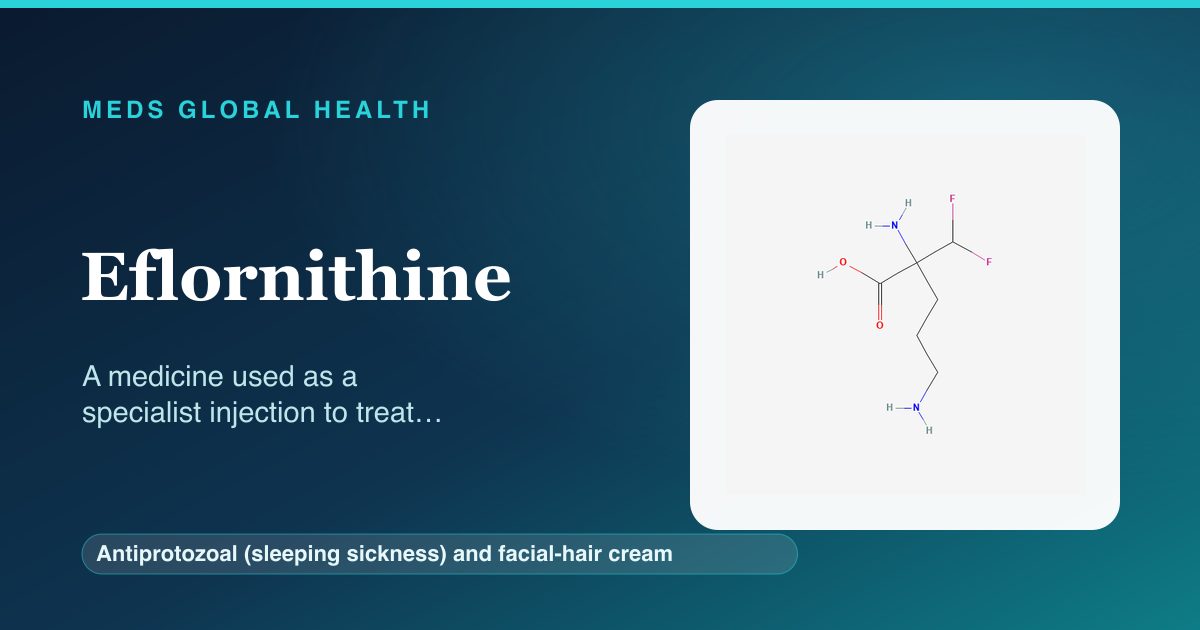
What it is
Eflornithine is a medicine that is used in two very different ways. In its injection form, given into a vein under specialist hospital care, it is used to treat African sleeping sickness (also called human African trypanosomiasis), a serious infection caused by a parasite spread by the tsetse fly. In its cream form, it is rubbed onto the skin of the face to slow the growth of unwanted facial hair in women. These are separate products for separate problems: one is a hospital infusion for a tropical infection, the other is a long-term skin treatment used at home.
How it works
Eflornithine blocks an enzyme that cells need to grow and multiply. In African sleeping sickness, this slows down the parasite so the immune system and treatment can clear the infection. In the skin cream, the same effect slows the rapid growth of hair-producing cells in the treated area, so unwanted facial hair grows back more slowly and finer. The cream does not remove hair already present and only works while it is being used; if it is stopped, hair growth gradually returns to how it was before.
Company & origin
A medicine with two very different uses in the UK: as a specialist injection for African sleeping sickness, and as a skin cream to slow the growth of unwanted facial hair in women.
Practical use
How to take Eflornithine
General, dose-free guidance — always follow your prescriber's and the leaflet's specific instructions.
- For the injection: it is given into a vein in hospital by a specialist team treating African sleeping sickness, following their schedule.
- For the cream: apply a thin layer to the affected areas of the face and rub it in, keeping it away from the eyes, lips and inside the nose.
- Do not wash treated skin for a few hours after applying the cream, and you can put on make-up or sunscreen once it has dried.
- Carry on with your usual hair-removal methods such as plucking or shaving, as the cream slows growth rather than removing hair.
- Give the cream time, as it can take a couple of months to show benefit, and stop if no improvement is seen after several months as advised.
Weighing it up
Advantages & disadvantages of Eflornithine
Advantages
- The injection is an effective specialist treatment for African sleeping sickness, a life-threatening infection.
- The cream offers a way to slow the growth of unwanted facial hair in women, used at home.
- The cream is applied only to the skin, so it does not act throughout the whole body.
Disadvantages
- The injection can lower blood cells and, less commonly, cause seizures, so it needs close hospital monitoring.
- The cream slows hair growth rather than removing hair, and the benefit fades once it is stopped.
- The cream commonly causes local skin irritation such as stinging, redness, dryness or spots.
Practical use
Good to know
It really helps to understand that eflornithine is two very different treatments. The injection is a serious hospital medicine for a serious infection, and because it can lower the body's blood cells and occasionally cause seizures, it is given and monitored by a specialist team. The cream, by contrast, is a home treatment for unwanted facial hair: it slows growth rather than removing hair, so other methods such as plucking or shaving are usually still needed alongside it, and it can take a couple of months before any benefit is seen. With the cream, the most common problems are local: stinging, burning, redness, dryness or spots where it is applied. It is kept away from the eyes, mouth and broken skin, and any new hair benefit fades once it is stopped.
Who should not take it / use with caution
- People who have had a serious allergic reaction to eflornithine should not use it.
- The cream is not for use by children or, generally, by men, and is used with caution in pregnancy and breastfeeding under medical advice.
- The injection is used only under specialist supervision, with monitoring of blood counts and for seizures.
Monitoring
- With the injection: regular blood counts to watch for a fall in blood cells, and watching for seizures.
- With the cream: reviewing the skin for irritation and checking whether hair growth is slowing.
- Reviewing whether the cream is still helping after a few months, and stopping it if there is no benefit.
Side effects
- With the cream: stinging, burning, redness, dryness, itching or spots where it is applied.
- With the injection: a fall in blood cells (raising the risk of infection, bleeding or anaemia).
- With the injection: nausea, diarrhoea and, less commonly, seizures.
- Rarely, more serious reactions that need urgent medical attention.
Key interactions
- The skin cream has few important interactions because little is absorbed into the body.
- The injection is used with care alongside other medicines that affect blood cells, under specialist guidance.
- Always tell your team about all your medicines, particularly before the injection is given.
Available as: A solution for injection into a vein (specialist use), and a cream applied to the skin of the face.
Answers
Eflornithine: frequently asked questions
Why is eflornithine used for two such different things?
It blocks an enzyme that cells need to grow; this slows the parasite in African sleeping sickness and, in the cream, slows the growth of hair-producing cells on the face.
Does the facial-hair cream remove hair?
No. It slows the growth of unwanted facial hair, so you usually still need methods such as plucking or shaving, and the benefit fades once you stop using it.
How soon does the cream work?
It can take a couple of months before you notice your facial hair growing more slowly; if there is no improvement after several months, it is usually stopped.
Why does the injection need hospital monitoring?
The injection can lower the body's blood cells and, less commonly, cause seizures, so it is given and closely monitored by a specialist team.
Is the cream safe in pregnancy?
It is used with caution in pregnancy and breastfeeding, so check with your doctor or pharmacist before using it if this applies to you.
Authoritative sources
- BNF
- NICE CKS
Building a medicines information resource?
We create evidence-led, dose-free drug and formulary references for teams.