A newer enzyme-replacement injection for ADA-SCID
Elapegademase
A recombinant enzyme-replacement injection for ADA-SCID, developed to replace the earlier bovine-derived product.
What is Elapegademase?
Elapegademase is a specialist enzyme-replacement medicine used to treat ADA deficiency, a rare inherited cause of severe combined immunodeficiency (ADA-SCID), in which a missing enzyme leaves the immune system unable to fight infection. It is a newer form of enzyme replacement that works by supplying the missing enzyme so immunity can recover. It is given as an injection into the muscle under specialist care. Like the older enzyme treatment, it is often used to protect children and rebuild immunity while a longer-term treatment, such as a stem-cell transplant, is being arranged.
Education and reference only. This is a plain-language guide to Elapegademase — it deliberately contains no doses. Doses depend on the person, the brand and the reason for treatment, and belong with your prescriber. Always check the BNF, the product labelling (SmPC) and follow medical advice.
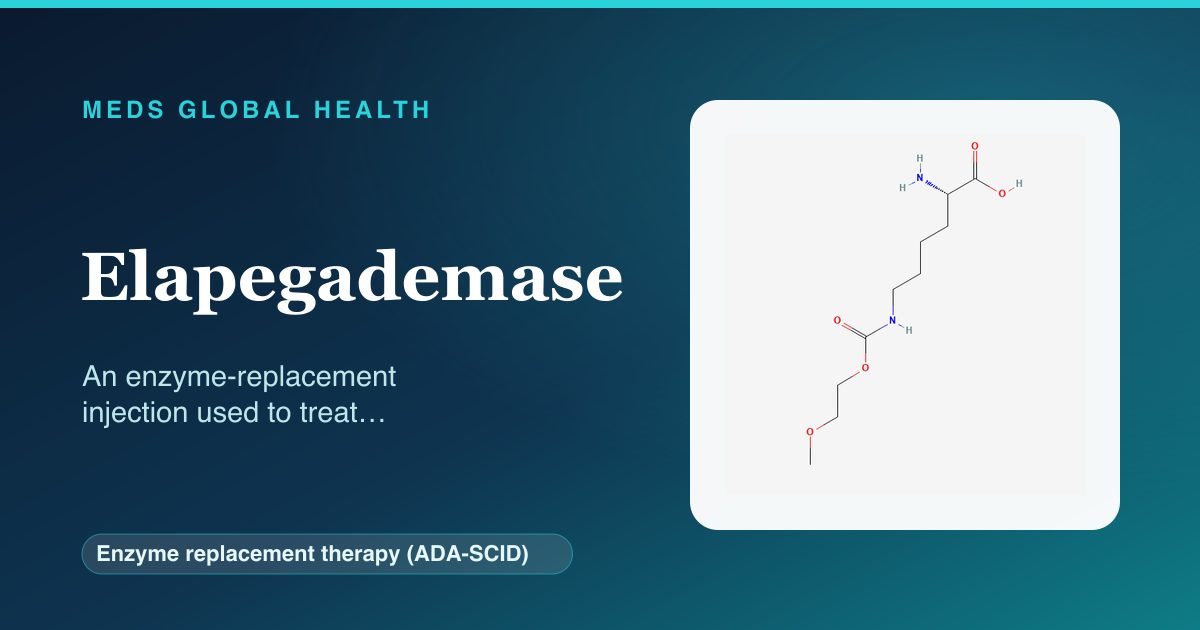
What it is
Elapegademase is an enzyme-replacement therapy for ADA deficiency, a rare inherited condition in which a lack of the enzyme adenosine deaminase (ADA) causes a build-up of toxic substances that destroy immune cells, leading to severe combined immunodeficiency (ADA-SCID). It is a newer manufactured form of the missing enzyme, given as a regular injection into the muscle. It is used under specialist immunology care, often to protect and rebuild the immune system while definitive treatment, such as a stem-cell transplant, is being planned.
How it works
In ADA deficiency, the missing enzyme allows toxic by-products to build up and poison developing immune cells, so a working immune system cannot form. Elapegademase replaces the enzyme in the bloodstream, helping clear those toxic substances so immune cells can survive and immunity can recover. Because the enzyme only works while it is present, it is given as regular injections to keep the effect going. As with the older enzyme treatment, it is often used to stabilise and rebuild immunity while a longer-term solution is arranged.
Company & origin
A specialist enzyme-replacement medicine used to treat ADA-SCID, a rare inherited condition that severely weakens the immune system.
Practical use
How to take Elapegademase
General, dose-free guidance — always follow your prescriber's and the leaflet's specific instructions.
- Have it as an injection into the muscle on the regular schedule your specialist team sets.
- Attend regular blood tests so the team can check enzyme activity and immune recovery.
- Keep taking the infection precautions your team advises, as immune protection builds gradually.
- Report any allergic-type or injection reactions, such as rash, swelling or feeling faint.
- Do not stop treatment without specialist advice, as immune protection depends on keeping it going.
Weighing it up
Advantages & disadvantages of Elapegademase
Advantages
- Replaces the missing enzyme in ADA-SCID, helping the immune system recover and fight infection.
- A newer enzyme-replacement option that can protect and rebuild immunity while longer-term treatment is arranged.
- Offers a treatment for a condition that is otherwise life-threatening very early.
Disadvantages
- Needs regular injections into the muscle, with the schedule guided by blood tests.
- Can cause allergic-type and injection reactions.
- Immune protection builds gradually and may not be complete, so infection precautions remain important.
Practical use
Good to know
A key point is that elapegademase is a newer enzyme-replacement option and, like the older one, is often used as a bridge: it protects children and rebuilds immunity while a more definitive treatment, such as a stem-cell transplant, is being planned. It is given as a regular injection into the muscle, with the schedule set and adjusted by the specialist team based on blood tests of enzyme activity and immune recovery. Allergic-type and injection reactions can occur, so it is given under close supervision. Because immune protection builds gradually and may not be complete, careful infection precautions remain important. It should not be stopped without specialist advice, and immune cell counts and enzyme levels are monitored regularly.
Who should not take it / use with caution
- People who have had a serious allergic reaction to elapegademase should not use it.
- It is used with care, with regular blood counts, because low blood-cell counts (including low platelets) can develop during treatment.
- It should only be used under specialist immunology supervision.
Monitoring
- Regular blood tests of enzyme activity and immune cell counts to guide the schedule.
- Watching for allergic-type and injection reactions.
- Reviewing how well immunity is recovering and planning longer-term treatment.
Side effects
- Reactions where the injection is given, such as redness, pain or swelling.
- Allergic-type reactions in some people, which should be reported.
- Rarely, blood problems such as changes in blood cell counts, which monitoring is designed to catch.
Key interactions
- It can affect blood tests that measure enzyme activity, so labs should know you are taking it.
- Certain medicines that affect the immune system, such as some used in transplant, are managed carefully by the team.
- There are few well-established routine interactions, but tell your team about everything you take.
Available as: A solution for injection into the muscle.
Answers
Elapegademase: frequently asked questions
What is elapegademase used for?
It is used to treat ADA deficiency (ADA-SCID), a rare inherited condition that leaves the immune system unable to fight infection, by replacing the missing enzyme so immunity can recover.
How is it different from the older enzyme treatment?
It is a newer form of enzyme replacement for the same condition; your specialist team will decide which option suits you, and both work by supplying the missing enzyme.
How is it given?
It is given as a regular injection into the muscle, with the schedule set and adjusted by the specialist team based on blood tests.
Do I still need to avoid infections?
Yes. Immune protection builds gradually and may not be complete, so the infection precautions your team advises remain important during treatment.
Can it be stopped once I feel well?
No. Immune protection depends on continuing it, so only change or stop treatment on specialist advice.
Authoritative sources
- BNF
- NICE CKS
Building a medicines information resource?
We create evidence-led, dose-free drug and formulary references for teams.