An oral capsule for Gaucher disease type 1
Eliglustat
An oral capsule used to treat Gaucher disease type 1, a rare inherited condition in which a fatty substance builds up in the body.
What is Eliglustat?
Eliglustat is a specialist medicine used for the long-term treatment of Gaucher disease type 1, a rare inherited condition in which a fatty substance builds up in the spleen, liver, bones and blood. It works by reducing how much of this substance the body makes, rather than replacing the missing enzyme. It is taken by mouth as a capsule, which some people prefer to enzyme infusions. Whether it suits a person depends on how their body breaks the medicine down (their CYP2D6 metaboliser status), and it can affect the heart's rhythm and interacts with many other medicines, so careful checks are needed.
Education and reference only. This is a plain-language guide to Eliglustat — it deliberately contains no doses. Doses depend on the person, the brand and the reason for treatment, and belong with your prescriber. Always check the BNF, the product labelling (SmPC) and follow medical advice.
What it is
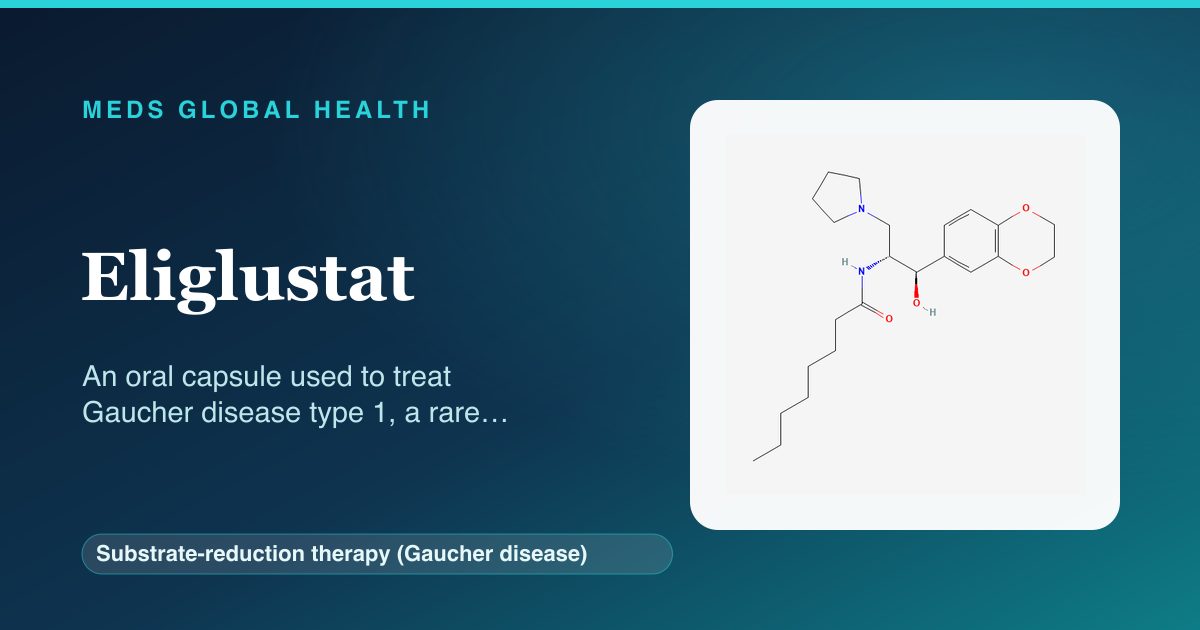
Eliglustat is a medicine used for the long-term treatment of Gaucher disease type 1, an inherited condition in which the body lacks an enzyme that breaks down a particular fatty substance, so it gradually builds up and affects the spleen, liver, bones and blood. Unlike enzyme replacement, which is given by infusion, eliglustat is taken by mouth as a capsule and works by lowering the amount of the fatty substance that is produced in the first place. It is only suitable for certain people, partly depending on how their body processes the medicine, and is prescribed and supervised by a specialist service.
How it works
In Gaucher disease, a missing enzyme means a fatty substance is not broken down properly and builds up in the body, causing the organ, bone and blood problems seen in the condition. Eliglustat works as a substrate-reduction therapy, meaning it slows down the body's production of that fatty substance so less of it accumulates over time. By keeping the amount made closer to what the body can handle, it helps reduce the build-up and its effects. The medicine is broken down mainly by a liver pathway called CYP2D6, and how active this pathway is in a person affects how the medicine behaves, which is why metaboliser status is checked before it is used.
Company & origin
A specialist oral medicine used in the UK for long-term treatment of Gaucher disease type 1 in suitable adults.
Practical use
How to take Eliglustat
General, dose-free guidance — always follow your prescriber's and the leaflet's specific instructions.
- Take the capsules by mouth as directed, swallowed whole with water, at evenly spaced times each day.
- Avoid grapefruit and grapefruit juice, which can change how much of the medicine is in your body.
- Give your team a full list of everything you take, including supplements such as St John's wort, as eliglustat interacts with many medicines.
- Tell your prescriber about any heart-rhythm problems before starting, as the medicine can affect the heart's rhythm.
- Keep taking it consistently for long-term control, and do not stop or change it without specialist advice.
Weighing it up
Advantages & disadvantages of Eliglustat
Advantages
- An oral treatment for Gaucher disease type 1, avoiding regular infusions for suitable people.
- Works by reducing how much of the harmful fatty substance the body makes.
- Can help control the condition over the long term when used in the right people.
Disadvantages
- Only suitable for certain people, depending on how their body breaks the medicine down.
- Can affect the heart's rhythm and interacts with a large number of other medicines.
- Needs careful checks before and during treatment, including for drug interactions.
Practical use
Good to know
An important point with eliglustat is that it is not suitable for everyone: before starting, a test is done to see how a person's body breaks the medicine down (their CYP2D6 metaboliser status), because this affects whether it can be used and at what intensity. It can affect the heart's electrical rhythm, so it is used with caution in people with certain heart problems, and the team may check the heart's tracing. It also interacts with a large number of other medicines, both by being affected by them and by affecting them, so it is essential to give a full and up-to-date list of everything you take, including over-the-counter products and supplements such as St John's wort and grapefruit. It is taken by mouth, which suits people who would rather avoid regular infusions, but it must be taken consistently for long-term control. The specialist team reviews how well it is working through blood tests and scans over time.
Who should not take it / use with caution
- People who have had a serious allergic reaction to eliglustat should not take it.
- It is not suitable for people whose body breaks the medicine down in a way that makes it unsafe, which is why metaboliser status is checked first.
- It is used with caution in people with certain heart conditions or heart-rhythm problems.
- It should only be used under specialist supervision, with attention to interactions and heart monitoring where needed.
Monitoring
- Checking how the body breaks the medicine down before starting.
- Reviewing the heart's electrical tracing where appropriate, especially with interacting medicines.
- Regular blood tests and scans to check how well the condition is being controlled.
Side effects
- Headache, tiredness, dizziness or joint pain in some people.
- Indigestion, nausea or other stomach upset.
- Less commonly, changes in the heart's electrical rhythm, which is why caution and checks are needed.
Key interactions
- It interacts with many other medicines, which can raise or lower the amount of eliglustat in the body, so a full medicines list is essential.
- Grapefruit and grapefruit juice can increase the amount of the medicine in the body and should be avoided.
- Medicines that affect the heart's rhythm should be reviewed before and during treatment.
Available as: Capsules taken by mouth.
Answers
Eliglustat: frequently asked questions
What is eliglustat used for?
It is used for the long-term treatment of Gaucher disease type 1, reducing how much of the harmful fatty substance the body makes so less builds up in the organs, bones and blood.
How is it different from enzyme replacement?
Enzyme replacement is given by infusion and replaces the missing enzyme, while eliglustat is a capsule that lowers the body's production of the fatty substance instead.
Why is a test done before I start?
A test checks how your body breaks the medicine down (your CYP2D6 metaboliser status), because this affects whether eliglustat is suitable and safe for you.
Why must I avoid grapefruit?
Grapefruit can increase the amount of the medicine in your body, so it is avoided to keep treatment safe.
Does it affect the heart?
It can affect the heart's electrical rhythm, so your team checks for heart problems and reviews other medicines that do the same before and during treatment.
Authoritative sources
- BNF
- NICE CKS
Building a medicines information resource?
We create evidence-led, dose-free drug and formulary references for teams.