An intravenous medicine for severe heart failure
Enoximone
An intravenous medicine used in hospital to help the heart pump in severe heart failure that has not responded to other treatment.
What is Enoximone?
Enoximone is a hospital-only medicine used for severe heart failure, usually when other treatments have not been enough. It helps the heart pump more strongly and also relaxes blood vessels so blood flows more easily, given as a drip into a vein. Because it stimulates the heart and affects the circulation, it can cause an irregular heart rhythm and a fall in blood pressure, so it is only used in hospital with continuous monitoring of the heart rhythm and blood pressure. It belongs to a group of medicines called phosphodiesterase inhibitors.
Education and reference only. This is a plain-language guide to Enoximone — it deliberately contains no doses. Doses depend on the person, the brand and the reason for treatment, and belong with your prescriber. Always check the BNF, the product labelling (SmPC) and follow medical advice.
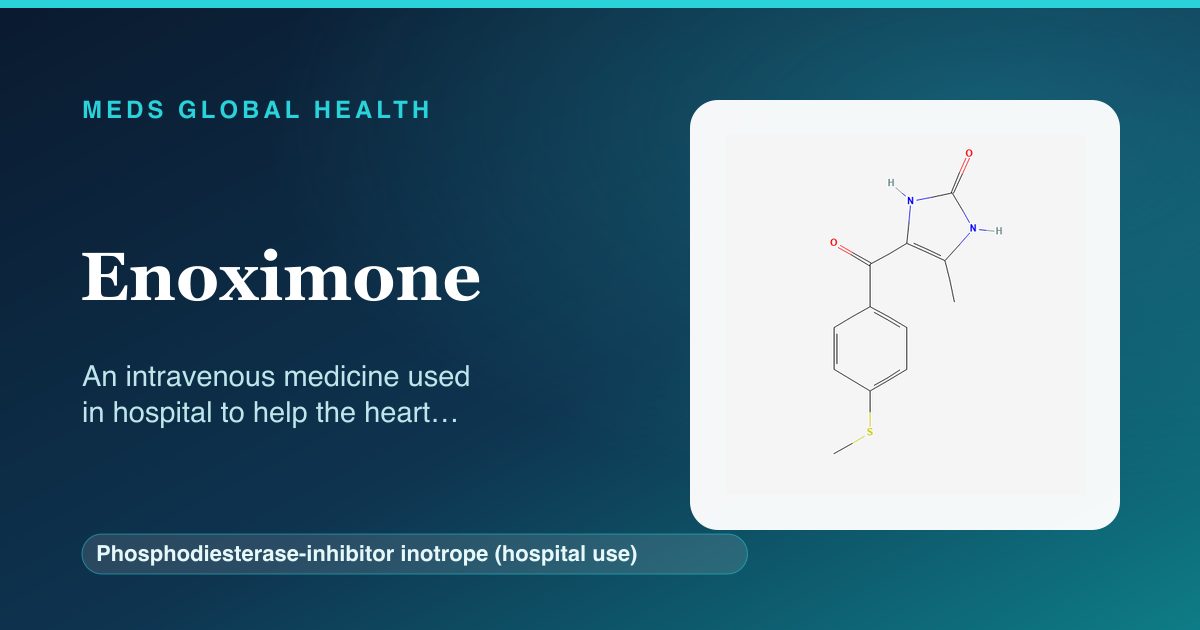
What it is
Enoximone is a medicine used in hospital to support patients with severe heart failure, typically when the usual treatments are not controlling things well enough. It belongs to a group called phosphodiesterase inhibitors, which both strengthen the heart's pumping and relax blood vessels. It is given only as a drip into a vein, in a high-dependency or intensive-care setting, and is closely supervised. It is a short-term treatment for a serious situation, not a medicine taken at home.
How it works
Enoximone works by blocking an enzyme inside heart and blood-vessel cells called phosphodiesterase. This raises the level of a signalling chemical that makes the heart contract more forcefully and relaxes the blood vessels. The result is a heart that pumps more strongly against less resistance, which can improve blood flow in severe heart failure. Because it stimulates the heart and widens blood vessels, it can also disturb the heart's rhythm and lower blood pressure. It acts over a short period, so the drip is adjusted while the team monitors the heart closely.
Company & origin
A hospital-only medicine used in the UK for severe heart failure, given as a drip when other treatments are not enough.
What it treats
Conditions Enoximone is used for
Practical use
How to take Enoximone
General, dose-free guidance — always follow your prescriber's and the leaflet's specific instructions.
- It is given only in hospital, as a drip into a vein, by trained staff.
- The rate of the drip is adjusted carefully according to how the heart and blood pressure respond.
- The heart rhythm and blood pressure are monitored continuously while it is running.
- It is used for as short a time as the situation allows.
- It is never adjusted or taken by the patient themselves.
Weighing it up
Advantages & disadvantages of Enoximone
Advantages
- Helps the heart pump more strongly in severe heart failure when other treatments are not enough.
- Also relaxes blood vessels, easing the work the heart has to do.
- Can provide support through a critical period in hospital.
Disadvantages
- Can cause an irregular heart rhythm.
- Can lower blood pressure, sometimes more than intended.
- Can only be given in hospital with continuous monitoring.
Practical use
Good to know
Enoximone is a specialist hospital medicine reserved for severe heart failure when other measures are not enough, and it is given as a carefully controlled drip. The key points are that it both strengthens the heart and relaxes blood vessels, and that these effects bring risks: it can trigger irregular heart rhythms and can lower blood pressure, sometimes more than intended. This is why it is always used with continuous monitoring of the heart rhythm and blood pressure. The team weighs its short-term benefit in supporting a failing heart against these risks and uses it for as short a time as the situation allows. It is not a long-term solution but a way to help through a critical period.
Who should not take it / use with caution
- People who have had a serious allergic reaction to enoximone should not be given it.
- It is used with great care in certain heart conditions where stimulating the heart could be harmful.
- It is only ever given under specialist supervision with continuous heart monitoring.
Monitoring
- Continuous monitoring of the heart rhythm while it is running.
- Close watching of blood pressure and how well blood is flowing around the body.
- Regular review of whether it is still needed and adjusting the drip accordingly.
Side effects
- An irregular heart rhythm.
- A fall in blood pressure.
- Headache, nausea or, less commonly, changes in blood tests.
Key interactions
- Other medicines that affect the heart rhythm or blood pressure may add to its effects and are reviewed by the team.
- It is used carefully alongside other heart-support medicines and fluids.
- Because it is used in intensive settings, all of a patient's medicines and drips are considered together.
Available as: A solution given as a drip into a vein in hospital.
Answers
Enoximone: frequently asked questions
What is enoximone used for?
It is a hospital medicine used for severe heart failure, usually when other treatments have not been enough, to help the heart pump more strongly.
How does it work?
It blocks an enzyme called phosphodiesterase, which strengthens the heart's pumping and relaxes blood vessels so blood flows more easily.
Why does it need close monitoring?
It can trigger an irregular heart rhythm and can lower blood pressure, so the heart rhythm and blood pressure are watched continuously while it is given.
How is it given?
It is given only in hospital as a drip into a vein, with the rate carefully adjusted by trained staff.
Is it a long-term treatment?
No. It is a short-term hospital treatment to support a failing heart through a critical period, not something taken long term or at home.
Authoritative sources
- BNF
- NICE CKS
Building a medicines information resource?
We create evidence-led, dose-free drug and formulary references for teams.