Adrenaline auto-injector for anaphylaxis
Epinephrine (adrenaline)
The emergency medicine for severe allergic reactions (anaphylaxis), given by auto-injector into the outer thigh — called adrenaline in the UK and epinephrine in the US.
What is Epinephrine (adrenaline)?
Epinephrine, known in the UK as adrenaline, is the emergency treatment for a severe, life-threatening allergic reaction (anaphylaxis). It is given as a pre-filled adrenaline auto-injector (such as EpiPen, Jext or Emerade — always learn how to use your own device) that delivers the medicine quickly into the muscle of the outer thigh.
Education and reference only. This is a plain-language guide to Epinephrine (adrenaline) — it deliberately contains no doses. Doses depend on the person, the brand and the reason for treatment, and belong with your prescriber. Always check the BNF, the product labelling (SmPC) and follow medical advice.
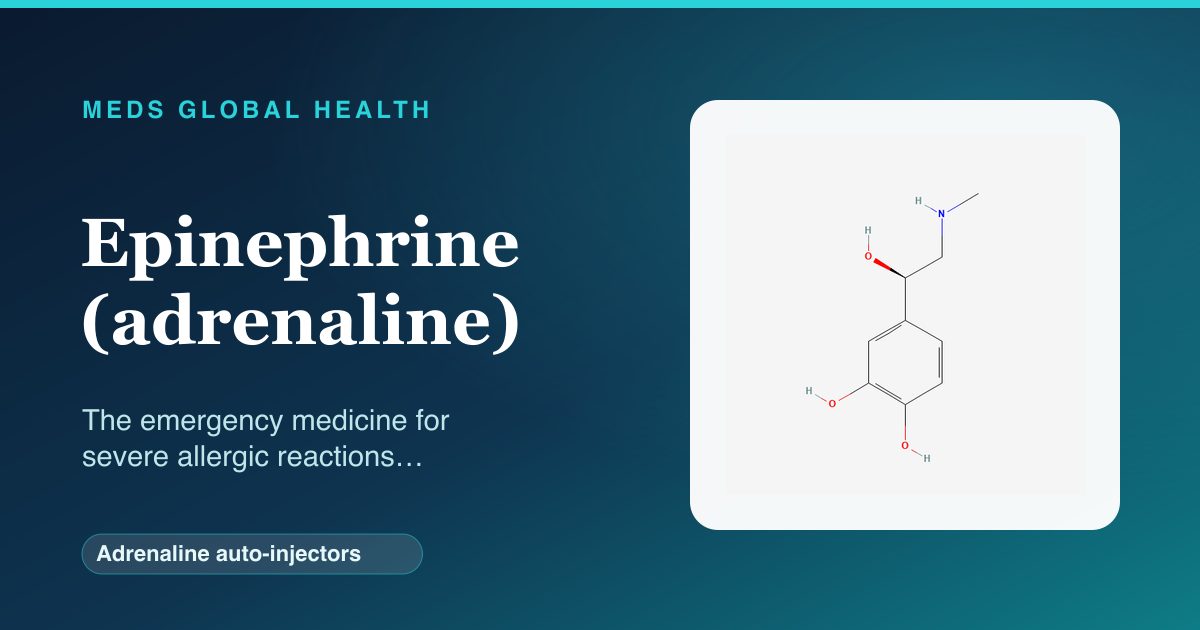
What it is
Epinephrine is the emergency treatment for a severe, life-threatening allergic reaction (anaphylaxis). Crucially, this is the same medicine known by two different names: in the UK it is called adrenaline, and in the US it is called epinephrine. It is supplied as a pre-filled auto-injector — devices such as EpiPen, Jext and Emerade — designed so that anyone can give it quickly in an emergency. People at risk of anaphylaxis (for example from food, insect stings or medicines) are prescribed auto-injectors to carry with them at all times.
How it works
In anaphylaxis, a massive allergic reaction causes blood vessels to leak and widen (dropping blood pressure), the airways to tighten, and the throat and tissues to swell — a combination that can be fatal within minutes. Adrenaline (epinephrine) rapidly reverses these changes: it tightens the widened blood vessels to restore blood pressure, relaxes and opens the airways to ease breathing, and reduces the swelling. It works fast, which is why it must be given without delay at the first signs of a severe reaction.
Company & origin
Originated / developed by: No single originator (natural hormone; first isolated by Jokichi Takamine / John Jacob Abel).
Epinephrine (adrenaline) is a natural hormone, not invented by one company; it was first isolated in purified, crystalline form around 1900-1901 by Jokichi Takamine (working with Parke-Davis), with related isolation work by John Jacob Abel. It was among the first hormones to be purified and used therapeutically.
Practical use
How to take Epinephrine (adrenaline)
General, dose-free guidance — always follow your prescriber's and the leaflet's specific instructions.
- Use it straight away at the first signs of a severe reaction, such as difficulty breathing, swelling of the throat, or feeling faint; do not wait.
- Inject it firmly into the outer thigh; it can be given through clothing if needed.
- Call 999 immediately and say anaphylaxis, even if the person seems to improve.
- Have the person lie down with their legs raised, or sit up if breathing is difficult.
- Carry two auto-injectors at all times and use the second one if there is no improvement after a few minutes.
- Check the expiry date regularly and learn how to use your specific device in advance.
Weighing it up
Advantages & disadvantages of Epinephrine (adrenaline)
Advantages
- Can be life-saving by rapidly reversing a severe allergic reaction.
- Designed to be used quickly and simply by the person or a bystander.
- Works fast when injected into the outer thigh muscle.
- Portable, so it can be carried and used wherever a reaction happens.
Disadvantages
- Is an emergency rescue treatment, not a way to prevent reactions.
- Can cause a pounding heart, shaking, paleness and anxiety after use.
- Always needs to be followed by calling 999 and hospital assessment.
- Devices have an expiry date and must be replaced, and a second is often needed.
- Accidental injection into a hand or finger can reduce blood flow and needs medical attention.
Practical use
Good to know
Use it without delay at the first signs of a severe reaction — do not wait to "see how things go". It is injected into the outer thigh (the side of the upper leg), and can be given through clothing. Always call 999 (or 911 in the US) immediately after using it, because the reaction can return and hospital observation is needed. Carry two auto-injectors at all times, as a second dose may be required before help arrives. Check the expiry date regularly and replace devices before they run out, and make sure family, friends, carers or school staff know where the devices are and how to use them. Lay the person down (or sit them up if breathing is hard) and raise the legs if they feel faint.
Who should not take it / use with caution
- In a true anaphylaxis emergency there are no absolute reasons not to use it — the benefit of adrenaline outweighs any risk, and it can be life-saving.
- It must be injected into the outer thigh only — never into a vein, the buttock, or the hands or feet.
- People with heart disease can still use it in an emergency, but should mention their history so the care team is aware.
Monitoring
- Always followed by emergency medical care after use
- Regular checks of expiry dates and device condition
- Periodic review of allergy action plan and injector technique
Side effects
- A fast or pounding heartbeat, paleness, trembling, anxiety and headache shortly after use — these are expected effects of the medicine and usually settle.
- Dizziness or sweating.
- These short-lived effects are far outweighed by the life-saving benefit in a severe allergic reaction; accidental injection into a finger needs medical attention.
Key interactions
- Certain medicines, such as some beta-blockers and some antidepressants, can alter how the body responds to adrenaline.
- These interactions never outweigh the need to use it in a genuine emergency — give it without hesitation.
- Tell your prescriber about all your medicines so your overall plan can take any interactions into account.
Available as: Pre-filled single-use auto-injectors (e.g. EpiPen, Jext, Emerade); each brand has a slightly different technique, so learn how your own device works.
Answers
Epinephrine (adrenaline): frequently asked questions
Is adrenaline the same as epinephrine?
Yes — they are exactly the same medicine, just with different names in different countries. In the UK it is called adrenaline; in the US it is called epinephrine. If you move between the two countries, or read US information, know that an "epinephrine auto-injector" and an "adrenaline auto-injector" are the same thing.
Where do I inject the auto-injector?
Always into the outer thigh — the side of the upper leg — where the large muscle helps the medicine work quickly. It can be given through clothing. Never inject it into a vein, the buttock, or into the hands or feet. Each brand (EpiPen, Jext, Emerade) has its own technique, so learn how yours works in advance.
Do I still need to call 999 after using it?
Yes, always — call 999 (or 911 in the US) immediately after giving adrenaline. The medicine buys time, but the reaction can come back, so the person needs urgent hospital assessment and observation even if they seem to recover.
Why do I need to carry two auto-injectors?
Because one dose is not always enough. If symptoms have not improved after a few minutes, a second injection may be needed before the ambulance arrives. Carrying two at all times means you are covered if a second dose is required or if one device fails.
What is the difference between an EpiPen, Jext and Emerade?
They are all auto-injectors containing the same medicine — adrenaline (epinephrine). They differ in their design and the exact steps to fire them, so it is important to be trained on, and carry, the specific brand you are prescribed. Check expiry dates and replace devices before they run out.
The wider class
About Adrenaline auto-injectors
Epinephrine (adrenaline) belongs to the adrenaline auto-injectors class. For how the class as a whole works, its shared safety principles and monitoring, see the full guide.
Browse by body system
Authoritative sources
- BNF: Adrenaline/epinephrine.
- Resuscitation Council UK: Emergency treatment of anaphylaxis.
- NICE CKS: Anaphylaxis.
Building a medicines information resource?
We create evidence-led, dose-free drug and formulary references for teams.