A nasal spray for treatment-resistant depression
Esketamine
A nasal-spray medicine for treatment-resistant depression, given under supervision in a clinic with a period of observation afterwards.
What is Esketamine?
Esketamine is a specialist nasal-spray medicine for depression that has not improved despite trying other antidepressants ('treatment-resistant depression'). It is used alongside an ordinary antidepressant and is always given under supervision in a clinic, never taken at home, because it can cause sedation, a sense of feeling detached from yourself or your surroundings (dissociation) and a rise in blood pressure. After each dose you stay in the clinic to be observed for a couple of hours, and you must not drive until the next day. It has a potential for misuse and, like other depression treatments, requires careful monitoring for changes in mood and any thoughts of self-harm.
Education and reference only. This is a plain-language guide to Esketamine — it deliberately contains no doses. Doses depend on the person, the brand and the reason for treatment, and belong with your prescriber. Always check the BNF, the product labelling (SmPC) and follow medical advice.
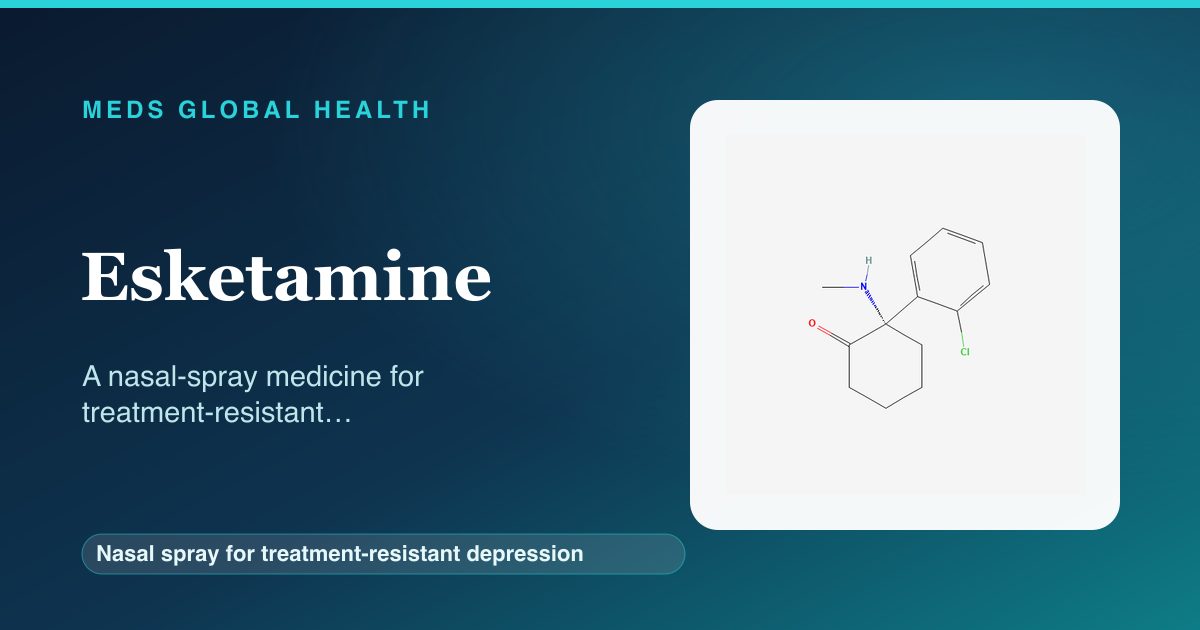
What it is
Esketamine is a medicine given as a nasal spray for treatment-resistant depression, meaning depression that has not responded well enough to other antidepressants. It is used together with a standard antidepressant tablet, not on its own. A defining feature is that it is only given in a clinic under direct supervision: the person uses the spray there, then stays to be observed. It is a specialist treatment, prescribed and supervised by a mental-health service, and is not a medicine that people take by themselves at home.
How it works
Esketamine works differently from most antidepressants. Rather than acting mainly on serotonin, it acts on a brain messenger system called glutamate, which is thought to help restore connections between brain cells and can lift mood relatively quickly in some people. This different way of working is why it can help when usual antidepressants have not. The same action on the brain is also responsible for its short-term effects, such as feeling sedated or detached, which is why each dose is given under supervision and followed by a period of observation until these effects wear off.
Company & origin
A specialist nasal-spray medicine used in the UK for depression that has not responded to other treatments, given under supervision in a clinic.
What it treats
Conditions Esketamine is used for
Practical use
How to take Esketamine
General, dose-free guidance — always follow your prescriber's and the leaflet's specific instructions.
- Use the nasal spray only in the clinic, under supervision; it is never taken at home.
- Stay in the clinic to be observed for a couple of hours after each dose until the effects wear off.
- Do not drive or operate machinery until the next day, after a proper night's sleep.
- Keep taking the ordinary antidepressant prescribed alongside it, as esketamine is used together with it.
- Report any worsening mood or thoughts of self-harm to your team straight away.
Weighing it up
Advantages & disadvantages of Esketamine
Advantages
- Offers a different approach for depression that has not responded to other antidepressants.
- Can improve mood relatively quickly in some people.
- Given under close supervision, with safety checks built into each visit.
Disadvantages
- Can cause sedation and a feeling of being detached (dissociation) after each dose.
- Requires attending a clinic for every dose and a period of observation afterwards, and no driving until the next day.
- Can raise blood pressure and has a potential for misuse.
Practical use
Good to know
The most important things to understand about esketamine are about safety and how it is used. It is always given under supervision in a clinic, never at home, because soon after a dose it can cause sedation and dissociation (a feeling of being detached from yourself or your surroundings) and can raise blood pressure. For this reason you stay in the clinic to be observed for a couple of hours after each dose, your blood pressure is checked, and you must not drive or operate machinery until you have had a proper sleep, usually the next day. It is used alongside an ordinary antidepressant rather than instead of one. It has a potential for misuse, so its supply and use are closely controlled. As with other treatments for depression, especially early on or when starting, there must be careful monitoring for any worsening of mood or thoughts of self-harm, and any such thoughts should be reported straight away.
Who should not take it / use with caution
- People who have had a serious allergic reaction to esketamine should not use it.
- It is used with great caution, or avoided, in people with certain conditions such as uncontrolled high blood pressure or some blood-vessel conditions in the brain.
- It should only be used under a specialist mental-health service that can supervise each dose and monitor afterwards.
Monitoring
- Observation in the clinic for a couple of hours after each dose, with blood-pressure checks.
- Regular review of mood and watching for any thoughts of self-harm, especially early in treatment.
- Reviewing how well it is working and whether it should be continued.
Side effects
- Sedation, dizziness or a feeling of being detached from yourself or your surroundings (dissociation).
- A rise in blood pressure, nausea or headache after a dose.
- Changes in mood; any worsening or thoughts of self-harm must be reported straight away.
Key interactions
- It can add to the sedating effects of alcohol, sleeping tablets and other medicines that cause drowsiness.
- Medicines that raise blood pressure or stimulate the body may add to its effect on blood pressure.
- Tell your team about all your medicines, as it is used alongside an ordinary antidepressant.
Available as: A nasal spray given under supervision in a clinic.
Answers
Esketamine: frequently asked questions
What is esketamine used for?
It is used for treatment-resistant depression, meaning depression that has not responded to other antidepressants, and is given alongside an ordinary antidepressant.
Why must it be given in a clinic?
Soon after a dose it can cause sedation, a feeling of being detached (dissociation) and a rise in blood pressure, so it is always given under supervision and you stay to be observed afterwards.
Can I drive after a dose?
No. You must not drive or operate machinery until the next day, after a proper night's sleep, because of the sedating and dissociative effects.
Do I still take my usual antidepressant?
Yes. Esketamine is used together with an ordinary antidepressant rather than instead of one, so keep taking the tablet you are prescribed.
What should I do if my mood gets worse?
As with other depression treatments, you should report any worsening mood or thoughts of self-harm to your team straight away, especially early in treatment.
Authoritative sources
- BNF
- NICE CKS
Building a medicines information resource?
We create evidence-led, dose-free drug and formulary references for teams.