A natural oestrogen hormone used in some HRT
Estrone
A naturally occurring oestrogen used as part of hormone replacement therapy to ease menopausal symptoms, prescribed and reviewed by a doctor.
What is Estrone?
Estrone is a natural oestrogen hormone. It is used as part of hormone replacement therapy (HRT) to relieve menopausal symptoms such as hot flushes, night sweats and vaginal dryness when the ovaries make less oestrogen. It is a prescription medicine, taken under medical supervision, and is usually combined with a progestogen in women who still have a womb to protect the lining of the womb. Like all HRT, it carries small but real risks, so the decision to use it is made individually with a doctor.
Education and reference only. This is a plain-language guide to Estrone — it deliberately contains no doses. Doses depend on the person, the brand and the reason for treatment, and belong with your prescriber. Always check the BNF, the product labelling (SmPC) and follow medical advice.
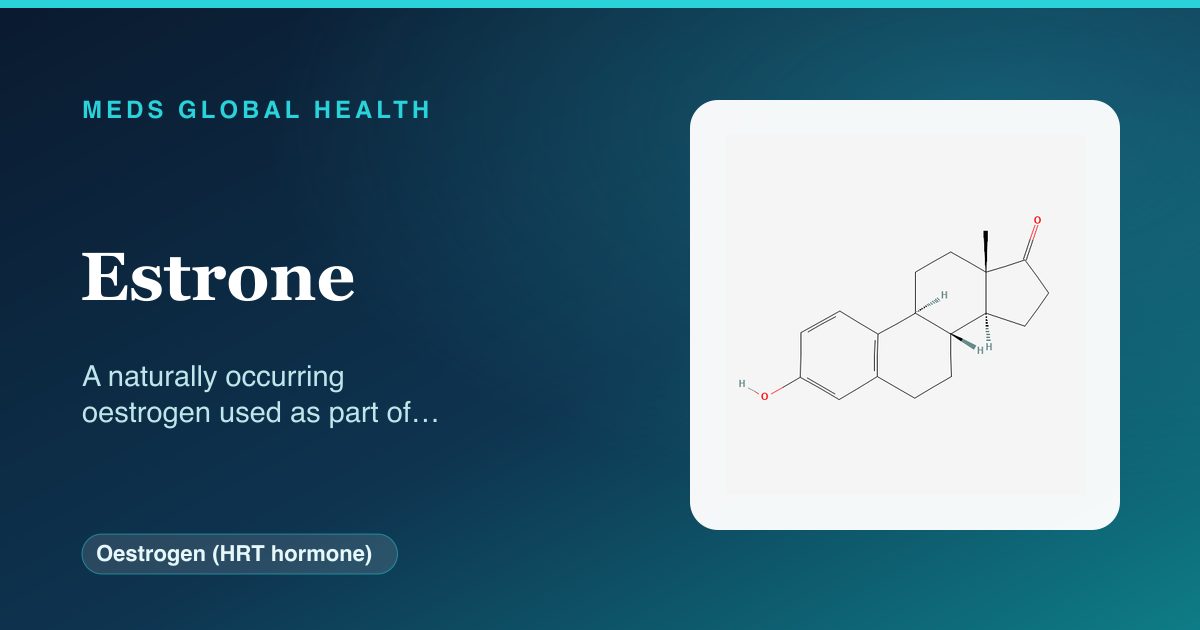
What it is
Estrone is one of the oestrogens produced naturally in the body, and it becomes the main circulating oestrogen after the menopause. As a medicine it is used as a form of oestrogen replacement, often as a component of esterified or conjugated oestrogen preparations. The purpose of replacing oestrogen is to top up the falling hormone levels that cause menopausal symptoms once the ovaries wind down. It is a prescription-only medicine and is not something to start or stop on your own.
How it works
Oestrogen acts on receptors found in many tissues, including the brain's temperature-control centre, the lining of the vagina and urinary tract, the bones and the breast. When oestrogen levels fall at the menopause, these tissues are affected, producing hot flushes, night sweats, vaginal dryness and accelerated bone thinning. By restoring oestrogen activity, estrone helps settle these symptoms. Because oestrogen also stimulates the lining of the womb, women who still have a womb are given a progestogen alongside it to keep that lining thin and reduce the risk of womb cancer.
Company & origin
One of the three oestrogens the human body makes, alongside oestradiol and oestriol. In medicine, estrone appears mainly as part of esterified and conjugated oestrogen preparations used in hormone replacement therapy (HRT) around the menopause. In the UK, most menopause HRT is based on oestradiol rather than estrone alone, so estrone is encountered more often as a named ingredient within combined oestrogen products than as a stand-alone branded medicine.
What it treats
Conditions Estrone is used for
Practical use
How to take Estrone
General, dose-free guidance — always follow your prescriber's and the leaflet's specific instructions.
- Use estrone-containing HRT exactly as your doctor or pharmacist directs, and do not change how you use it without advice.
- If you still have a womb, take any prescribed progestogen alongside the oestrogen as instructed, because this protects the womb lining.
- Report any unexpected vaginal bleeding, breast changes, or new leg swelling or pain promptly rather than waiting for a routine review.
- Keep regular review appointments so the need to continue can be reassessed and the lowest helpful level used.
- Tell any doctor, dentist or surgeon that you take HRT, especially before planned operations or long periods of immobility.
Weighing it up
Advantages & disadvantages of Estrone
Advantages
- Effectively relieves common menopausal symptoms such as hot flushes, night sweats and vaginal dryness.
- Helps protect against the bone thinning (osteoporosis) that follows the menopause.
- Uses an oestrogen the body makes naturally, replacing what the ovaries no longer produce.
Disadvantages
- Carries a small increased risk of blood clots in the veins and lungs.
- Can slightly raise the risk of breast cancer depending on the type used and how long it is taken.
- Needs ongoing medical supervision, prescriptions and regular review rather than casual use.
Practical use
Good to know
HRT is generally most appropriate for women with troublesome menopausal symptoms, and the benefits and risks shift with age, time since menopause and personal and family history. Oestrogen carries a small increased risk of blood clots and, depending on the type and duration, of breast cancer. It must never be started while the cause of any unexplained vaginal bleeding is unknown. Your doctor will weigh up your own situation, and HRT is usually reviewed regularly to confirm it is still the right choice at the lowest effective level.
Who should not take it / use with caution
- Anyone with unexplained vaginal bleeding that has not yet been investigated.
- People with a current or past oestrogen-sensitive cancer, such as some breast cancers, unless a specialist advises otherwise.
- People with active or recent blood clots, certain liver conditions, or a history of clot-related stroke or heart attack, who need specialist assessment.
Monitoring
- Regular HRT reviews to confirm the symptoms, benefits and risks still favour continuing.
- Attendance at routine breast screening and cervical screening as invited.
- Prompt assessment of any unexpected bleeding, new lumps, or signs of a blood clot.
Side effects
- Breast tenderness, bloating, nausea or headaches, especially when first starting.
- Irregular or breakthrough bleeding or spotting in the early weeks.
- Mood changes and fluid retention in some people.
Key interactions
- Some epilepsy medicines and certain other liver-enzyme-inducing drugs can reduce how well oestrogen works.
- St John's wort, a herbal remedy, can lower oestrogen levels and should be avoided without advice.
- Always give your full medicine and herbal list to the prescriber, as HRT interacts with several treatments.
Available as: Usually tablets taken by mouth, with oestrogen also available in patches, gels and vaginal preparations depending on the product.
Answers
Estrone: frequently asked questions
Is estrone the same as oestradiol?
They are both natural oestrogens but they are different hormones. Oestradiol is the main oestrogen before the menopause and is the basis of most UK HRT, while estrone becomes the dominant oestrogen afterwards and is often found within conjugated or esterified oestrogen preparations.
Do I need to take a progestogen with it?
If you still have a womb, yes. Oestrogen on its own stimulates the womb lining, so a progestogen is added to keep that lining thin and protect against womb cancer. Women who have had a hysterectomy usually take oestrogen alone.
Does HRT increase the risk of breast cancer?
There is a small increase in risk with combined HRT that relates to the type used and how long it is taken, and it falls again after stopping. Your doctor will help you weigh this against the benefits for your own situation.
Can I start HRT if I have unexplained bleeding?
No. Any unexplained vaginal bleeding must be investigated first, because HRT could mask an important underlying cause. Tell your doctor about any bleeding before starting.
How long can I stay on HRT?
There is no fixed time limit, but HRT is reviewed regularly so you and your doctor can check it is still the right choice and is being used at the lowest helpful level. The decision is individual.
Authoritative sources
- BNF
- NICE CKS
Building a medicines information resource?
We create evidence-led, dose-free drug and formulary references for teams.