A general anaesthetic for going to sleep
Etomidate
An intravenous anaesthetic used to send people to sleep, chosen especially when a stable blood pressure matters.
What is Etomidate?
Etomidate is a general anaesthetic given into a vein to send someone quickly to sleep at the start of surgery. It is given by an anaesthetist, who monitors breathing, heart rate, blood pressure and consciousness. Its main advantage is that it causes very little drop in blood pressure, which makes it useful for people who are unstable or have heart problems. Its drawbacks are that it can briefly lower the body's adrenal stress hormone, and it commonly causes pain at the injection site and small muscle twitches as it works.
Education and reference only. This is a plain-language guide to Etomidate — it deliberately contains no doses. Doses depend on the person, the brand and the reason for treatment, and belong with your prescriber. Always check the BNF, the product labelling (SmPC) and follow medical advice.
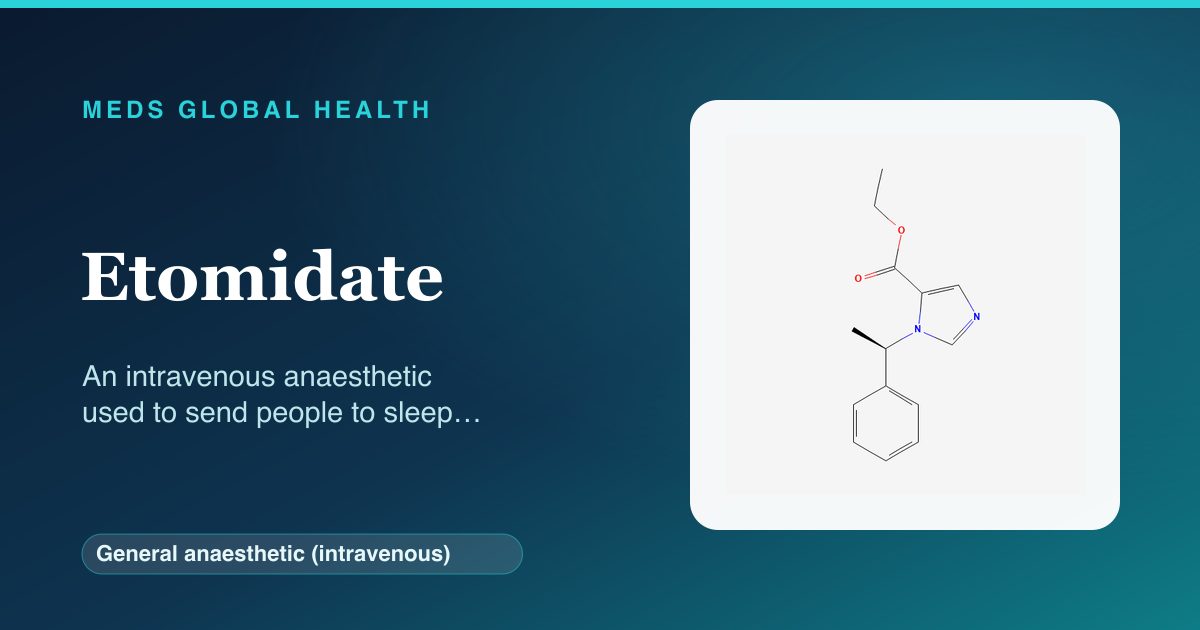
What it is
Etomidate is an intravenous general anaesthetic used to send people to sleep at the start of an operation (this is called induction). It is given and supervised by anaesthetists, who watch breathing, heart rate, blood pressure and consciousness throughout. It is particularly valued in people who are unwell, unstable or have heart disease, because it causes much less fall in blood pressure than many other anaesthetics. It is given as a single injection to start anaesthesia, after which other agents usually keep the person asleep.
How it works
Etomidate works on the brain's calming chemical messenger system to switch off awareness quickly and smoothly, sending the person to sleep within moments. Its standout feature is that it does this with very little effect on the heart and blood vessels, so blood pressure stays much more stable than with most other induction anaesthetics. A separate, known effect is that it briefly suppresses the adrenal glands, which make the body's stress hormone, although this is usually short-lived after a single dose.
Company & origin
An intravenous anaesthetic used in UK hospitals to send people to sleep, valued because it causes little drop in blood pressure.
Practical use
How to take Etomidate
General, dose-free guidance — always follow your prescriber's and the leaflet's specific instructions.
- Etomidate is given as an injection into a vein by an anaesthetist; it is not something you take yourself.
- Tell the anaesthetic team about your medicines, allergies and any heart, blood-pressure or hormone conditions beforehand.
- You will be monitored throughout, with the team managing your breathing, heart and consciousness.
- You may feel some stinging where the injection goes in, and may twitch a little as you fall asleep; both are expected and harmless.
- After waking, tell staff if you feel sick, as nausea can occur and can be treated.
Weighing it up
Advantages & disadvantages of Etomidate
Advantages
- Causes very little drop in blood pressure, making it a good choice for unstable patients and those with heart disease.
- Sends people to sleep quickly and smoothly for the start of anaesthesia.
- Has a long track record as a reliable induction agent.
Disadvantages
- Commonly causes pain or stinging at the injection site.
- Often causes small, harmless muscle twitches as the person goes to sleep.
- Briefly suppresses the adrenal stress hormone, so it is usually given as a single dose rather than a continuous infusion.
Practical use
Good to know
Etomidate is given by an anaesthetist in a monitored setting, so your breathing, heart and blood pressure are watched closely. Its big advantage is a very stable blood pressure on going to sleep, which is why it is often chosen for people who are unwell, shocked or have heart conditions. Two practical points are worth knowing: it commonly stings or hurts where it goes into the vein, and it can cause small involuntary muscle movements or twitching as you go under, which look dramatic but are harmless. It also briefly lowers the adrenal stress hormone, so it is generally given as a single dose to start anaesthesia rather than as a continuous infusion, and the team keeps this effect in mind, especially in very ill patients.
Who should not take it / use with caution
- It is generally avoided as a continuous infusion because of its effect on the adrenal stress hormone.
- Used with particular care in people who are critically ill or have known adrenal problems, where the team weighs the brief hormone effect.
- As with all anaesthetics, the team must know about any personal or family history of serious reactions to anaesthesia.
Monitoring
- Continuous monitoring of breathing, oxygen levels, heart rate, blood pressure and consciousness while it is given.
- Watching the injection site for pain and managing it where possible.
- In very ill patients, awareness of the temporary effect on the adrenal stress hormone.
Side effects
- Pain or stinging where it is injected into the vein.
- Small involuntary muscle movements or twitching as the person goes to sleep, which are harmless.
- Nausea or vomiting after waking, and a brief lowering of the adrenal stress hormone.
Key interactions
- Its sedative effect adds to that of other anaesthetics, sedatives, strong painkillers and alcohol; the team accounts for this.
- Care is taken alongside other medicines that affect blood pressure.
- The brief adrenal effect is considered in people taking, or needing, steroid hormones.
Available as: Injection given into a vein in hospital to start anaesthesia.
Answers
Etomidate: frequently asked questions
Why was etomidate chosen for me?
It is often chosen when keeping a stable blood pressure matters, such as in people who are unwell or have heart disease, because it causes little drop in blood pressure.
Why did the injection sting?
Etomidate commonly causes pain or stinging where it goes into the vein; the team can take steps to reduce this.
Why did I twitch as I fell asleep?
Small muscle twitches are a known, harmless effect of etomidate as it sends you to sleep.
What is the adrenal effect I have read about?
Etomidate briefly lowers the adrenal stress hormone, which is why it is usually given as a single dose rather than a continuous infusion; the team keeps this in mind.
Will I be aware during surgery?
No. It sends you to sleep at the start of anaesthesia, and the team keeps you asleep and monitored throughout the operation.
Authoritative sources
- BNF
- NICE CKS
Building a medicines information resource?
We create evidence-led, dose-free drug and formulary references for teams.