An add-on medicine for rare, severe childhood epilepsies
Fenfluramine
An add-on liquid medicine used to reduce seizures in rare, severe childhood epilepsies, given with regular heart-valve checks.
What is Fenfluramine?
Fenfluramine is a specialist medicine used as an add-on treatment to help control seizures in rare, severe childhood epilepsies, particularly Dravet syndrome and Lennox-Gastaut syndrome. It is taken by mouth as a liquid alongside other anti-seizure medicines. Its most important safety issue is a risk of heart-valve problems and raised pressure in the lungs, so regular heart scans (echocardiograms) are required before and during treatment. It often reduces appetite and can cause weight loss, which is monitored. It is only available through a controlled access programme with specialist supervision.
Education and reference only. This is a plain-language guide to Fenfluramine — it deliberately contains no doses. Doses depend on the person, the brand and the reason for treatment, and belong with your prescriber. Always check the BNF, the product labelling (SmPC) and follow medical advice.
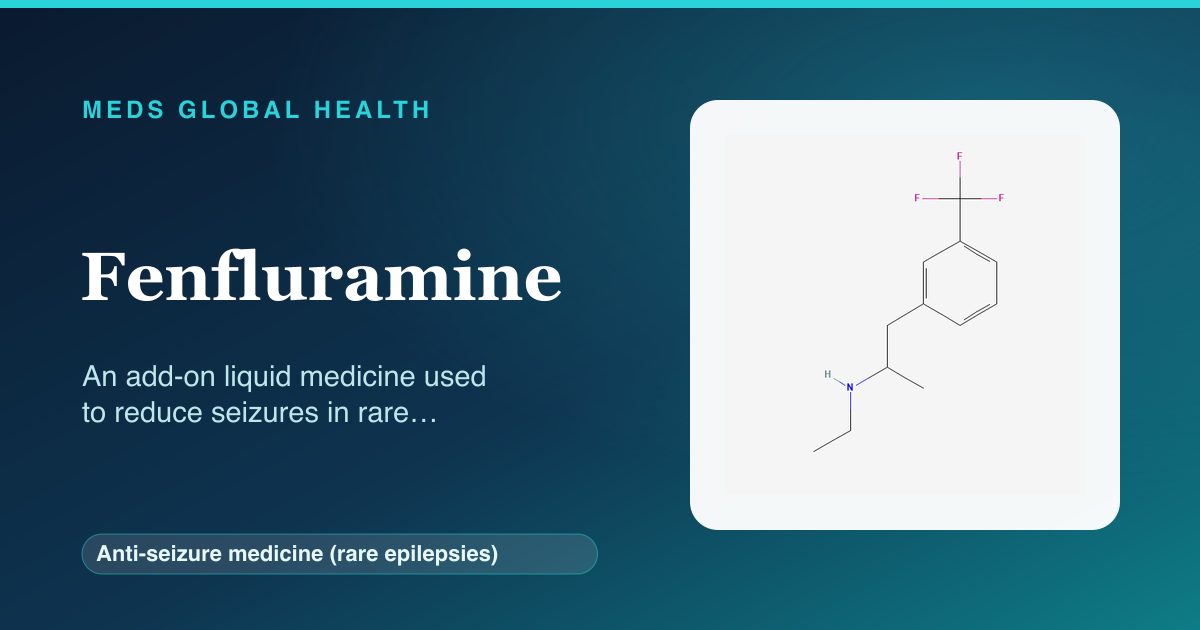
What it is
Fenfluramine is a medicine used to help control seizures in rare and severe forms of childhood epilepsy, especially Dravet syndrome and Lennox-Gastaut syndrome, which are often very difficult to treat. It is used as an add-on, meaning it is given together with other anti-seizure medicines rather than on its own. It is taken by mouth as a liquid, which makes it easier to give to children. Because of its safety profile, it is prescribed only by epilepsy specialists and is supplied through a controlled access programme that ensures the necessary heart monitoring is done.
How it works
Fenfluramine acts on chemical messengers in the brain, particularly serotonin, in a way that helps calm the abnormal electrical activity that causes seizures. By steadying this activity, it can reduce how often seizures happen and how severe they are when added to existing treatment. It works gradually as part of a wider plan, which is why the dose is built up carefully and why it is always used alongside other anti-seizure medicines rather than replacing them.
Company & origin
A specialist medicine used in the UK to help control seizures in rare, severe childhood epilepsies such as Dravet syndrome and Lennox-Gastaut syndrome.
What it treats
Conditions Fenfluramine is used for
Practical use
How to take Fenfluramine
General, dose-free guidance — always follow your prescriber's and the leaflet's specific instructions.
- Give it by mouth as a liquid, measured carefully with the oral syringe provided, at the times your epilepsy specialist advises.
- Keep taking your other anti-seizure medicines as well, as fenfluramine is used alongside them, not instead of them.
- Attend all heart scan (echocardiogram) appointments before, during and after treatment, as these are essential for safety.
- Do not stop it suddenly; any changes must be made gradually under specialist guidance to avoid more seizures.
- Tell your specialist about appetite changes or weight loss, and report any breathlessness or tiredness.
Weighing it up
Advantages & disadvantages of Fenfluramine
Advantages
- Can meaningfully reduce seizures in rare, severe childhood epilepsies that are hard to treat.
- Taken as a liquid, which makes it easier to give to children.
- Used as an add-on, so it can be combined with existing anti-seizure treatment.
Disadvantages
- Carries a risk of heart-valve problems and raised pressure in the lungs, needing regular heart scans.
- Often reduces appetite and can cause weight loss, which must be monitored.
- Only available through a controlled access programme with strict specialist supervision.
Practical use
Good to know
The single most important thing to understand about fenfluramine is its effect on the heart and lungs: it can cause problems with the heart valves and raise the pressure in the blood vessels of the lungs, so a heart scan called an echocardiogram is done before starting, regularly during treatment, and after stopping. Because of this, the medicine is only available through a controlled access programme, where the prescriber, family and pharmacy all agree to the monitoring. Another common effect is a reduced appetite, which can lead to weight loss, so growth and weight are checked, especially in children. It is taken as a liquid, which should be measured carefully with the syringe provided. Tiredness, drowsiness and changes in behaviour can also happen. The dose is built up slowly, and it must never be stopped suddenly because that can trigger more seizures.
Who should not take it / use with caution
- People with certain existing heart-valve disease or raised pressure in the lungs should not use it.
- People who have had a serious allergic reaction to fenfluramine should not take it.
- It must not be used with certain other medicines that act strongly on serotonin, because of the risk of a serious reaction.
Monitoring
- Heart scans (echocardiograms) before starting, regularly during treatment, and after stopping.
- Checking weight, appetite and growth, especially in children.
- Reviewing seizure control, alertness and any behaviour changes over time.
Side effects
- Reduced appetite and weight loss, which is why weight and growth are monitored.
- Tiredness, drowsiness or changes in behaviour and alertness.
- Rarely but importantly, heart-valve problems or raised pressure in the lungs, which the heart scans are designed to detect.
Key interactions
- Medicines that strongly raise serotonin levels can combine with it to cause a serious reaction, so they are avoided or used with care.
- Some other anti-seizure medicines change how fenfluramine is handled, so doses are adjusted by the specialist.
- Always give your team a full list of medicines, as several interactions need careful management.
Available as: An oral liquid (solution) given by mouth.
Answers
Fenfluramine: frequently asked questions
What is fenfluramine used for?
It is used as an add-on medicine to help control seizures in rare, severe childhood epilepsies, particularly Dravet syndrome and Lennox-Gastaut syndrome.
Why are heart scans needed?
Fenfluramine can affect the heart valves and raise the pressure in the lungs, so regular echocardiograms are done before, during and after treatment to catch any problems early.
Why does it affect appetite and weight?
It commonly reduces appetite and can cause weight loss, so weight and growth are checked regularly, which is especially important in children.
Why is it only available through a special programme?
Because of the heart monitoring it requires, it is supplied through a controlled access programme so that the necessary scans and specialist supervision are always in place.
Can it be stopped suddenly?
No. Stopping any anti-seizure medicine suddenly can trigger more seizures, so changes are made gradually under specialist guidance.
Authoritative sources
- BNF
- NICE CKS
Building a medicines information resource?
We create evidence-led, dose-free drug and formulary references for teams.