A 5-alpha-reductase inhibitor
Finasteride
A tablet that gradually shrinks an enlarged prostate over months; a lower-strength version is also used for male-pattern hair loss.
What is Finasteride?
Finasteride is a 5-alpha-reductase inhibitor used mainly to treat the urinary symptoms of an enlarged prostate by gradually shrinking the gland over several months. It works by blocking a hormone process that drives prostate growth, and is also used at a lower intensity for male-pattern hair loss.
Education and reference only. This is a plain-language guide to Finasteride — it deliberately contains no doses. Doses depend on the person, the brand and the reason for treatment, and belong with your prescriber. Always check the BNF, the product labelling (SmPC) and follow medical advice.
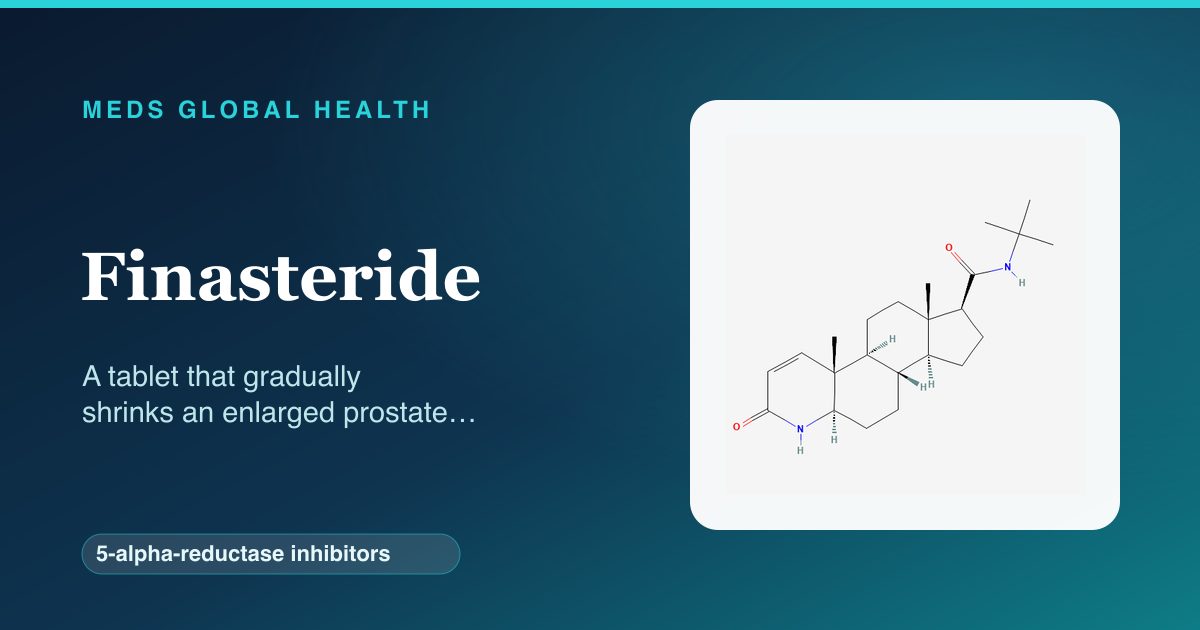
What it is
Finasteride is used mainly to treat the urinary symptoms of an enlarged prostate (benign prostatic hyperplasia, or BPH) by slowly shrinking the gland over months. By reducing prostate size it can ease the flow of urine and lower the chance of complications such as a sudden inability to pass urine. A lower-strength version (branded Propecia) is also licensed to treat male-pattern hair loss. It is a long-term, once-daily tablet, and the prostate benefit builds up gradually rather than quickly.
How it works
The prostate grows partly under the influence of a powerful male hormone called dihydrotestosterone (DHT), made from testosterone by an enzyme called 5-alpha-reductase. Finasteride blocks this enzyme, so less DHT is produced. With lower DHT, the prostate gradually shrinks, easing pressure on the urine channel; the same drop in DHT slows hair loss and can partly regrow hair in male-pattern baldness. Because it works by slowly changing tissue rather than relaxing muscle, the effect takes months to build.
Company & origin
Originated / developed by: Merck & Co..
Finasteride (development code MK-906) was developed by Merck & Co. in the United States during the 1980s as a 5-alpha-reductase inhibitor. It was first approved by the FDA in 1992 as Proscar for benign prostatic hyperplasia, with the hair-loss formulation Propecia approved in 1997.
What it treats
Conditions Finasteride is used for
Practical use
How to take Finasteride
General, dose-free guidance — always follow your prescriber's and the leaflet's specific instructions.
- Take it once a day, with or without food, at a time you will remember.
- Be patient, as it usually takes several months to notice an improvement in prostate symptoms.
- Keep taking it regularly, as benefits are lost if you stop.
- Women who are or may become pregnant should not handle crushed or broken tablets, as the medicine can harm a developing baby.
- Tell your doctor if you notice mood changes, breast lumps or tenderness, as these should be checked.
Weighing it up
Advantages & disadvantages of Finasteride
Advantages
- Shrinks the prostate over time, addressing a cause of urinary symptoms rather than just easing them.
- Can reduce the need for prostate surgery in some men.
- Taken once a day and generally well tolerated.
- Long track record in both prostate enlargement and hair loss.
Disadvantages
- Works slowly, so it can take months before symptoms improve.
- Can cause sexual side effects such as reduced desire, erection problems or ejaculation changes.
- May affect mood and has been linked to low mood in some people.
- Lowers a blood marker (PSA) used in prostate cancer screening, which needs to be allowed for.
- Must not be handled by pregnant women because of the risk to a baby.
Practical use
Good to know
It is taken once a day and needs to be taken for several months before the full benefit on urine symptoms is seen, so patience is needed; for severe symptoms it is sometimes combined with a faster-acting alpha-blocker such as tamsulosin. Two points are especially important. First, finasteride lowers the PSA blood test (a marker sometimes used to check for prostate problems), so tell any doctor interpreting a PSA result that you take it, as the figure may need adjusting. Second, women who are or may become pregnant should not handle crushed or broken tablets, because the medicine could harm the development of a male baby; the tablets are coated to make this safe if swallowed whole and intact. Some men get sexual side effects, which usually settle on stopping but can occasionally persist.
Who should not take it / use with caution
- Women, especially those who are or could become pregnant — they should also avoid handling crushed or broken tablets.
- Children, and anyone with a known allergy to finasteride.
- Used with care in significant liver problems, as the medicine is processed by the liver.
Monitoring
- Improvement in urinary symptoms over months
- PSA blood test interpreted with the medicine in mind
- Any mood changes, breast changes or sexual side effects
Side effects
- Sexual side effects — lower sex drive, difficulty getting an erection, or problems with ejaculation; these usually settle after stopping but can occasionally persist.
- Breast tenderness or enlargement; report any new breast lump, pain or nipple discharge, as breast cancer in men has very rarely been reported.
- Low mood or mood changes have been reported; rarely, allergic reactions such as rash, itching or swelling.
Key interactions
- It has relatively few drug interactions, but always share your full medicine list with your prescriber and pharmacist.
- It can be taken alongside an alpha-blocker (such as tamsulosin) when both are needed for prostate symptoms.
- It alters the PSA blood test result, which other clinicians must take into account when interpreting it.
Available as: Film-coated tablets (the coating protects against handling exposure when the tablet is whole and undamaged).
Answers
Finasteride: frequently asked questions
How long does finasteride take to work?
For prostate symptoms the benefit builds gradually as the gland shrinks, and it can take several months to see the full effect, so patience is important. If quicker symptom relief is needed, a doctor may add an alpha-blocker such as tamsulosin, which works within days to weeks.
Why does finasteride affect my PSA test?
Finasteride lowers the PSA level measured in the blood, so a result can look reassuringly low even if it should not be. Always tell any clinician interpreting your PSA that you take finasteride, so they can adjust how they read the figure when checking for prostate problems.
Why shouldn't pregnant women handle the tablets?
The medicine can interfere with the normal development of a male baby, so women who are or may become pregnant should not handle crushed or broken tablets. Whole, intact film-coated tablets are designed to prevent exposure, so the risk comes mainly from broken or powdered tablets.
Will the sexual side effects go away?
For most men, effects like reduced sex drive or erection problems improve after stopping the medicine. In a small number they can persist for a time even after stopping, so discuss any troubling effects with your doctor, who can weigh up whether to continue, change or stop treatment.
What is the difference between Proscar and Propecia?
Both contain the same active ingredient, finasteride. Proscar is the version licensed for an enlarged prostate, while Propecia is a lower-strength version licensed for male-pattern hair loss. Finasteride is the generic (active-ingredient) name for both.
The wider class
About 5-alpha-reductase inhibitors
Finasteride belongs to the 5-alpha-reductase inhibitors class. For how the class as a whole works, its shared safety principles and monitoring, see the full guide.
Browse by body system
Authoritative sources
- BNF: Finasteride.
- electronic Medicines Compendium (SmPC): Finasteride (Proscar, Propecia).
- NICE CKS: Finasteride.
- NICE: Lower urinary tract symptoms in men.
Building a medicines information resource?
We create evidence-led, dose-free drug and formulary references for teams.