An orange dye used to examine the eyes and its blood vessels
Fluorescein
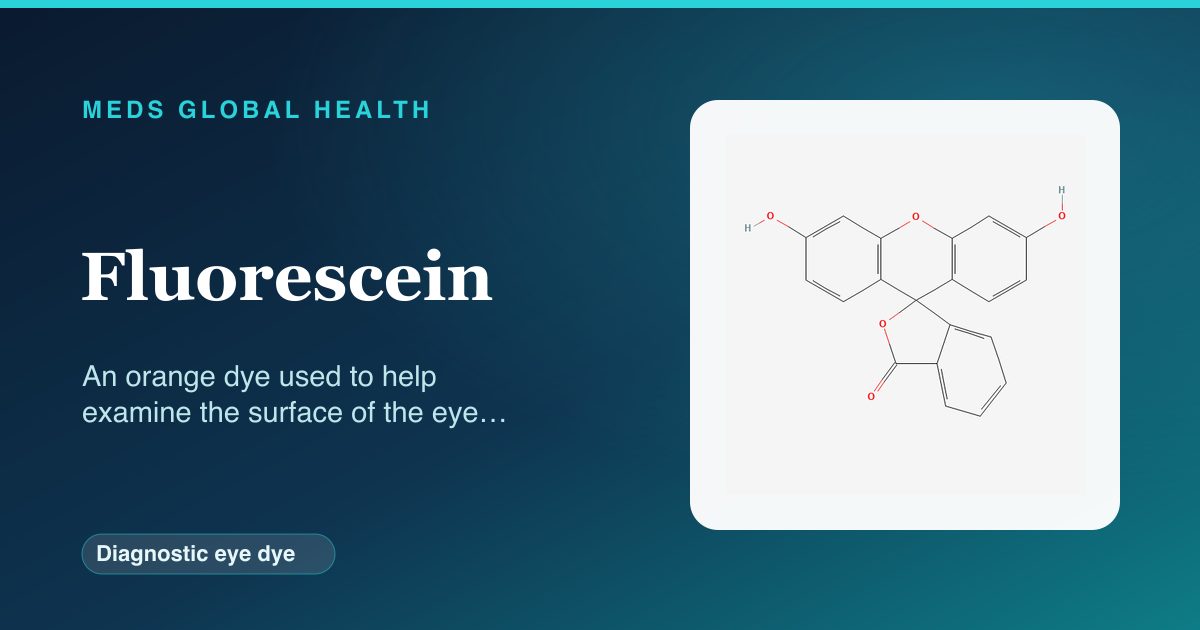
An orange dye used to help examine the surface of the eye and, when injected, to image the blood vessels at the back of the eye.
What is Fluorescein?
Fluorescein is an orange dye used to help examine the eyes; it is a diagnostic aid, not a treatment. As eye drops, it stains the surface of the eye so a professional can see scratches, ulcers or dryness under a special blue light. As an injection into a vein (fluorescein angiography), it travels to the blood vessels at the back of the eye so they can be photographed. After use it commonly causes a temporary harmless yellow tint to the skin and urine, and the injectable form can rarely cause a serious allergic (anaphylactic) reaction.
Education and reference only. This is a plain-language guide to Fluorescein — it deliberately contains no doses. Doses depend on the person, the brand and the reason for treatment, and belong with your prescriber. Always check the BNF, the product labelling (SmPC) and follow medical advice.
What it is
Fluorescein is a bright orange dye used by eye-care professionals to help examine the eyes. It is not a medicine that treats a condition; it is a diagnostic aid. Put onto the eye as drops or strips, it highlights the surface so problems such as a scratch, an ulcer, dryness or a foreign body show up clearly under a special blue light. Given as an injection into a vein, in a test called fluorescein angiography, it travels through the bloodstream to the back of the eye so the blood vessels there can be photographed. It helps with diagnosis rather than treatment.
How it works
Fluorescein glows when light of a certain colour shines on it. When it is put onto the eye, it collects in areas where the surface is damaged or where there are problems with the tear film, so under a blue light these areas light up and can be seen clearly. When it is injected into a vein, it spreads through the bloodstream and reaches the fine blood vessels at the back of the eye; a camera then captures how the dye flows through them, which shows up leaks, blockages or abnormal vessels. In both cases it makes things visible rather than changing anything in the body.
Company & origin
An orange diagnostic dye used in the UK during eye examinations and eye imaging, not a treatment.
Practical use
How to take Fluorescein
General, dose-free guidance — always follow your prescriber's and the leaflet's specific instructions.
- Understand that fluorescein is used to examine the eye, not to treat a condition.
- For the eye drops or strips: they are applied by a professional during an eye examination under a blue light.
- For angiography: the dye is injected into a vein and the back of the eye is photographed by trained staff.
- Do not be alarmed if your skin looks yellow or your urine is bright yellow afterwards; this is harmless and fades within a day or so.
- Remove contact lenses before fluorescein eye drops, as the dye can stain soft lenses.
Weighing it up
Advantages & disadvantages of Fluorescein
Advantages
- Makes problems on the surface of the eye, such as scratches, ulcers or dryness, easy to see.
- When injected, allows the blood vessels at the back of the eye to be photographed to aid diagnosis.
- A widely used and, for the eye drops, very safe way to help examine the eye.
Disadvantages
- It is only a diagnostic dye and does not treat any condition.
- Commonly causes a temporary yellow tint to the skin and bright yellow urine.
- The injectable form used for angiography can rarely cause a serious allergic (anaphylactic) reaction.
Practical use
Good to know
The key thing to understand is that fluorescein is a dye for looking at the eye, not a treatment, so it does not cure or relieve anything by itself. After it is used, a temporary, harmless yellow or orange tint to the skin and a brighter yellow colour to the urine are very common and simply mean the dye is passing out of the body over a day or so. With the eye drops, a brief sting and a few moments of yellow-tinged or blurred vision are normal. The most important safety point applies to the injectable form used for angiography: although usually very safe, it can occasionally cause an allergic reaction, and very rarely a serious, life-threatening one (anaphylaxis), so the test is done where staff and equipment are ready to deal with this. Contact lenses are usually removed before fluorescein drops, as the dye can stain soft lenses.
Who should not take it / use with caution
- People who have had a serious allergic reaction to fluorescein should not be given it, particularly the injectable form.
- The injectable form is used with caution, and with full emergency readiness, in people with a history of strong allergies.
- Use in pregnancy, breastfeeding or with other health conditions is decided by the eye specialist on an individual basis.
Monitoring
- With the injection: watching closely during and after the test for any allergic reaction.
- Having staff and emergency equipment ready when the injectable form is used.
- Reassuring people that the yellow tint to the skin and urine is harmless and fades quickly.
Side effects
- A temporary, harmless yellow tint to the skin and bright yellow urine.
- With eye drops: brief stinging and a few moments of yellow-tinged or blurred vision.
- With the injection: temporary nausea, a warm flush or, occasionally, an itchy rash.
- Rarely with the injection: a serious allergic (anaphylactic) reaction, which needs immediate emergency treatment.
Key interactions
- As a diagnostic dye, it has few medicine interactions of note.
- Tell the eye team about any allergies, especially previous reactions to fluorescein or contrast dyes.
- Mention all your medicines and health conditions before fluorescein angiography.
Available as: Eye drops and dye-impregnated strips for the eye, and a solution for injection into a vein.
Answers
Fluorescein: frequently asked questions
Is fluorescein a treatment?
No. Fluorescein is an orange dye used to help examine the eye; it is a diagnostic aid, not a medicine that treats a condition.
Why does my skin and urine turn yellow?
After fluorescein, a harmless yellow tint to the skin and bright yellow urine are very common and simply mean the dye is passing out of your body over a day or so.
What is fluorescein angiography?
It is a test in which the dye is injected into a vein so the blood vessels at the back of the eye can be photographed, showing leaks, blockages or abnormal vessels.
Is the injection safe?
It is usually very safe, but it can occasionally cause an allergic reaction and very rarely a serious one, so the test is done where staff are ready to treat this.
Do I need to remove my contact lenses?
Yes, contact lenses are usually removed before fluorescein eye drops because the dye can stain soft lenses.
Authoritative sources
- BNF
- NICE CKS
Building a medicines information resource?
We create evidence-led, dose-free drug and formulary references for teams.